Sustainable Construction: Optimization of Microbial Soil Stabilization for Enhanced Construction Materials
DOI:
https://doi.org/10.5281/zenodo.14874393Keywords:
Artificial Rock Conglomerate, Microbially Induced Calcium Precipitation, Sand Stabilization, Urease ActivityAbstract
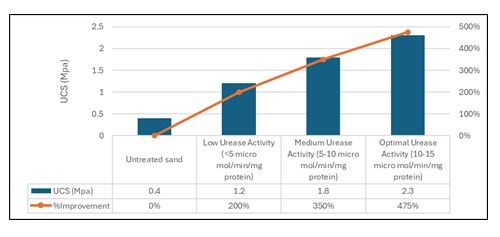
Microbially Induced Calcium Precipitation (MICP) has emerged as an effective and sustainable method for soil stabilization, utilizing microbial processes to enhance soil strength through calcium carbonate formation. This research explores the transformation of Mongu sand into a strong construction material using MICP, with a focus on optimizing urease activity, bacterial concentration, and cementation media. Given the scarcity of rock conglomerates in the region but the abundance of sand, this study provides innovative solutions to address this issue by improving and even transforming materials into more suitable forms for construction. MICP presents significant potential for infrastructure development in areas with limited access to conventional materials, with future efforts aimed at scaling the process for larger and more complex projects. The findings provide insights into the optimal parameters for material transformation, revealing that maintaining urease activity between 10-15 µmol urea hydrolyzed per minute per mg of protein and bacterial concentrations of 1.5 x 10⁸ CFU/mL results in a substantial improvement in compressive strength and durability—up to 475% higher than untreated sand. Additionally, the study underscores the effectiveness of Sporosarcina pasteurii in promoting calcium carbonate precipitation, further emphasizing MICP’s potential for soil stabilization and construction in resource-constrained regions.
Downloads
References
Michelo, S., Kunda, S., & Musonda, D. (2018). Geotechnical assessment of sands from Western Zambia for construction applications. International Journal of Geotechnical Engineering, 10(4), 299-310.
S. Tunay. (2020). The effect of bacterial concentration on calcium carbonate precipitation in soils. Journal of Biological Engineering, 14(1).
Whiffin, V. S., van Paassen, L. A., & Harkes, M. P. (2007). Microbial carbonate precipitation as a soil improvement technique. Geomicrobiology Journal, 24(5), 417-423.
Stocks-Fischer, S., Galinat, J. K., & Bang, S. S. (1999). Microbiological precipitation of CaCO₃. Soil Biology and Biochemistry, 31(11), 1563-1571.
DeJong, J. T., Mortensen, B. M., Martinez, B. C., & Nelson, D. C. (2010). Bio-mediated soil improvement. Ecological Engineering, 36(2), 197-210.
Akiyama, M., & Kawasaki, S. (2012). Microbially mediated sand solidification using calcium carbonate. Proceedings of the ICE - Ground Improvement, 165(4), 229-238.
Dhami, N. K., Reddy, M. S., & Mukherjee, A. (2013). Biomineralization of calcium carbonates and their engineered applications: A review. Frontiers in Microbiology, 4, 314.
DeJong, J. T., Soga, K., Banwart, S. A., Whalley, W. R., Ginn, T. R., Nelson, D. C., & Aydilek, A. H. (2011). Soil engineering in vivo: Harnessing natural biogeochemical systems for sustainable, multi-functional engineering solutions. Journal of the Royal Society Interface, 8(54), 1-15.
Ndilila, W., Chileshe, M.N., & Mulenga, C.K. (2017). Geotechnical properties of sands from the Western Province of Zambia. Journal of African Earth Sciences, 135, 112-121.
Qian, C., & Cheng, L. (2017). Engineering properties of MICP-treated sand under different environmental conditions. Construction and Building Materials, 142, 316-324.
Achal, V., Mukherjee, A., Basu, P. C., & Reddy, M. S. (2009). Strain improvement of Sporosarcina pasteurii for enhanced urease and calcite production. Journal of Industrial Microbiology & Biotechnology, 36(7), 981-988.
Achal, V., Mukherjee, A., & Reddy, M. S. (2013). Biogenic treatment improves the durability and remediates the cracks of concrete structures. Construction and Building Materials, 48, 1-5.
Cheng, L., & Cord-Ruwisch, R. (2013). Selective enrichment and production of highly urease active bacteria by non-sterile chemostat culture. Journal of Applied Microbiology, 114(3), 713-725.
Whiffin, V. S. (2004). Microbial CaCO₃ precipitation for the production of biocement. Murdoch University.
Cheng, L., & Cord-Ruwisch, R. (2012). In situ soil cementation with ureolytic bacteria to improve soil mechanical properties. Journal of Geotechnical and Geoenvironmental Engineering, 138(3), 333-340.
Chou, C. W., Seagren, E. A., Aydilek, A. H., & Lai, M. (2011). Biocalcification of sand through ureolysis. Journal of Geotechnical and Geoenvironmental Engineering, 137(12), 1179-1189.
van Paassen, L. A., Harkes, M. P., van Zwieten, G. A., van der Zon, W. H., van der Star, W. R., & van Loosdrecht, M. C. (2010). Scale up of BioGrout: A biological ground reinforcement method. Journal of Environmental Geotechnics, 1(2), 123-138.
Gomez, M.G., Anderson, C.M., Graddy, C.M.R., DeJong, J.T., Nelson, D.C., & Ginn, T.R. (2017). Large scale biocementation field trials in sands: lessons learned. Journal of Geotechnical and Geoenvironmental Engineering, 145(5).
Carmona, J. S., Oliveira, P. J. V., & Monteiro, G. A. (2016). Enhancement of sand properties using biocementation via microbially induced calcite precipitation. Soils and Rocks, 39(3), 321-330.
Cheng, L., Shahin, M.A., & Cord-Ruwisch, R. (2014). Cementation of sand soil by microbially induced calcite precipitation at various degrees of saturation. Canadian Geotechnical Journal, 51(8), 917-924.
Fujita, Y., Taylor, J. L., Gresham, T. L. T., Delwiche, M. E., Colwell, F. S., & McLing, T. L. (2008). Stimulation of microbial urea hydrolysis in groundwater to enhance calcite precipitation. Environmental Science and Technology, 42(8), 3025-3032.
Qian, C., Wang, R., Cheng, L., & Wang, J. (2011). Application of microbial carbonate precipitation in self-healing of cement-based materials. Journal of Materials in Civil Engineering, 23(7), 992-997.
Cheng, L., & Cord-Ruwisch, R. (2013). Upscaling effects of soil improvement by microbially induced calcite precipitation by surface percolation. Geomicrobiology Journal, 30(5), 461-469.
Khan, A., & Khandaker, M.U. (2020). Effects of environmental factors on the calcite precipitation induced by ureolytic bacteria. Environmetal Technology and Innivation, 17.
Cheng, L., & Cord-Ruwisch, R. (2012). In situ soil cementation with ureolytic bacteria by surface percolation. Ecological Engineering, 42, 64-72.
Katotobwe, C., Chabota K., & Agabu, K.L. (2024). Enhanced local contractor participation: case of Zambia water supply and sanitation sub-sector. International Journal of Engieering and Management Research, 14(1), 246-260d.
Published
How to Cite
Issue
Section
License
Copyright (c) 2025 Joseph Shikabonga, Kelvin Agabu Lungu, Denis Mwaba, Charles Mubita, Michael N Mulenga, Erastus Mwanaumo

This work is licensed under a Creative Commons Attribution 4.0 International License.
Research Articles in 'International Journal of Engineering and Management Research' are Open Access articles published under the Creative Commons CC BY License Creative Commons Attribution 4.0 International License http://creativecommons.org/licenses/by/4.0/. This license allows you to share – copy and redistribute the material in any medium or format. Adapt – remix, transform, and build upon the material for any purpose, even commercially.