Socio-Economic Impact of Human-Wildlife Conflicts on Agriculture based Livelihood in the Kodagu Karanataka State
DOI:
https://doi.org/10.5281/zenodo.14898524Keywords:
Human-Wildlife Conflict, Agriculture, Livelihoods, Kodagu, Karnataka, Economic Impact, Conservation PoliciesAbstract
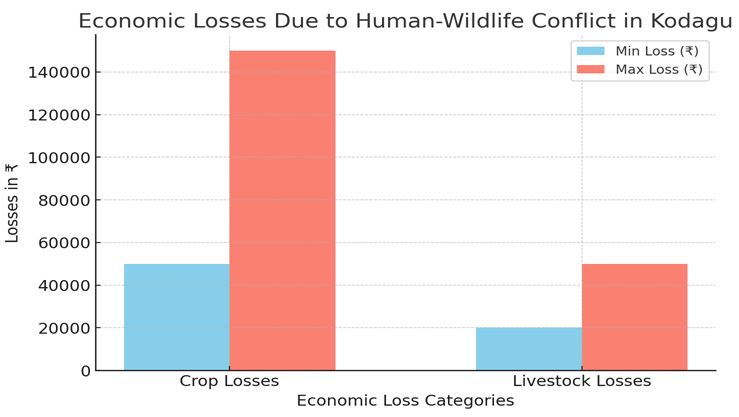
Human-wildlife conflicts (HWC) pose significant socio-economic challenges for agriculture-based livelihoods in Kodagu, Karnataka. This study examines the extent and impact of wildlife-related damages on crops, livestock, and farmer well-being, focusing on economic losses, food security, and coping mechanisms. Kodagu, known for its rich biodiversity and proximity to protected areas, experiences frequent conflicts with elephants, wild boars, and other species, leading to substantial financial strain on farmers. Additionally, psychological stress and rural migration trends further exacerbate socio-economic instability. The study highlights the effectiveness of existing mitigation strategies, including compensation schemes, fencing, and community-based conservation efforts. Policy recommendations emphasize the need for sustainable, long-term conflict resolution strategies to balance conservation goals with farmers’ livelihoods.
Downloads
References
Laurie, C., & Sivamani, S. (2022). Analyzed the management of leopard–human conflict in India, focusing on distribution, seasonality, actions taken, government involvement, community engagement, and scientific knowledge.
Sanjay, K., et al. (2023). Conducted studies on the conflict between Asian elephants and humans in parts of Karnataka, noting that communities living near elephant habitats hinder elephant life, leading to deaths on both sides. The study emphasized the need for physical barriers, conservation of key habitat linkages, and baseline data for future work.
Krithi, S., et al. (2023). Collected information on the effectiveness of compensation payments in mitigating and resolving HWC, analyzing procedures, types, and payments made for incidents reported in India from 2010 to 2015.
Meena, A. (2023). Examined the positive and negative aspects of human and wildlife interactions both within and outside protected areas, emphasizing the need for government synergy to achieve common conservation goals.
Shaurabh, K., & Sindhu, S. (2023). Conducted a case study on HWC in India, analyzing trends from 1995 to 2010, highlighting the rapid spread of conflicts across a significant portion of the country's geographical area.
Govind, R., & Jayson, P. (2023). Investigated human-leopard conflict on the Kerala-Tamil Nadu border, quantifying leopard attacks on humans and livestock during 2009-2012.
Inong, F., & Mubita, E. (2023). Assessed the causes, consequences, and management strategies of HWC in Mosi-Oa-Tunya National Park, Zambia, determining the animals causing conflicts and evaluating mitigation measures.
Bhatia, S., et al. (2023). Studied the role of media representations in human-leopard conflict in Mumbai through content analysis of print media articles over a 10-year period (2001-2011).
Shaffer, D., et al. (2024). Emphasized that effective management of human-elephant conflict requires addressing site-specific factors and developing strategic plans at the landscape level that directly tackle underlying anthropogenic drivers and their spatiotemporal variations.
Senthilkumar, K., & Mathialagan, P. (2024). Conducted studies on the biosocial perspective of animals to understand human-wildlife relationships, providing insights into the complex interactions between humans and wildlife.
Karnataka Forest Department (2025). Reported that between 2010–2011 and 2023–2024, Karnataka recorded 618 deaths due to human-wildlife conflict, underscoring the severity of the issue in the state.
Kumar, S., & Ramesh, M. (2020). Socio-economic effects of wildlife conflicts in coffee plantations in the Western Ghats. International Journal of Environmental Science and Technology, 17(4), 1247-1256.
Sharma, P., & Singh, R. (2021). Understanding the effects of human-wildlife conflict on food security in rural India. Environmental Science & Policy, 114, 67-75.
Published
How to Cite
Issue
Section
License
Copyright (c) 2025 Karthik, Dr. K.Prathiba

This work is licensed under a Creative Commons Attribution 4.0 International License.
Research Articles in 'International Journal of Engineering and Management Research' are Open Access articles published under the Creative Commons CC BY License Creative Commons Attribution 4.0 International License http://creativecommons.org/licenses/by/4.0/. This license allows you to share – copy and redistribute the material in any medium or format. Adapt – remix, transform, and build upon the material for any purpose, even commercially.