A Prediction of The Air Quality Index: An Analysis of Ghaziabad City
DOI:
https://doi.org/10.5281/zenodo.14970329Keywords:
ANN, Air Pollution, AQI, Multilayer PerceptronAbstract
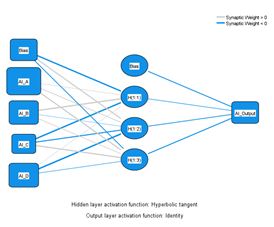
PM10 is one of the main air pollutants that causes air pollution. This study used Artificial Neural Networks (ANN), a common learning technique, to estimate the impact of this contaminant on human health and the environment using data between 2019 and 2023. The Pollution Control Board of Uttar Pradesh (UPPCB)'S air observation center obtained information related to the center of industry of Ghaziabad and finished the simulation and optimization procedures required using SPSS programming. Before being compared with the real data, the obtained air quality estimation results underwent a multilayer perceptron analysis. Moreover, there have been instances where the Ghaziabad province's Air Quality Index (AQI) values have exceeded the allowable limit, especially during times of great output.
Downloads
References
Asadollahfardi G., Zangooei H., & Aria S. H. (2016). Predicting PM2.5 concentrations using artificial neural networks and markov chain, a case study Keraj City. Asian Journal of Atmospheric Environment, 10(2), 67-79.
Bhavsar R. (2019). Air pollution monitoring using artificial neural network. International Journal of Scientific & Engineering Research, 10(12), 515-519.
Boznar M., Lesjak M., & Mlakar P. (1993). A neural network-based method for short-term predictions of ambient So2 concentrations in highly polluted industrial areas of complex terrain. Atmospheric Environment, 27B, 221-230.
Boznar M.Z., & Mlakar P. (2002). Use of neural networks in the field of air pollution modelling. Air Pollution Modeling and Its Application, XV, 375-383.
Cogliani E. (2001). Air pollution forecast in cities by an air pollution index highly correlated with meteorological variables. Atmospheric Environment, 35, 2871- 2877.
Comrie A.C. (1997). Comparing neural networks and regression models for ozone forecasting. Air & Waste Management Association, 47, 653- 663.
Freeman A. M. III (1974). Air pollution and property values, a further comment. Review of Economics and Statistics, 56, 554– 556.
Kumar G., & Sharma R.K. (2017). Air pollution evaluation methods. International Journal of Engineering Research and Development, 13(9), 12-17.
Kumar G. (2018). Time series analysis of PM10 for Bulandhshahr Industrial Area in NCR using Multiple Linear Regression. International Journal of Engineering Research and Development, 14(3), 56-62.
Kumar G. (2018). Time series analysis of PM10 for Noida Sector 1 Industrial Area in NCR using Multiple Linear Regression. Bulletin of Pure and Applied Sciences, Section E-Math. & Stat., 37(2), 273-277.
Reshma J. (2020). Analysis and prediction of air quality. International Research Journal of Engineering and Technology, 7(1), 266-270.
Published
How to Cite
Issue
Section
License
Copyright (c) 2025 Lokesh Kumar, Gaurav Kumar

This work is licensed under a Creative Commons Attribution 4.0 International License.
Research Articles in 'International Journal of Engineering and Management Research' are Open Access articles published under the Creative Commons CC BY License Creative Commons Attribution 4.0 International License http://creativecommons.org/licenses/by/4.0/. This license allows you to share – copy and redistribute the material in any medium or format. Adapt – remix, transform, and build upon the material for any purpose, even commercially.


