A Conceptual Enquiry on the Role of Academic Incubators in Nurturing Entrepreneurship among Students
DOI:
https://doi.org/10.5281/zenodo.15043801Keywords:
Academic Incubators, Higher Education Institutes, Investors, Mentors, StartupAbstract
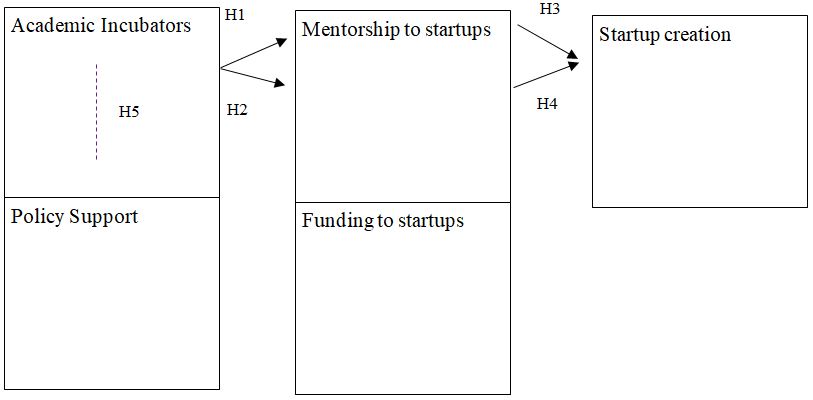
Educated youth of India are finding it difficult to secure jobs and have an economically viable livelihood. To help the economy grow and create new jobs, the government needs to encourage new ideas and put money into the education of the next generation of workers. Entrepreneurship development can be a big part of the fight against unemployment and the growth of the economy as it makes possible conversion of innovative ideas into new businesses or start-ups resulting in creation of jobs. The government and the higher education institutes (HEIs) should work together to create an environment that is conducive to the launch of new businesses and shift the mindset of educated young people towards the pursuit of self-employment rather than job hunting. Many state governments, in conjunction with the central government, have enacted legislation to provide assistance to newly founded firms in their respective areas. And higher education institutions have also established incubation centers to nurture and assist entrepreneurial fervor among students. In a start-up ecosystem, in addition to the government, there are a wide variety of other institutions and ecosystem facilitators that provide assistance to start-up units. Some examples of these ecosystem facilitators and institutions include incubators, accelerators, educational institutions, research institutions, investors, and mentors (NGOs). Higher education institutions and universities are playing a significant role in the promotion of new business ventures and the provision of platforms for enterprise creation. The study hypotheses, given the current entrepreneurial ecosystem in India, that entrepreneurship among students can be directly linked to the support offered to them by the academic incubators. The current study proposes a model for the establishment and operation of startup incubators within academic institutions, so that entrepreneurial fervour can be nurtured among students.
Downloads
References
Albort-Morant, G., & Oghazi, O. (2016). How useful are incubators for new entrepreneurs?. Journal of Business Research, 69, 2125–2129.
Albort-Morant, G., & Ribeiro-Soriano, D. (2016). A bibliometric analysis of international impact of business incubators. Journal of Business Research, 69(5), 1775–1779.
Al-Mubaraki H., & Busler M. (2013). Business incubation as an economic development strategy: A literature review. International Journal of Management (IJM), 30(1), 362-372.
Amezcua, A., Ratinho, T., Plummer, L. A., & Jayamohan, P. (2019). Organisational sponsorship and the economics of place: How regional urbanisation and localisation shape incubator outcomes. Journal of Business Venturing, 105967. https://doi.org/10.1016/j.jbusvent.2019.105967.
Audretsch, D.B. (2014). From the entrepreneurial university to the university for the entrepreneurial society. The Journal of Technology Transfer, 39(3), 313-321.
Ayatse, F.A., Kwahar, N., & Iyortsuun, A.S. (2017). Business incubation process and firm performance: An empirical review. Journal of Global Entrepreneurship Research, 7(1), 72-85.
Barbero, J.L., Casillas, J.C., Ramos, A., & Guitar, S. (2012). Revisiting incubation performance: How incubator typology affects results. Technological Forecasting and Social Change, 79(5), 888- 902.
Bergmann, H., Hundt, C., & Sternberg, R. (2016). What makes student entrepreneurs? On the relevance (and irrelevance) of the university and the regional context for student start-ups. Small Business Economics, 47(1), 53–76. https://doi.org/10.1007/s11187-016-9700-6.
Bhatli, D. (2016). Top University Business Incubators 2015-2016. in UBI Global Benchmark Report, Stockholm: UBI Global.
Blank, Tali. (2021). When incubator resources are crucial: survival chances of student startups operating in an academic incubator. The Journal of Technology Transfer, 46, 1-24. DOI: 10.1007/s10961-020-09831-4.
Bouncken RB, Aslam MM, & Qiu Y. (2021). Co-working spaces: understanding, using, and managing sociomateriality. Business Horizons, Elsevier, 64(1), 119-130.
Bouncken RB, & Kraus S. (2021). Entrepreneurial ecosystems in an interconnected world: Emergence, governance and digitalisation. Review of Managerial Science. https://doi.org/10.1007/s11846-021-00444-1.
Brun EC. (2019). Understanding a business incubator as a start-up factory: a value chain model perspective. International Journal of Innovation and Technology Management, 16(03), 1–28.
Bruneel, J., Ratinho, T., Clarysse, B., & Groen, A. (2012). The evolution of business incubators: Comparing demand and supply of business incubation services across different incubator generations. Technovation, 32(2), 110-121.
Chandra, A., Alejandra, M., & Silva, M. (2012). Business incubation in Chile: Development, financing and financial services. Journal of Technology Management and Innovation, 7(2), 1-13.
Corsi, C., & Prencipe, A. (2016). Improving innovation in university spin-offs. The fostering role of university and region. Journal of Technology Management and Innovation, 11(2), 13–21.
Dahms, S., & S. Kingkaew. (2016). University business incubators: An institutional demand side perspective on value adding features. Entrepreneurial Business and Economic Review, 4(3), 41–56. DOI: 10.15678/EBER.2016.040304.
Dalmarco, G., Hulsink, W., & Blois, G. V. (2018). Creating entrepreneurial universities in an emerging economy: Evidence from Brazil. Technological Forecasting and Social Change, 135, 99–111.
Davaris, A., Kokkinos, D., & Fotopoulos, A. (2013). The impact of higher education institutes incubator/accelerator centers to technological education advancement: A review of selected case studies. World Transactions on Engineering and Technology Education, 11(3), 280-283.
Del Campo Villares, M.O., Miguéns-Refojo, V., & Ferreiro-Seoane, F.J. (2020). Business survival and the influence of innovation on entrepreneurs in business incubators. Sustainability, 12, 6197.
Deyanova, K., Brehmer, N., & Lapidus, A. (2022). Hatching start-ups for sustainable growth: a bibliometric review on business incubators. Review of Managerial Science. https://doi.org/10.1007/s11846-022-00525-9.
Entrepreneur India. (2014). Business incubator. Irvine, CA: Entrepreneur Media Inc.
Escobar Débora, De Pablos-Heredero Carmen, Montes Jose Luis, José Francisco, & Garcia Anton. (2022). Business incubators and survival of startups in Times of covid-19. Sustainability. DOI: 10.3390/su14042139.
Etzkowitz, H., Germain-Alamartine, E., Keel, J., Kumar, C., Smith, K. N., & Albats, E. (2019). Entrepreneurial university dynamics: structured ambivalence, relative deprivation and institution-formation in the Stanford innovation system. Technological Forecasting and Social Change, 141, 159–171.
Feola, R., Parente, R., & Cucino, V. (2021). The entrepreneurial university: How to develop the entrepreneurial orientation of academia. J Knowl Econ 12, 1787–1808. https://doi.org/10.1007/s13132-020-00675-9.
Fern, D., Arruti, A., Markuerkiaga, L., & Saenz, N. (2018). The entrepreneurial university: a selection of good practices. Journal of Entrepreneurship Education, 21, 1-17.
Fernández-N, D., Arruti, A., Markuerkiaga, L., & Nerea, S. (2018). The entrepreneurial university: A selection of good practices. Journal of Entrepreneurship Education, 21, 1-17.
Ferreira JJ, Fernandes CI, & Kraus S. (2019). Entrepreneurship research: Mapping intellectual structures and research trends. Review of Managerial Science, 13(1), 181–205.
Filippetti A., & Savona M. (2017). University–industry linkages and academic engagements: Individual behaviours and firms’ barriers: Introduction to the special section. The Journal of Technology Transfer, 1-11.
Fink, A. (2013). Conducting research literature reviews: From the internet to paper. (4th ed.). Thousand Oaks, CA: Sage.
Published
How to Cite
Issue
Section
License
Copyright (c) 2025 Dr. Nazia Sultana, Akkinapally Yugendhar

This work is licensed under a Creative Commons Attribution 4.0 International License.
Research Articles in 'International Journal of Engineering and Management Research' are Open Access articles published under the Creative Commons CC BY License Creative Commons Attribution 4.0 International License http://creativecommons.org/licenses/by/4.0/. This license allows you to share – copy and redistribute the material in any medium or format. Adapt – remix, transform, and build upon the material for any purpose, even commercially.