GIS-Based Landslide Mapping and Analysis using QGIS: A Study in Palakkad, Kerala
DOI:
https://doi.org/10.5281/zenodo.15070403Keywords:
GIS, QGIS, Landslide, MappingAbstract
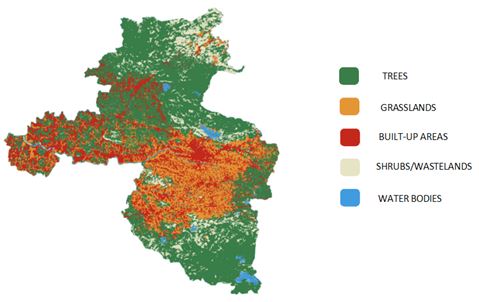
Landslides are a major natural hazard in hilly regions, posturing critical dangers to life, infrastructure, and the environment. This study centers on landslide vulnerability mapping in Veezhumala, Palakkad, utilizing QGIS as the essential apparatus for geospatial investigation. Different conditioning components such as slope, elevation, aspect, soil type, land use, and rainfall patterns have been considered to evaluate landslide-prone regions.
Information collection included getting Digital Elevation Models (DEMs), meteorological rainfall data, and chronicled landslide events. Thematic maps for each calculate were generated in QGIS to establish their spatial dispersion and impact on landslide vulnerability. The another stage of the ponder will include applying the Evidence-Based Frequency (EBF) Method, which can assign probability weights to each calculate based on its relationship with past landslides. This will empower the creation of a landslide vulnerability index, categorizing the think about region into distinctive chance zones.
The discoveries of this study will contribute to disaster readiness, urban planning, and natural administration by recognizing high-risk zones and suggesting moderation measures. The ultimate vulnerability outline will serve as a important instrument for policymakers, engineers, and nearby specialists in landslide risk evaluation and administration methodologies.
Downloads
References
Ebrahim Nohani , Meisam Moharrami , Samira Sharafi, Khabat Khosravi, Biswajeet Pradhan, Binh Thai Pham , Saro Lee , & Assefa M. Melesse. (2019). Landslide susceptibility mapping using different GIS-based bivariate models. Water, 11(7), 1402.
Emmanouil Psomiadis, Andreas Papazachariou, Konstantinos X. Soulis, Despoina-Simoni Alexiou, & Ioannis Charalampopoulos. (2020). Landslide mapping and susceptibility assessment using geospatial analysis and earth observation data. Land, 9(5), 133.
Tilahun Mersha, & Matebie Meten. (2020). GIS-based landslide susceptibility mapping and assessment using bivariate statistical methods in Simada area, northwestern Ethiopia. Geoenvironmental Disasters, 7, 20.
Lee, Saro. (2019). Current and future status of GIS-based landslide susceptibility mapping: A literature review. Korean Journal of Remote Sensing, 35(1).
Irjesh Sonker, Jayant Nath Tripathi, & Swarnim. (2022). Remote sensing and GIS based landslide susceptibility mapping using frequency ratio method in Sikkim, Himalaya. Quaternary Science Advances, 8.
Chalachew Tesfa, & Demeke Sewnet. (2024). GIS-based MCDM approach for landslide hazard zonation mapping in east Gojjam zone, central Ethiopia. Quaternary Science Advances, 15.
Chenglong Yu, & Jianping Chen. (2020). Application of a GIS-based slope unit method for landslide susceptibility mapping in Helong city: Comparative assessment of ICM, AHP, and RF model. Symmetry, 12(11), 1848.
Rachida Senouci, Nasr-Eddine Taibi, Ana Claudia Teodoro, Lia Duarte, Hamidi Mansour, & Rabia Yahia Meddah. (2021). GIS-based expert knowledge for landslide susceptibility mapping (LSM): Case of mostaganem coast district, west of Algeria. Sustainability, 13(2), 630.
Sajid Ali, Peter Biermanns, Rashid Haider, & Klaus Reicherter. (2019). Landslide susceptibility mapping by using a geographic information system (GIS) along the China–Pakistan economic corridor (Karakoram highway), Pakistan. Natural Hazards and Earth System Sciences, 19(5).
Zorgati Anis, Gallala Wissem, Vakhshoori Vali, Habib Smida, & Gaied Mohamed Essghaier. (2019). GIS-based landslide susceptibility mapping using bivariate statistical methods in North-western Tunisia. Open Geosciences.
Renwei Li, & Nianqin Wang. (2019). Landslide susceptibility mapping for the muchuan county (China): A comparison between bivariate statistical models (WoE, EBF, and IoE) and their ensembles with logistic regression. Symmetry.
Debasish Roy, Amit Sarkar, Priyanka Kundu, Surajit Paul, & Bipul Chandra Sarkar. (2023). An ensemble of evidence belief function (EBF) with frequency ratio (FR) using geospatial data for landslide prediction in Darjeeling Himalayan region of India. Quaternary Science Advances.
Jayanta Dasa, Pritam Sahab, Rajib Mitrac, Asraful Alama, & Md Kamruzzaman. (2023). GIS-based data-driven bivariate statistical models for landslide susceptibility prediction in Upper Tista Basin, India.
https://earthexplorer.usgs.gov/.
Published
How to Cite
Issue
Section
License
Copyright (c) 2025 Dr. B. V. Mathew, Jayakrishnan. R, Anagha Chandran, Pranav A, V S Rishikesh

This work is licensed under a Creative Commons Attribution 4.0 International License.
Research Articles in 'International Journal of Engineering and Management Research' are Open Access articles published under the Creative Commons CC BY License Creative Commons Attribution 4.0 International License http://creativecommons.org/licenses/by/4.0/. This license allows you to share – copy and redistribute the material in any medium or format. Adapt – remix, transform, and build upon the material for any purpose, even commercially.