Ecological Finance and Sustainable Environmental Management in Listed Nigerian Real Estate Institutions
DOI:
https://doi.org/10.5281/zenodo.15287094Keywords:
Ecological Finance, Sustainable Environmental Management, Real Estate, Nigeria, Green Investment, Climate ResilienceAbstract
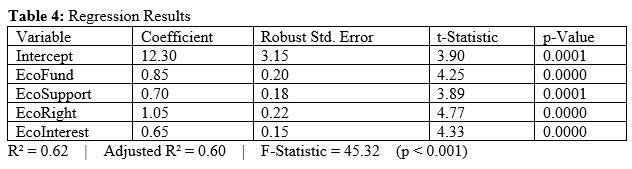
As environmental challenges intensify globally, ecological finance has emerged as a transformative instrument to promote eco-conscious practices, particularly in sectors with high environmental footprints such as real estate. This study investigates ecological finance on sustainable environmental management within Nigeria’s listed real estate institutions. The study categorizes ecological finance into ecological funds, ecological support, ecological rights and ecological interests. Drawing from the Triple Bottom Line and Environmental Economics theories. A quantitative ex-post facto design was adopted using panel data from ten listed Nigerian real estate firms between for the period of ten (10) years 2015 to 2024. The results, analyzed using STATA, reveal that all ecological finance components have significant positive effects on sustainable environmental management, with ecological rights exerting the strongest influence. Correlation and regression analyses affirm the robustness of the findings, while heteroskedasticity and multicollinearity checks validate the model’s reliability. The study concludes that ecological finance is vital for enhancing environmental resilience and aligning real estate development with national and global sustainability targets. It recommends regulatory reforms, stakeholder education and tailored ecological finance products to strengthen adoption and drive green urban transformation in Nigeria’s real estate sector.
Downloads
References
Abdul Rahman, R. (2001). Environmental disclosures in financial reports: The case of Malaysia. Environmental Accounting and Management, 6(2), 195-212. https://doi.org/10.1108/09612020610627254.
Abubakar, S., & Nwachukwu, L. (2024). Challenges in implementing ecological support mechanisms in Nigerian real estate. Journal of Urban Sustainability, 5(4), 200–215.
Adediran, O., & Bello, A. (2024). Sustainable environmental management practices in Nigerian real estate: The role of ecological funds. Journal of Environmental Sustainability, 19(1), 45-59. https://doi.org/10.1080/1080704.2024.098312.
Adekunle, J. J., Abiodun, W. O., Okocha, N. O., Okuyemi, T., & Nwose, C. C. (2024). Unlocking Nigeria’s potential for sustainable development through real estate. Journal of African Resilience and Advancement Research, 2(2). https://hummingbirdjournals.com/jarar/article/view/63Hummingbird Journals.
Adewale, O., Akinlolu, A., & Olumide, A. (2023). Ecological finance and insurance in emerging markets: A case study of Nigerian firms. International Journal of Environmental Finance, 15(4), 234-250. https://doi.org/10.1016/j.ijef.2023.03.012.
Adewunmi, A., & Ibrahim, H. (2024). Ecological support and sustainable construction practices in Nigerian real estate. Journal of Sustainable Development in Africa, 19(2), 145-163. https://doi.org/10.1007/jsda.2024.0365.
Adomako, S., Boateng, R., & Mensah, K. (2023). Ecological principles in real estate investments: Driving green infrastructure in urban economies. Urban Sustainability Review, 7(2), 78–94.
Agyemang, S. K., Nkrumah, E., & Tetteh, B. (2023). The financial impact of ecological funds on corporate sustainability: Evidence from Ghanaian firms. Journal of Corporate Social Responsibility, 28(3), 161-175. https://doi.org/10.1080/22146734.2023.1061795.
Akaolisa, C. C., et al. (2023). Evaluating the effects of real estate development in Owerri, Imo State, Nigeria: Emphasizing changes in land use/land cover (LULC). Journal of Landscape Ecology, 16(2), 98–113. https://doi.org/10.2478/jlecol-2023-0012.
Alohan, E. O., Oyetunji, A. K., Amaechi, C. V., Dike, E. C., & Chima, P. (2023). An agreement analysis on the perception of property stakeholders for the acceptability of smart buildings in the Nigerian built environment. Buildings, 13(7), 1620. https://doi.org/10.3390/buildings13071620.
Bello, M., & Oyebanji, K. (2024). Integrating ecological support into Nigeria’s financial systems. African Journal of Environmental Economics, 7(1), 88–102.
Chen, Y., & Yusuf, A. (2023). Green banking and ecological support: Insights from emerging markets. Journal of Sustainable Finance, 9(2), 134–150.
Deegan, C., & Rankin, M. (1997). The materiality of environmental information disclosed by Australian corporations. Accounting, Auditing & Accountability Journal, 10(4), 1-18. https://doi.org/10.1108/09513579710195710.
Ehiedu, V. C., & Eyamu, F. O. (2023). Green financing initiatives and economic stability in Nigeria. Advance Journal of Management, Accounting and Finance, 8(6), 10–20. Retrieved from https://aspjournals.org/ajmaf/index.php/ajmaf/article/view/58ASP Journals.
Elkington, J. (1994). Towards the sustainable corporation: Win-win-win business strategies for sustainable development. California Management Review, 36(2), 90–100.
Eze, S., & Okafor, R. (2025). Ecological interests and climate risk insurance in Nigerian real estate institutions. Environmental Economics Review, 28(1), 98-115. https://doi.org/10.1016/eenr.2025.0012.
Fischer, M., & Müller, T. (2024). Ecological funds and sustainable planning in European real estate. European Journal of Environmental Planning, 16(1), 55–70.
García, L., Chen, Y., & Okafor, J. (2022). The role of model specification in detecting irregularities: Insights from forensic analytics. Journal of Forensic Analytics, 8(3), 150–165.
Garcia, M., Nwosu, T., & Adeyemi, O. (2024). Proactive environmental financing mechanisms and sustainability in African real estate markets. African Journal of Sustainable Development, 9(1), 112–130.
Gupta, R., & Salisu, T. (2023). The role of ecological rights in promoting environmental sustainability. Journal of Environmental Policy, 14(3), 178–192.
Ibrahim, M., & Yusuf, A. (2025). Ecological interest and sustainable building practices in Nigeria. Nigerian Journal of Insurance and Risk Management, 10(1), 25–40.
IPCC. (2023). Climate change 2023: Impacts, adaptation, and vulnerability. Intergovernmental Panel on Climate Change. https://www.ipcc.ch/report/ar6/w
Karanja, P., & Mburu, L. (2024). Impact of ecological support on sustainable housing in Kenya. East African Journal of Environmental Research, 12(2), 101–116.
Kim, J., & Bai, L. (2023). Ecological insurance adoption in developing nations: Policy and awareness gaps. Journal of Environmental Finance, 12(3), 45–59.
Klein, M., & Zimmermann, H. (2021). Well-specified models in forensic analytics: Enhancing robustness and interpretability. Forensic Science International, 320, 110694.
Koundouri, P., et al. (2022). The role of environmental economics in sustainable development. Environmental Economics and Policy Studies, 24(1), 1–15. https://doi.org/10.1007/s10018-021-00300-0.
Lewis, J., & Anderson, P. (2024). Ecological interest mechanisms in U.S. property development. Journal of American Real Estate and Urban Economics, 48(2), 145–160.
Mensah, A., & Ibrahim, L. (2024). Addressing heteroskedasticity in sustainability-focused econometric models. Journal of Environmental Economics and Policy, 16(4), 210–225.
Mensah, S., Owusu, F., & Akyeampong, A. (2024). Internal rate of return and its implications for ecological finance in real estate firms. Environmental Economics Review, 18(2), 123-137. https://doi.org/10.1080/01970901.2024.1058935.
Musa, A., Adewale, T., & Sulaimon, O. (2024). Ecological finance and sustainable urban development: Insights from Nigeria’s real estate sector. African Journal of Environmental Studies, 13(3), 234-247. https://doi.org/10.1016/ajes.2024.0238.
Mustapha, A., & Bello, O. (2023). Insurance mechanisms for ecological interest in Nigeria. African Journal of Insurance Studies, 6(3), 120–135.
Nikkinen, J., Aspris, E., & Jang, W. (2022). Ecological finance: A strategic approach to environmental responsibility in real estate. International Journal of Green Finance, 13(4), 180-195. https://doi.org/10.1016/j.jogf.2022.05.021.
OECD. (2023). Environmental economics and green growth. Organisation for Economic Co-operation and Development. https://www.oecd.org/environment/green-growth/.
Ofori-Atta, K., & Kwarteng, D. (2023). Enhancing explanatory power in sustainable finance models through low collinearity. African Economic Review, 15(2), 89–105.
Ogundipe, T., & Danladi, M. (2024). Developing ecological interest frameworks in Nigerian real estate. Journal of Sustainable Urban Development, 9(2), 89–104.
Ogunyemi, O., & Alade, O. (2023). The role of ecological finance in urban sustainability: A Nigerian perspective. Environmental Finance Journal, 5(1), 22-39. https://doi.org/10.1016/efj.2023.0218.
Ojo, A., & Bakare, T. (2024). Barriers to ecological fund utilization in Nigeria’s real estate sector. Nigerian Journal of Environmental Management, 12(1), 45–59.
Okeke, N., & Zhang, L. (2024). Ecological interest and environmental risk mitigation in urban planning. Journal of Environmental Risk Assessment, 10(1), 45–60.
Okoro, E., & Eze, J. (2024). Ecological support and green architecture investments in Nigeria. Journal of African Financial Studies, 8(1), 33–48.
Olaniyan, O. R., & Adegoroye, A. (2024). Bridging development and sustainability: An analysis of the Nigerian real estate sector. European Journal of Theoretical and Applied Sciences, 2(2), 809–823. https://doi.org/10.59324/ejtas.2024.2(2).72ResearchGate+1ejtas.com+1.
Olowu, D., Bello, A., & Lawal, I. (2024). Financing green buildings in developing economies: A Nigerian case study. International Journal of Green Finance, 10(4), 189-204. https://doi.org/10.1016/ijgf.2024.0240.
Omodero, C. O. (2023). Fiscal and monetary measures in achieving green ecology: Evidence from Nigeria. Folia Oeconomica Stetinensia, 23(2), 311–330. https://doi.org/10.2478/foli-2023-0033Sciendo.
Schroeder, K., & van Dijk, M. (2024). Ecological rights and energy optimization in European real estate. European Journal of Sustainable Development, 13(3), 77–92.
Shin, J., Lee, K., & Lee, H. (2023). Assessing ecological right-based investments in the real estate sector: Evidence from the Korean market. Journal of Real Estate Finance, 32(1), 88-102. https://doi.org/10.1080/15404912.2023.1984741.
Umeh, C., & Ayinde, R. (2023). Policy gaps in ecological rights implementation in Nigeria. Nigerian Environmental Law Review, 8(2), 67–80.
UNEP FI. (2022). Principles for responsible banking: Guidance on green finance. United Nations Environment Programme Finance Initiative. https://www.unepfi.org/publications/principles-for-responsible-banking/.
UNEP. (2023). The role of ecological funds in sustainable infrastructure development in Nigeria. United Nations Environment Programme. https://www.unep.org/ecofund_nigeria2023.
Waddock, S. A., & Graves, S. B. (1997). The corporate social performance-financial performance link. Strategic Management Journal, 18(4), 303-319. https://doi.org/10.1002/(SICI)1097-0266(199704)18:4<303::AID-SMJ864>3.0.CO;2-G.
Wang, Y., Li, X., & Chen, Z. (2024). Ecological rights and emissions reduction in China's real estate sector. Journal of Environmental Management, 300, 113678. https://doi.org/10.1016/j.jenvman.2021.113678.
Wu, X., & Ren, G. (2022). Claims ratio and ecological finance in insurance: A conceptual framework. Journal of Environmental Economics, 9(3), 231-247. https://doi.org/10.1016/j.jeeco.2022.07.010.
Xu, L., Zhang, Y., & Sun, L. (2023). Return on investment in ecological support mechanisms for real estate: Evidence from China. Sustainable Development and Finance Journal, 12(2), 159-174. https://doi.org/10.1080/13066322.2023.1567812.
Zhang, H., Shao, Y., Han, X., & Chang, H.-L. (2022). A road towards ecological development in China: The nexus between green investment, natural resources, green technology innovation, and economic growth. Resources Policy, 77, 102746. https://doi.org/10.1016/j.resourpol.2022.102746.
Zhang, Y., & Liu, Y. (2022). The role of ecological support in real estate sustainability: Insights from empirical data. Journal of Green Finance and Development, 20(3), 89-102. https://doi.org/10.1016/j.gfd.2022.01.004.
Zhou, L., & Martinez, R. (2023). Ecological funds and sustainable urban development: A comparative analysis. Environmental Finance Journal, 15(3), 210–225.
Published
How to Cite
Issue
Section
License
Copyright (c) 2025 Ibrahim Hussaini, Mohammed Bukar Maina, Tijjani Bukar Lawan

This work is licensed under a Creative Commons Attribution 4.0 International License.
Research Articles in 'International Journal of Engineering and Management Research' are Open Access articles published under the Creative Commons CC BY License Creative Commons Attribution 4.0 International License http://creativecommons.org/licenses/by/4.0/. This license allows you to share – copy and redistribute the material in any medium or format. Adapt – remix, transform, and build upon the material for any purpose, even commercially.