A Detailed Study on Introduction of Computational Intelligence
DOI:
https://doi.org/10.5281/zenodo.15309780Keywords:
Computational Intelligence, Symbolic Reasoning, Artificial Neural Network, Fuzzy SystemAbstract
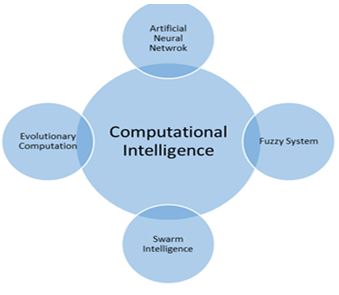
This article demonstrates an analysis of Computational Intelligence (CI) through its crucial concepts together with principles and implementation examples in the field of artificial intelligence. The core computational models in CI help replicate human reasoning and solve complex problems through neural networks as well as fuzzy systems alongside evolutionary algorithms while hybrid systems interpolate their benefits. The paper demonstrates CI development from inception to present day while focusing on eminent milestones alongside CI adoption across data mining and robotic control and optimal decision making applications. The chapter explores both theoretical perspectives of CI and provides an evaluation of its strengths and limitations. This paper uses different examples to validate the importance and usage of CI in modern technology before establishing directions for future research in this developing field. The obtained outcomes demonstrate that CI methods can reach practical use after implementing improvements. This paper delivers an extensive overview of CI principles to support researchers and practitioners so they can boost innovation alongside cross-disciplinary work in this developing field.
Downloads
References
D. Saxena, S.N. Singh, & K.S. Verma. (2010). Application of computational intelligence in emerging power systems. International Journal of Engineering, Science and Technology, 2(3), 1-7.
Kevin E. Voges, & Nigel Pope. (2006). Business applications and computational intelligence. https://books.google.co.in/books?isbn=1591407044.
Esteva, A., Kuprel, B., Novoa, R. A., Ko, J., Swetter, S. M., Blau, H. M., & Thrun, S. (2019). Dermatologist-level classification of skin cancer with deep neural networks. Nature, 542(7639), 115–118.
Korach, Z. T., Yang, S., Rosset, S., & Topol, E. (2020). Leveraging machine learning to individualize treatment for patients with multiple chronic conditions. Nature Communications, 11(1), 619.
Vankipuram, M., Kahol, K., & Cohen, T. (2018). A predictive analytics approach to reducing 30-day avoidable heart failure readmissions. JMIR Medical Informatics, 6(4), e10104.
Mishra, R., Jha, R., & Mishra, A. (2018). AI-based decision support system: A proposed paradigm for remote areas. Health Information Science and Systems, 6(1), 4.
Sarker, A., Chandrashekar, P., Magge, A., Cai, H., Klein, A., Gonzalez, G., & Scotch, M. (2019). Discovering cohorts of pregnant women from social media for safety surveillance and analysis. Journal of Medical Internet Research, 21(4), e13044.
Aliper, A., Plis, S., Artemov, A., Ulloa, A., Mamoshina, P., & Zhavoronkov, A. (2016). Deep learning applications for predicting pharmacological properties of drugs and drug repurposing using transcriptomic data. Molecular Pharmaceutics, 13(7), 2524–2530.
Olivecrona, M., Blaschke, T., Engkvist, O., & Chen, H. (2017). Molecular de-novo design through deep reinforcement learning. Journal of Chemical Information and Modeling, 57(11), 2657–2666.
Published
How to Cite
Issue
Section
License
Copyright (c) 2025 Nikita Saklani, Kanchan Bade

This work is licensed under a Creative Commons Attribution 4.0 International License.
Research Articles in 'International Journal of Engineering and Management Research' are Open Access articles published under the Creative Commons CC BY License Creative Commons Attribution 4.0 International License http://creativecommons.org/licenses/by/4.0/. This license allows you to share – copy and redistribute the material in any medium or format. Adapt – remix, transform, and build upon the material for any purpose, even commercially.