The Role of Machine Learning in Predicting Patient Outcomes and Hospital Readmissions
DOI:
https://doi.org/10.5281/zenodo.15355035Keywords:
Hospital Readmissions, Machine Learning (ML), Electronic Health Records (EMR), Diagnostic Imaging, Genomic SequencingAbstract
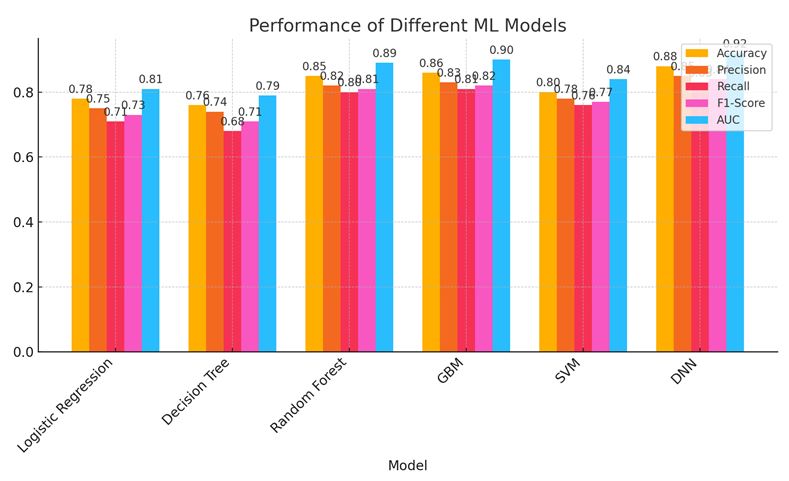
With an aging population, ascendent prevalence of chronic disease and rising therapy costs, the demands on global health care systems have reached new levels, calling for new solutions to improve patients’ care and health care delivery efficiency. Thus, in a clinical context, Machine Learning (ML) is a rapidly evolving subbranch of Artificial Intelligence (AI) which can provide a transformational potential to automate the data-intensive decision making. Vast and complicated datasets spawned from electronic health records (EHRs), laboratory results, diagnostic imaging, patient histories and other sources can be analysed by ML algorithms to find patterns that humans cannot. Moreover, these predictive capabilities come into play when it comes to predicting patient outcome or patients at high risk of readmission so that suitable interventions can be taken place and healthcare costs can be claimed. This paper systematically studies the application of ML in predicting clinical outcomes and readmissions through a comparative analysis of different ML model: such as logistic regression, decision trees, ensemble, and different deep learning architectures. We evaluate the performance, accuracy, and practical utility of these models in hospital settings by leveraging real world datasets. We also discuss broader ML adoption related to healthcare, including model interpretability and integration issues and ethics. We show that ML has the unique potential to drive precision medicine and improve the entire healthcare delivery.
Downloads
References
Bobadilla, A. V. P., Schmitt, V., Maier, C. S., Mensing, S., & Stodtmann, S. (2024). Practical guide to SHAP analysis: Explaining supervised machine learning model predictions in drug development [Review of Practical guide to SHAP analysis: Explaining supervised machine learning model predictions in drug development]. Clinical and Translational Science, 17(11). Wiley. https://doi.org/10.1111/cts.70056.
Cutillo, C. M., Sharma, K. R., Foschini, L., Kundu, S., Mackintosh, M., Mandl, K. D., Beck, T., Collier, E., Colvis, C. M., Gersing, K., Gordon, V., Jensen, R. E., Shabestari, B., & Southall, N. (2020). Machine intelligence in healthcare—perspectives on trustworthiness, explainability, usability, and transparency. NPJ Digital Medicine, 3(1). https://doi.org/10.1038/s41746-020-0254-2.
Eckhardt, C., Madjarova, S., Williams, R. J., Ollivier, M., Karlsson, J., Pareek, A., & Nwachukwu, B. U. (2022). Unsupervised machine learning methods and emerging applications in healthcare [Review of Unsupervised machine learning methods and emerging applications in healthcare]. Knee Surgery Sports Traumatology Arthroscopy, 31(2), 376. Springer Science+Business Media. https://doi.org/10.1007/s00167-022-07233-7.
Fatima, M., & Pasha, M. (2017). Survey of machine learning algorithms for disease diagnostic. Journal of Intelligent Learning Systems and Applications, 9(1), 1. https://doi.org/10.4236/jilsa.2017.91001.
Li, Y.-H., Li, Y., Wei, M.-Y., & Li, G. (2024). Innovation and challenges of artificial intelligence technology in personalized healthcare [Review of Innovation and challenges of artificial intelligence technology in personalized healthcare]. Scientific Reports, 14(1). Nature Portfolio. https://doi.org/10.1038/s41598-024-70073-7.
Morgan, D. J., Bame, B., Zimand, P., Dooley, P. M., Thom, K. A., Harris, A. D., Bentzen, S. M., Ettinger, W. H., Garrett-Ray, S., Tracy, J. K., & Liang, Y. (2019). Assessment of machine learning vs standard prediction rules for predicting hospital readmissions. JAMA Network Open, 2(3). https://doi.org/10.1001/jamanetworkopen.2019.0348.
Myers, J. E., Frieden, T. R., Bherwani, K. M., & Henning, K. (2008). Ethics in public health research. American Journal of Public Health, 98(5), 793. https://doi.org/10.2105/ajph.2006.107706 .
Petersen, E., Potdevin, Y., Mohammadi, E., Zidowitz, S., Breyer, S., Nowotka, D., Henn, S., Pechmann, L., Leucker, M., Rostalski, P., & Herzog, C. (2021). Responsible and regulatory conform machine learning for medicine: A survey of technical challenges and solutions. arXiv (Cornell University). http://export.arxiv.org/pdf/2107.09546.
Pianykh, O. S., Guitron, S., Parke, D., Zhang, C., Pandharipande, P. V., Brink, J. A., & Rosenthal, D. (2020). Improving healthcare operations management with machine learning. Nature Machine Intelligence, 2(5), 266. https://doi.org/10.1038/s42256-020-0176-3.
Sheetrit, E., Brief, M., & Elisha, O. (2023). Predicting unplanned readmissions in the intensive care unit: A multimodality evaluation. Scientific Reports, 13(1). https://doi.org/10.1038/s41598-023-42372-y.
Sidey-Gibbons, J. A. M., & Sidey‐Gibbons, C. (2019). Machine learning in medicine: a practical introduction. BMC Medical Research Methodology, 19(1). https://doi.org/10.1186/s12874-019-0681-4.
Tang, Y., Tang, Y., Peng, Y., Yan, K., Bagheri, M., Redd, B., Brandon, C., Lu, Z., Han, M., Xiao, J., & Summers, R. M. (2020). Automated abnormality classification of chest radiographs using deep convolutional neural networks. NPJ Digital Medicine, 3(1). https://doi.org/10.1038/s41746-020-0273-z.
Wallis, C. (2019). How artificial intelligence will change medicine. Nature, 576(7787). https://doi.org/10.1038/d41586-019-03845-1.
Xiao, C., Ma, T., Dieng, A. B., Blei, D. M., & Wang, F. (2018). Readmission prediction via deep contextual embedding of clinical concepts. PLoS ONE, 13(4). https://doi.org/10.1371/journal.pone.0195024.
Published
How to Cite
Issue
Section
License
Copyright (c) 2025 Priyanka Garg

This work is licensed under a Creative Commons Attribution 4.0 International License.
Research Articles in 'International Journal of Engineering and Management Research' are Open Access articles published under the Creative Commons CC BY License Creative Commons Attribution 4.0 International License http://creativecommons.org/licenses/by/4.0/. This license allows you to share – copy and redistribute the material in any medium or format. Adapt – remix, transform, and build upon the material for any purpose, even commercially.