Railroad Track Defect Detections using Deep Learning
DOI:
https://doi.org/10.5281/zenodo.15356939Keywords:
Deep Learning, Railroad Transportation, Convolutional Neural Networks (CNNs), YOLOv5Abstract
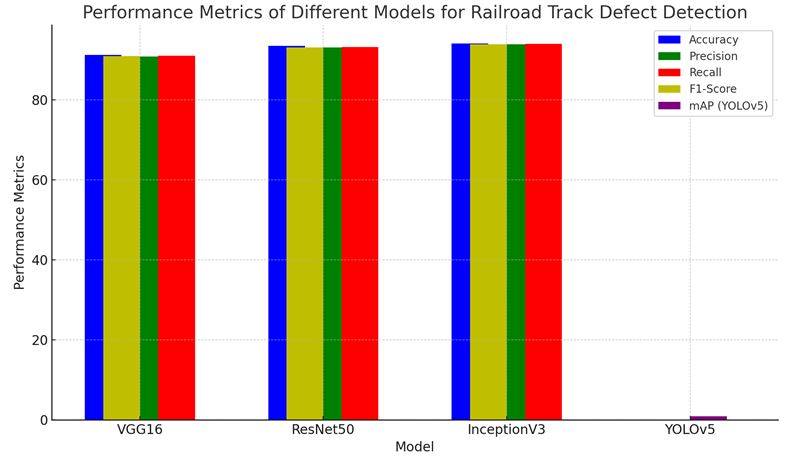
However, railroad transportation continues to be one of the most important components to global terms of freight and passenger transport, and is integral to the success of economic development and logistics efficiency. With bigger demand for rail service comes ever more need to not only maintain functionality of the rail system, but also to keep it safe and reliable. With railroad tracks being the case, one of the most pressing concerns at hand is to be able to detect defects in the tracks early and accurate. Due to labor intensive, time consuming and human error prone nature of traditional inspection methods, there is an immediate requirement of approaches to automated, intelligent inspection. Using high resolution inspection images of railroad tracks, this study investigates the use of deep learning techniques for automation in detecting defects in railroad tracks. Then based on the leakage of convolutional neural networks (CNNs), transfer learning strategies and real time object detection frameworks (e.g., YOLOv5), provide the good enough track anomaly classification and locating capabilities such as cracks, broken rail, loose fasteners and vegetation interference. Experimental results show that the classification accuracy was 94% for InceptionV3 model, and the real time detection using YOLOv5 has the mAP of 0.89 and the inference time of just 23ms per image. Deep learning appears to be a robust scalable and practical method of improving railway safety and maintenance operation.
Downloads
References
Akabal, F. M., Masirin, M. I. M., Akasah, Z. A., & Rohani, M. M. (2017). Review on selection and suitability of rail transit station design pertaining to public safety. IOP Conference Series Materials Science and Engineering, 226, 12033. https://doi.org/10.1088/1757-899x/226/1/012033.
Chandran, P., Rantatalo, M., Odelius, J., Lind, H., & Famurewa, S. M. (2019). Train-based differential eddy current sensor system for rail fastener detection. Measurement Science and Technology, 30(12), 125105. https://doi.org/10.1088/1361-6501/ab2b24.
Banić, M., Miltenović, A., Pavlović, M., & Ćirić, I. (2019). Intelligent machine vision based railway infrastructure inspection and monitoring using UAV. Facta Universitatis Series Mechanical Engineering, 17(3), 357. https://doi.org/10.22190/fume190507041b.
Edwards, J. R., Hart, J. M., Resendiz, E., Barkan, C. P. L., & Ahuja, N. (2009). Advancements in railroad track inspection using machine-vision technology. https://www.arema.org/files/library/2009_Conference_Proceedings/Advancements_in_Railroad_Track_Inspection_Using_Machine-Vision_Technology.pdf.
Kliuiev, S., Медведєв, Є., & Халіпова, Н. В. (2020). Study of railway traffic safety based on the railway track condition monitoring system. IOP Conference Series Materials Science and Engineering, 985(1), 12012. https://doi.org/10.1088/1757-899x/985/1/012012.
Teshaev, N., Makhsudov, B., Ikramov, I., & Mirjalalov, N. (2024). Advances and prospects in machine learning for GIS and remote sensing: A comprehensive review of applications and research frontiers [Review of Advances and Prospects in Machine Learning for GIS and Remote Sensing: A Comprehensive Review of Applications and Research Frontiers]. E3S Web of Conferences, 590, 3010. EDP Sciences. https://doi.org/10.1051/e3sconf/202459003010.
Yang, C., Sun, Y., Ladubec, C., & Liu, Y. (2020). Developing machine learning-based models for railway inspection. Applied Sciences, 11(1), 13. https://doi.org/10.3390/app11010013.
Bai, T., Gao, J., Yang, J., & Yao, D. (2021). A study on railway surface defects detection based on machine vision. Entropy, 23(11), 1437. https://doi.org/10.3390/e23111437.
Kaparthi, S., & Bumblauskas, D. (2020). Designing predictive maintenance systems using decision tree-based machine learning techniques. International Journal of Quality & Reliability Management, 37(4), 659. https://doi.org/10.1108/ijqrm-04-2019-0131.
Wu, Y., Qin, Y., Qian, Y., Guo, F., Wang, Z., & Jia, L. (2021). Hybrid deep learning architecture for rail surface segmentation and surface defect detection. Computer-Aided Civil and Infrastructure Engineering, 37(2), 227. https://doi.org/10.1111/mice.12710.
Τρίγκα, Μ., & Δρίτσας, Η. (2025). A comprehensive survey of deep learning approaches in image processing [Review of A Comprehensive Survey of Deep Learning Approaches in Image Processing]. Sensors, 25(2), 531. https://doi.org/10.3390/s25020531.
Hsieh, C.-C., Lin, Y., Tsai, L.-H., Huang, W.-H., Hsieh, S., & Hung, W.-H. (2020). Offline deep-learning-based defective track fastener detection and inspection system. Sensors and Materials, 32(10), 3429. https://doi.org/10.18494/sam.2020.2921.
Valente, J., António, J., Mora, C. L. de, & Jardim, S. (2023). Developments in image processing using deep learning and reinforcement learning [Review of Developments in Image Processing Using Deep Learning and Reinforcement Learning]. Journal of Imaging, 9(10), 207. https://doi.org/10.3390/jimaging9100207.
Yang, C., Sun, Y., Ladubec, C., & Liu, Y. (2020). Developing machine learning-based models for railway inspection. Applied Sciences, 11(1), 13. https://doi.org/10.3390/app11010013.
Published
How to Cite
Issue
Section
License
Copyright (c) 2025 Anita

This work is licensed under a Creative Commons Attribution 4.0 International License.
Research Articles in 'International Journal of Engineering and Management Research' are Open Access articles published under the Creative Commons CC BY License Creative Commons Attribution 4.0 International License http://creativecommons.org/licenses/by/4.0/. This license allows you to share – copy and redistribute the material in any medium or format. Adapt – remix, transform, and build upon the material for any purpose, even commercially.