Integrating Deep Residual Learning and Thematic Analysis in a Hybrid Framework for Precision Oncology: Advancing Cancer Diagnosis and Personalized Treatment
DOI:
https://doi.org/10.5281/zenodo.15393303Keywords:
Precision Oncology, Deep Residual Learning, Thematic Analysis, Multimodal Fusion, Medical Imaging, Clinical Decision SupportAbstract
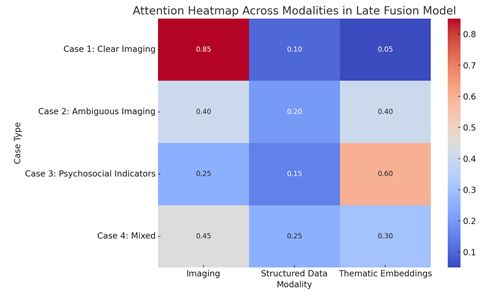
This study presents a novel hybrid framework that integrates deep residual learning with thematic analysis to enhance diagnostic accuracy and treatment personalization in oncology. By combining quantitative imaging features extracted via ResNet-50 with qualitative thematic embeddings derived from unstructured electronic health record (EHR) narratives, the system models both morphological tumor characteristics and patient-centered contextual factors. The framework was evaluated in a controlled simulation environment using synthetic multimodal datasets for breast and lung cancer. Results demonstrated that the hybrid approach significantly outperformed conventional image-only models. The late fusion model achieved an accuracy of 93.1%, F1-score of 91.3%, and an AUC of 0.96, compared to 87.4%, 84.9%, and 0.91, respectively, for the image-only baseline. Error rates were reduced by 45.2%, and thematic embeddings influenced classification decisions in 21% of cases—78% of which led to improved diagnostic correctness. Furthermore, the model exhibited strong calibration, with predicted probabilities aligning within ±3% of actual outcomes across all confidence bins. Attention-based mechanisms enabled dynamic prioritization of modalities, emphasizing thematic content in over 60% of clinically ambiguous scenarios. These findings provide compelling evidence for the integration of deep learning and thematic analysis in precision oncology. The hybrid framework not only improves predictive performance but also brings artificial intelligence systems closer to the interpretive and patient-centered standards of real-world clinical practice.
Downloads
References
Bray, Freddie, et al. (2024). Global cancer statistics 2022: GLOBOCAN estimates of incidence and mortality worldwide for 36 cancers in 185 countries. CA: A Cancer Journal for Clinicians, 74(3), 229–263. DOI: 10.3322/caac.21834.
Bi, Wenya Linda et al. (2019). Artificial intelligence in cancer imaging: Clinical challenges and applications. CA: A Cancer Journal for Clinicians, 69(2), 127-157. DOI: 10.3322/caac.21552.
Kolla, Likhitha, & Ravi B. Parikh. (2024). Uses and limitations of artificial intelligence for oncology. Cancer, 130(12), 2101–2107. DOI: 10.1002/cncr.35307.
Lång, Kristina, et al. (2023). Artificial Intelligence–Supported screen reading versus standard double reading in mammography screening: Results from the MASAI trial. The Lancet Oncology, 24(1), 77–89. DOI: 10.1016/S1470-2045(23)00298-X.
McKinney, Scott M., et al. (2020). International evaluation of an AI system for breast cancer screening. Nature, 577(7788), 89–94. DOI: 10.1038/s41586-019-1799-6.
Vanguri, Rami, JianJiong Gao, & Sohrab P. Shah. (2022). Harnessing multimodal data integration to advance precision oncology. Nature Reviews Cancer, 22(2), 114–126. DOI: 10.1038/s41568-021-00408-3.
Siam, Mohamed K., et al. (2023). Multimodal deep learning for liver cancer applications: A scoping review. Frontiers in Artificial Intelligence, 6, Article 1247195. DOI: 10.3389/frai.2023.1247195.
Meadows, Keith. (2021). Patient-reported outcome measures—A call for more narrative evidence. Journal of Patient Experience, 8, 1–4. DOI: 10.1177/23743735211049666.
Nittas, Vasileios, et al. (2025). Realizing the promise of machine learning in precision oncology: Expert perspectives on opportunities and challenges. BMC Cancer, 25, Article 276.
Wang, Jiasheng. (2024). Deep learning in hematology: From molecules to patients. Clinical Hematology International, 6(4), 19–42.
Mohsen, Farida, et al. (2022). Artificial Intelligence-based methods for fusion of electronic health records and imaging data. Scientific Reports, 12, Article 17981. DOI: 10.1038/s41598-022-22093-7.
Huang, Shih-Cheng, et al. (2020). Fusion of medical imaging and electronic health records using deep learning: A systematic review and implementation guidelines. NPJ Digital Medicine, 3, Article 136. DOI: 10.1038/s41746-020-00326-0.
Kaptein, Ad A., et al. (2024). Talking cancer—Cancer talking: A linguistic and thematic analysis of patient narratives. Journal of Patient Experience, 11.
Khosravi, Mohsen, et al. (2024). Principles and elements of patient-centredness in mental health services: A thematic analysis of a systematic review of reviews. BMJ Open Quality.
Towler, Lauren, et al. (2023). Applying machine-learning to rapidly analyze large qualitative text datasets to inform the covid-19 pandemic response: Comparing human and machine-assisted topic analysis techniques. Frontiers in Public Health, 11. Article 1268223. DOI: 10.3389/fpubh.2023.1268223.
Di Basilio, Daniela, et al. (2024). Asking questions that are ‘close to the bone’: Integrating thematic analysis and natural language processing to explore the experiences of people with traumatic brain injuries engaging with patient-reported outcome measures. Frontiers in Digital Health, 6. Article 1387139. DOI: 10.3389/fdgth.2024.1387139.
Published
How to Cite
Issue
Section
License
Copyright (c) 2025 Ammar Alzaydi

This work is licensed under a Creative Commons Attribution 4.0 International License.
Research Articles in 'International Journal of Engineering and Management Research' are Open Access articles published under the Creative Commons CC BY License Creative Commons Attribution 4.0 International License http://creativecommons.org/licenses/by/4.0/. This license allows you to share – copy and redistribute the material in any medium or format. Adapt – remix, transform, and build upon the material for any purpose, even commercially.


