IOT-Based Accident Prevention System: A Model Experiment for U-Turn Curves
DOI:
https://doi.org/10.5281/zenodo.15365062Keywords:
U Turn, IOT, LED Light, Sensor, Signal, Vehicle, Driver, Accident, PreventionAbstract
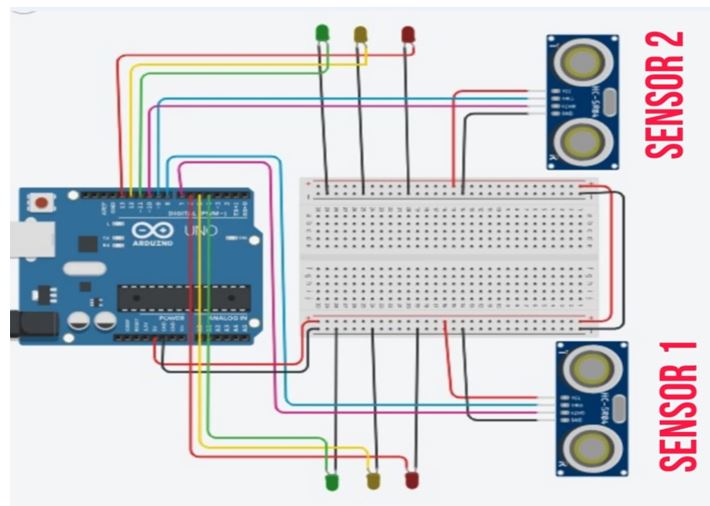
In today’s world, the combination of high population density and the widespread use of vehicles has led to a serious concern: the increasing number of road accidents. Every year, thousands of people lose their lives or suffer serious injuries in such incidents. In developing countries like India, road accidents remain one of the leading causes of death. National highways, as well as mountain and hill areas, have dangerous roads and curves that are narrow and single-lane. Accidents at U-turns commonly occur due to limited sight distance, especially on curved or hilly roads, where drivers cannot see oncoming traffic in time to react safely. Inadequate road signage, poor lighting, and lack of dedicated turning lanes further increase the risk. Additionally, high vehicle speeds, misjudgment of gaps in traffic, and sudden or illegal U-turns made without proper signaling often lead to collisions. In areas with high traffic volume or narrow roads, the risk multiplies as vehicles may not have sufficient space or time to complete a U-turn safely. Addressing these risks requires a combination of improved road design, warning systems, enforcement of traffic laws, and driver awareness. At these curved sections, drivers are often unable to see oncoming vehicles or obstacles, and if their vehicle is not in good condition, it becomes difficult to control, increasing the risk of accidents. To minimize such accidents, we propose a project aimed at preventing collisions at U-turns by alerting drivers to oncoming vehicles. This is done by keeping an ultra sound sonic sensor on both sides of the U-turn and so that if vehicle comes from one end of the curve, then sensor senses and it gives signal to Arduino and Arduino gives command to LED lights of the other side in order to alert the driver.
Downloads
References
Abdulrahman, R., Almoshaogeh, M., Haider, H., Alharbi, F., & Jamal, A. (2025). Development and application of a risk analysis methodology for road traffic accidents. Alexandria Engineering Journal, 111, 293-305.
Acharja, H. P., Choki, S., Wangmo, D., Al Abdouli, K. M., Muramatsu, K., & Chettri, N. (2024). Development of fog visibility enhancement and alert system using IoT. Cogent Engineering, 11(1), 2408328.
Ahmed, A., & Aijaz, B. (2023). A case study on the potential applications of V2V communication for improving road safety in Pakistan. Engineering Proceedings, 32(1).
Arafat, S., & Gajendiran, K. S. (2024, August). Advanced Fog and Pollution-Resistant Accident Detection System. In: 10th International Conference on Electrical Energy Systems (ICEES), pp. 1- 4. IEEE. Arulkumar, Shimpy Ralhan, Baru Debtera, “Optimization of Hello Message.
Bhatia, J., Italiya, K., Jadeja, K., Kumhar, M., Chauhan, U., Tanwar, S., ... & Raboaca, M. S. (2022). An overview of fog data analytics for IoT applications. Sensors, 23(1), 199.
Bipin Kumar Singh, & Abdul rahoof. Road safety and road safety audit in India review. NIMS University, Broadcasting Prediction Model for Stability Analysis. Wireless.
C. Mohd. Keya. A case study of road accident in Kerala during 2010 - 2016. KMEA Engineering College, Kerala.
Chandra Reddy. (2015). Performance is primary qualification is secondary. International Journal in Management and Social Science, 3(11), 316-325.
Chui, K. T., Kochhar, T. S., Chhabra, A., Singh, S. K., Singh, D., Peraković, D., ... & Arya, V. (2022). Traffic accident prevention in low visibility conditions using VANETs cloud environment. International Journal of Cloud Applications and Computing (IJCAC), 12(1), 1-21.
Dr Kamireddy (2024), The role of contingent workforce on the Vodafone company performance, International Journal of Engineering and Management Research, 14(1), 118-126.
Dr. C S R Kamireddy. (2025). A study on the potential natural heritage values for the sustainable tourism practices in Al Hamra and Misafat Al-Abriyeen—Visitor’s perception. Journal of Information Systems Engineering and Management, 10(29S).
Dr. Reddy. (2025). Systematic literature review: Business models proposed for integrating natural heritage values into sustainable tourism for economic development using campbell collaboration. South Eastern European Journal of Public Health, 26(S2), 3282–3289.
Gao, J., Tian, H., Li, A., Song, J., & Zhu, X. (2023). Analysis of agglomerate fog meteorological characteristics in Anhui Province based on traffic accident data. Pure and Applied Geophysics, 180(1), 313-333.
Howlader, S. N., Khanom, S., Hossain, M. M., Sarker, S., Mohammad, N., & Sarker, M. M. (2024, March). Real-time traffic control using IoT nodes based on traffic density information. In: 3rd International Conference on Sentiment Analysis and Deep Learning (ICSADL), pp. 618-624. IEEE. https://finance.gov.pk/survey/chapter_24/12_population pdf.
K. A. Nagaty. (2023). IoT commercial and industrial applications and AI powered IoT,” in frontiers of quality electronic design (QED) AI, IoT and hardware security. Springer, 465–500.
Kheder, M. Q., & Mohammed, A. A. (2024). Real-time traffic monitoring system using IoT-aided robotics and deep learning techniques. Kuwait Journal of Science, 51(1), 100153.
Khurshid, A., Sohail, A., Khurshid, M., Shah, M. U., & Jaffry, A. A. (2021). Analysis of road traffic accident fatalities in Karachi, Pakistan: an autopsy-based study. Cureus, 13(4).
Ninan, B. (2024, July). A Confirmation Based Accident Detection System Using IoT for Smart Vehicles. In: IEEE 3rd World Conference on Applied Intelligence and Computing (AIC), pp. 1136-1141. IEEE.
Parveen, N., Ali, A., & Ali, A. (2020, October). IOT based automatic vehicle accident alert system. In: IEEE 5th International Conference on Computing Communication and Automation (ICCCA), pp. 330-333. IEEE.
Sharma, N., & Garg, R. D. (2023). Real-time IoT-based connected vehicle infrastructure for intelligent transportation safety. IEEE Transactions on Intelligent Transportation Systems, 24(8), 8339-8347.
T. subarmani, & R. Arulmohar. (2022). Ghat road alignment in palamalai hills, Tamil Nadu, India using Ghat tracer, GTS and GPS", CEG, Anna university, chennai, India.
Technology, 8(03), 01-08.
Yaqoob, S., Hussain, A., Subhan, F., Pappalardo, G., & Awais, M. (2023). Deep learning based anomaly detection for fog-assisted IoVs network. IEEE Access, 11, 19024-19038.
Zaman, Q., Ali, M., Kayani, H., Khan, W., Nawaz, S., Haider, B., & Iqbal, S. (2024). National trends and patterns in traffic road accidents in Pakistan: A statistical analysis. Journal of Asian Development Studies, 13(3), 336-345.
Zhang, H., & Lu, X. (2020). Vehicle communication network in intelligent transportation system based on Internet of Things. Computer Communications, 160, 799-806.
Zhang, Y., Carballo, A., Yang, H., & Takeda, K. (2023). Perception and sensing for autonomous vehicles under adverse weather conditions: A survey. ISPRS Journal of Photogrammetry and Remote Sensing, 196, 146-177.
Published
How to Cite
Issue
Section
License
Copyright (c) 2025 Kamireddy Devaki, Brundavanam Krishna Manojna, Bhimavarapu Jayanth Reddy, Bhimavarapu Sasank Reddy, Kamireddy Hareswara Reddy

This work is licensed under a Creative Commons Attribution 4.0 International License.
Research Articles in 'International Journal of Engineering and Management Research' are Open Access articles published under the Creative Commons CC BY License Creative Commons Attribution 4.0 International License http://creativecommons.org/licenses/by/4.0/. This license allows you to share – copy and redistribute the material in any medium or format. Adapt – remix, transform, and build upon the material for any purpose, even commercially.


