Educational Leadership Theories and Their Role in School Improvement: A Study of the Haitian Secondary School System
DOI:
https://doi.org/10.5281/zenodo.15447860Keywords:
Educational Leadership, Transformational Leadership, Instructional Leadership, Haitian Education, School Improvement, Leadership TheoryAbstract
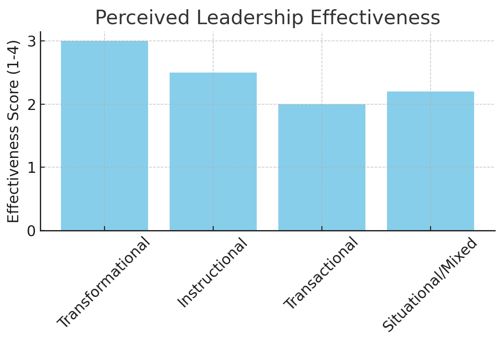
This study investigates the application of educational leadership theories within the Haitian secondary school system, aiming to identify the dominant leadership styles and their impact on school improvement. Drawing from a wide array of theoretical frameworks—including transformational, instructional, transactional, and distributed leadership—the research uses a mixed-methods approach combining qualitative interviews with quantitative data analysis. Findings indicate that transformational and instructional leadership styles are prevalent, but often blended with administrative and transactional elements. The study emphasizes the importance of contextual adaptation and recommends strategic leadership development tailored to the Haitian educational landscape.
Downloads
References
Bass, B. M. (1990). From transactional to transformational leadership: Learning to share the vision. Organizational Dynamics, 18(3), 19-31.
Bass, B. M., & Riggio, R. E. (2006). Transformational leadership. (2nd ed.). Lawrence Erlbaum Associates.
Burns, J. M. (1978). Leadership. Harper & Row.
Gronn, P. (2002). Distributed leadership as a unit of analysis. The Leadership Quarterly, 13(4), 423-451.
Hallinger, P. (2005). Instructional leadership and the school principal: A passing fancy that refuses to fade away. Leadership and Policy in Schools, 4(3), 221-239.
Harris, A. (2008). Distributed leadership: According to the evidence. Journal of Educational Administration, 46(2), 172-188.
Hersey, P., & Blanchard, K. H. (1982). Management of organizational behavior: Utilizing human resources. (4th ed.). Prentice-Hall.
Leithwood, K., & Jantzi, D. (2005). A review of transformational school leadership research 1996–2005. Leadership and Policy in Schools, 4(3), 177-199.
McCleskey, J. (2014). Situational, transformational, and transactional leadership and leadership development. Journal of Business Studies Quarterly, 5(4), 117-130.
Robinson, V. M. J., Lloyd, C., & Rowe, K. J. (2008). The impact of leadership on student outcomes: An analysis of the differential effects of leadership types. Educational Administration Quarterly, 44(5), 635-674.
Schein, E. H. (2010). Organizational culture and leadership. (4th ed.). Jossey-Bass.
Sheahan, M. (2019). Theories of educational leadership. Retrieved from https://www.educationcorner.com/educational-leadership-theories.html.
Spillane, J. P. (2005). Distributed leadership. The Educational Forum, 69(2), 143-150.
Creswell, J. W., & Creswell, J. D. (2018). Research design: Qualitative, quantitative, and mixed methods approaches. (5th ed.). SAGE.
Joyner, R., Rouse, W. A., & Glatthorn, A. A. (2012). Writing the winning thesis or dissertation: A step-by-step guide. Corwin Press.
Published
How to Cite
Issue
Section
License
Copyright (c) 2025 Willy Lima, Ph.D., MBA, Omulda Lima Guerrier

This work is licensed under a Creative Commons Attribution 4.0 International License.
Research Articles in 'International Journal of Engineering and Management Research' are Open Access articles published under the Creative Commons CC BY License Creative Commons Attribution 4.0 International License http://creativecommons.org/licenses/by/4.0/. This license allows you to share – copy and redistribute the material in any medium or format. Adapt – remix, transform, and build upon the material for any purpose, even commercially.