Ontology Based Personalized Diet Recommendation System for Sri Lankan
DOI:
https://doi.org/10.5281/zenodo.16880010Keywords:
Diet Recommendation, Recurrent Neural Network (RNN), Long Short-Term Memory (LSTM), OntologyAbstract
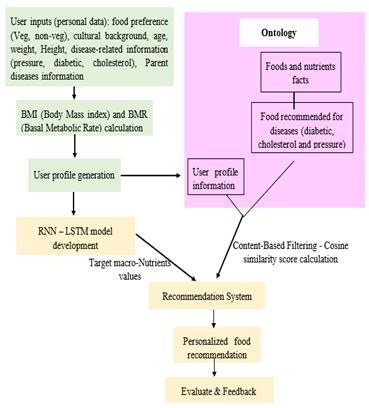
Hectic lifestyles and health neglect are prime causes of non-communicable diseases. Healthy diets help to prevent various non-communicable diseases such as diabetics, pressure, cholesterol etc. However, due to the busy life cycle, people do not have time to consult dietitians and get their meal plans. The diet recommendation system can solve this issue by providing a fingerprint distance response. In this study, we developed ontology based Recurrent Neural Network- Long Short-Term Memory (RNN -LSTM) model for diet recommendation in Sri Lankan context. This system recommends diet plans for breakfast, lunch and dinner based on user’s calorie requirements, macronutrient needs, user preference, cultural background, dietary restriction and disease information. We developed ontology, which consists of food related information including their nutrients values. Then we developed RNN–LSTM model to predict target macronutrient values based on user information such as age, BMI, BMR and diseases information. The RNN-LSTM model demonstrated high performance with an R-squared value of 0.9704, a Pearson correlation coefficient of 0.9869, a mean squared error of 0.0209, a mean absolute error of 0.1239, and a root mean squared error of 0.1703. These metrics indicate that the RNN-LSTM model provided accurate predictions with a strong positive linear relationship between the actual and predicted value. Additionally, the RNN-LSTM model was compared with the KNN model using the same dataset. The RNN-LSTM model outperformed the KNN model across all evaluation metrics. Using content-based filtering and cosine similarity between target nutrient values and food nutrient values, the system recommends food for three meals. This recommendation properly aligns with the nutrient’s needs and calorie needs. Finally, we can conclude that there is greater potential for future work in the field of food recommendation using Artificial Intelligence. Future work of this study involves further development of an ontology based RNN model combined with micronutrient needs.
Downloads
References
“Healthy Diet.” Accessed: Apr. 02, 2024. [Online]. Available: https://www.who.int/news-room/fact-sheets/detail/healthy-diet
Q. Zhang, J. Lu, & G. Zhang. (2022). Recommender systems in e-learning. J Smart Environ Green Comput. DOI: 10.20517/jsegc.2020.06.
Y. Ding, & S. Foo. (2022). Ontology research and development. Part I - A review of ontology generation. Journal of Information Science, 28, 123–136. DOI: 10.1177/016555150202800204.
A. El-Rady. (2020). An ontological model to predict dropout students using machine learning techniques, pp. 1–5. DOI: 10.1109/ICCAIS48893.2020.9096743.
T. N. Trang Tran, M. Atas, A. Felfernig, & M. Stettinger. (2018). An overview of recommender systems in the healthy food domain. J Intell Inf Syst, 50(3), 501–526. DOI: 10.1007/s10844-017-0469-0.
C. Trattner, & D. Elsweiler. (2017). Food recommender systems: Important contributions, challenges and future research directions.
H. Ko, S. Lee, Y. Park, & A. Choi. (2022). A survey of recommendation systems: recommendation models, techniques, and application fields. Electronics, 11(1), Art. No. 1. DOI: 10.3390/electronics11010141.
“[PDF] Using Content-Based Filtering for Recommendation | Semantic Scholar.” Accessed: Jul. 29, 2025. [Online]. Available: https://www.semanticscholar.org/paper/Using-Content-Based-Filtering-for-Recommendation-Meteren/4a57e0f0641b7a70fece89c14fbf5030869ededb
C. Obeid, I. Lahoud, H. El Khoury, & P.-A. Champin. (2018). Ontology-based Recommender System in Higher Education. In: Companion of the the Web Conference 2018 on the Web Conference, Lyon, France: ACM Press, pp. 1031–1034. DOI: 10.1145/3184558.3191533.
A. Ruiz-Iniesta, & O. Corcho. A review of ontologies for describing scholarly and scientific documents.
Ontology-based machine learning to predict diabetes patients. In: ResearchGate. DOI: 10.1007/978-3-030-91738-8_40.
Y. Zhang, & X. Chen. (2020). Explainable recommendation: A survey and new perspectives. INR, 14(1), 1–101. DOI: 10.1561/1500000066.
R. Pawar, S. Lardkhan, S. Jani, & K. Lakhi. (2021). NutriCure: A disease-based food recommender system, 6(6).
Published
How to Cite
Issue
Section
License
Copyright (c) 2025 D.M.L.M. Dissanayake, Thushari Silva

This work is licensed under a Creative Commons Attribution 4.0 International License.
Research Articles in 'International Journal of Engineering and Management Research' are Open Access articles published under the Creative Commons CC BY License Creative Commons Attribution 4.0 International License http://creativecommons.org/licenses/by/4.0/. This license allows you to share – copy and redistribute the material in any medium or format. Adapt – remix, transform, and build upon the material for any purpose, even commercially.