IntelliLearn: Empowering Education Through Artificial Intelligence: A Comprehensive Indian Perspective
DOI:
https://doi.org/10.5281/zenodo.17256093Keywords:
Artificial Intelligence in Education, AI in Indian Classrooms, Personalized Learning, AI Ethics, Virtual Classrooms, Adaptive Learning, Language Learning, Education Technology, Inclusive Education, Administrative AutomationAbstract
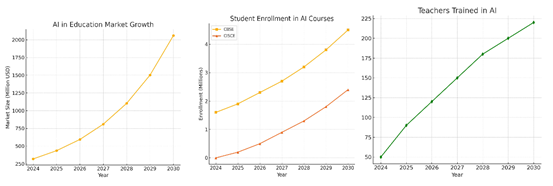
Global education ecosystems are being rapidly transformed by artificial intelligence (AI), and India is no exception. India, which has a population of over 1.4 billion and one of the most intricate educational systems in the world, stands to gain a great deal from the thoughtful application of AI in administration, education, and learning. This essay summarizes recent developments and empirical studies on artificial intelligence (AI) in Indian education, focusing on curriculum development, inclusive learning, virtual classrooms, administrative effectiveness, and individualized learning. The paper examines how AI-powered technologies such as adaptive platforms, speech recognition, AI tutors, and real-time analytics are changing Indian classrooms using national statistics, recent case studies, and international literature. In addition, the study identifies the infrastructure and ethical issues that are specific to India and provides practical policy suggestions that complement NITI Aayog's AI strategy and NEP 2020. For researchers, educators, and policymakers, visual data provides strong insights that bolster important conclusions.
Downloads
References
Bardia, A., & Agrawal, A. (2025). MindCraft: Revolutionizing education through AI-powered personalized learning. arXiv. https://doi.org/10.48550/arXiv.2502.05826
Dwivedi, Y. K., Hughes, L., Coombs, C., Constantiou, I., Duan, Y., Edwards, J. S., ... & Wade, M. R. (2021). Artificial intelligence (AI): Multidisciplinary perspectives on emerging challenges, opportunities, and agenda for research, practice and policy. International Journal of Information Management, 57, 101994. https://doi.org/10.1016/j.ijinfomgt.2019.08.002
Education Times. (2024). Over 40% of Indian teachers are concerned about AI. https://educationtimes.com
EdTechReview. (2023). AI trends in Indian education sector. https://edtechreview.in/
Frontline. (2023). Is generative AI the answer for Indian schools?. https://frontline.thehindu.com
Government of Andhra Pradesh. (2024). School education AI pilot report. Department of Education.
Government of Karnataka. (2023). AI in government schools. Bengaluru.
Grand View Research. (2024). India AI in education market outlook. https://grandviewresearch.com
Maheshwari, A., & Mangal, V. (2024). Regional NLP for inclusive learning. Indian Journal of Educational Technology, 18(1), 19–32.
Ministry of Education. (2023). Annual report on digital learning. Government of India.
NITI Aayog. (2022). AI for All. https://niti.gov.in
Sangwan, S., Verma, N., & Yadav, R. (2023). Predictive learning analytics. Education and AI Journal, 4(3), 83–94.
Sharma, R., & Tiwari, P. (2023). AI in Indian classrooms. Journal of EdTech and Learning Analytics, 6(2), 44–58.
TeamLease EdTech. (2024). AI usage among Indian educators. https://fortuneindia.com
Times of India. (2024). 8 lakh CBSE students enrolled in AI. https://timesofindia.indiatimes.com
Tracxn. (2023). Top AI EdTech startups. https://tracxn.com
Zawacki-Richter, O., Marín, V. I., Bond, M., & Gouverneur, F. (2019). Systematic review of research on artificial intelligence applications in higher education – where are the educators? International Journal of Educational Technology in Higher Education, 16(1), 1–27. https://doi.org/10.1186/s41239-019-0171-0
https://www.ey.com/en_in/insights/education/how-ai-is-activatingstep-changes-in-indian-education
Published
How to Cite
Issue
Section
License
Copyright (c) 2025 Meghna Bhatia

This work is licensed under a Creative Commons Attribution 4.0 International License.
Research Articles in 'International Journal of Engineering and Management Research' are Open Access articles published under the Creative Commons CC BY License Creative Commons Attribution 4.0 International License http://creativecommons.org/licenses/by/4.0/. This license allows you to share – copy and redistribute the material in any medium or format. Adapt – remix, transform, and build upon the material for any purpose, even commercially.