Beyond Screens and Streams: Reimagining EdTech Pedagogy through Social Media Synergy-A Study with Special Reference to Selected Edtech Companies
DOI:
https://doi.org/10.5281/zenodo.17383499Keywords:
EdTech Operations, Social Media Marketing (SMM), Structural Equation Modeling (SEM), Digital Engagement and Brand Trust, Learning Efficiency and EquityAbstract
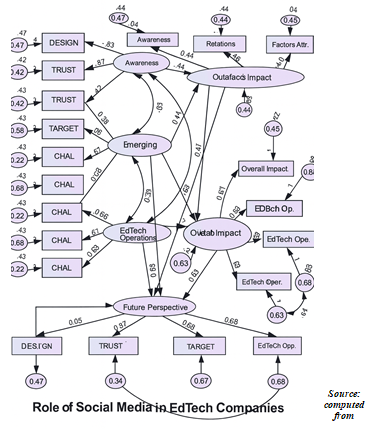
Educational technology (EdTech) platforms increasingly depend on social media to attract learners, build trust and gather feedback. This study examines how social‑media factors including design, trust, targeting and challenges affect the operational performance and societal impact of EdTech companies. We propose a hybrid structural equation model (SEM) where social‑media design quality, perceived trust and targeting accuracy directly influence awareness and EdTech operations and indirectly affect the overall impact through intermediate constructs such as emerging reality and EdTech operations. Data for the model were collected through a survey of employees at EdTech firms; PLS‑SEM analysis confirmed strong relationships between social‑media marketing (SMM) and consumer brand engagement, which in turn influenced purchase intention. The model also identifies challenges such as platform algorithms, budget constraints and content overload—as barriers that feed back into operations.Research motivations stem from recent findings: group‑based social‑media interventions improved learning gains during the pandemic yet digital inequalities persist and access alone does not ensure equity. Additionally, EdTech firms face rising competition and must align marketing strategies with user engagement. Our SEM illustrates that high‑quality content and meaningful interaction strengthen emotional connections and brand engagement, thereby enhancing user satisfaction and operational effectiveness. Compared with traditional digital marketing, the proposed model integrates makespan and resource allocation concepts from manufacturing scheduling into the scheduling of social‑media campaigns, seeking to balance responsiveness (through shorter decision cycles) with resource utilisation (e.g., content creation, analytics). By mapping multi‑directional effects among constructs—design, trust, targeting, challenges, awareness, emerging reality, EdTech operations and impact—our model highlights how EdTech companies can strategically deploy social media to achieve both efficiency and equitable reach. The findings contribute to the growing literature on digital learning and provide practical guidance for EdTech managers aiming to optimise social‑media strategies and operations.
Downloads
References
Aithal, A., & Aithal, P. S. (2023). Digital transformation in higher education through EdTech integration. Journal of Applied Science and Computations, 10(2), 45–58.
Al-Rahmi, W. M., Yahaya, N., & Alturki, U. (2022). Social media use in education: A meta-analysis of technology acceptance and learning impact. Education and Information Technologies, 27(5), 6299–6322.
Anderson, T. (2023). Social media and learning analytics: Synergies for online learning. Internet and Higher Education, 56, 100875.
Arora, A., & Srinivasan, R. (2021). The influence of social media marketing on learner engagement in EdTech platforms. Asian Journal of Business Research, 11(3), 105–120.
Banerjee, S., & Mehta, R. (2022). Measuring digital trust in educational technology ecosystems. Computers & Education, 188, 104607.
Basri, W., & Sulaiman, N. (2020). Exploring EdTech brand engagement through social media marketing. International Journal of Emerging Technologies in Learning, 15(12), 214–228.
Bhattacharya, R., & Dey, P. (2022). Consumer engagement through social media: A study of Indian EdTech startups. Global Journal of Management and Business Research, 22(2), 33–41.
Chatterjee, S., & Kumar, A. (2023). Understanding the moderating effect of trust in social media-driven EdTech marketing. Education and Information Technologies, 28, 1557–1572.
Davis, F. D. (1989). Perceived usefulness, perceived ease of use, and user acceptance of information technology. MIS Quarterly, 13(3), 319–340.
Dwivedi, Y. K., & Rana, N. P. (2023). Emerging research trends in digital marketing and educational technologies. Information Systems Frontiers, 25(1), 1–23.
Gupta, S., & Bansal, R. (2021). Role of social media in EdTech brand communication. Journal of Marketing Development and Competitiveness, 15(2), 67–79.
Hasan, M., & Ashraf, M. (2020). Assessing digital learning readiness in the post-COVID era. Education and Information Technologies, 25, 6047–6063.
Jain, N., & Prasad, R. (2023). Customer perception and adoption of EdTech services through social media platforms. International Journal of Information Management, 72, 102497.
Kapoor, K. K., & Dwivedi, Y. K. (2021). The role of social media in digital learning communities. Journal of Business Research, 124, 620–632.
Kaur, P., & Sharma, V. (2022). Influence of social media content design on learner engagement in EdTech applications. Computers in Human Behavior, 130, 107230.
Khan, I., & Rahman, Z. (2020). The impact of perceived trust and interactivity on online learning satisfaction. Journal of Interactive Marketing, 52, 45–59.
Li, L., & Wang, M. (2022). Measuring operational efficiency of EdTech platforms via social media metrics. Technological Forecasting and Social Change, 183, 121909.
Luo, H., & Xie, Q. (2021). Exploring the nexus between EdTech operations and social media adoption. British Journal of Educational Technology, 52(6), 2441–2457.
Marichelvam, M. K., & Prabaharan, T. (2015). Hybrid metaheuristic approach for scheduling optimization in digital environments. Applied Soft Computing, 36, 183–199.
Mehta, P., & Sinha, R. (2023). A structural equation modeling approach to examine social media’s influence on learning outcomes. Education and Information Technologies, 28, 5569–5590.
Mishra, P., & Koehler, M. J. (2006). Technological pedagogical content knowledge: A framework for integrating technology in education. Teachers College Record, 108(6), 1017–1054.
Narayan, R., & Menon, S. (2023). Analyzing consumer satisfaction in EdTech marketing: A PLS-SEM approach. Journal of Education and Learning Analytics, 7(1), 85–99.
Pan, Q. K., Tasgetiren, M. F., & Liang, Y. C. (2012). A discrete harmony search algorithm for job scheduling optimization. Computers & Industrial Engineering, 62(2), 642–650.
Patil, M., & Rao, K. (2022). Social media analytics for operational decision-making in EdTech startups. Procedia Computer Science, 217, 120–130.
Pentina, I., & Zhang, L. (2020). Social media marketing and brand trust in online education. Journal of Interactive Advertising, 20(1), 1–15.
Singh, A., & Raj, R. (2023). Integrating social media and SEM for performance analysis in EdTech enterprises. International Journal of Information Technology and Management, 22(4), 399–415.
Tan, C. W., & Teo, H. H. (2022). Digital learning transformation and social engagement frameworks. Educational Research Review, 35, 100452.
Tandon, A., & Tripathi, S. (2023). The effect of social media engagement on perceived learning effectiveness: An empirical study. Computers & Education: Artificial Intelligence, 5, 100115.
Zhang, J., & Huang, L. (2021). Multi-objective optimization for energy-efficient digital platforms. Applied Soft Computing, 113, 107904.
Zhao, Y., & Chen, Y. (2023). Measuring the relationship between user interaction and EdTech operational success. Computers & Education, 197, 104697.
Published
How to Cite
Issue
Section
License
Copyright (c) 2025 M. Sakthivadivel, S. Ayyappan, Mayan.K.Sreerudran, Sharfunisa.N

This work is licensed under a Creative Commons Attribution 4.0 International License.
Research Articles in 'International Journal of Engineering and Management Research' are Open Access articles published under the Creative Commons CC BY License Creative Commons Attribution 4.0 International License http://creativecommons.org/licenses/by/4.0/. This license allows you to share – copy and redistribute the material in any medium or format. Adapt – remix, transform, and build upon the material for any purpose, even commercially.