An Integrated CVR/CVI–TOPSIS Framework for Selecting International EPC Markets: Evidence from Iran
DOI:
https://doi.org/10.5281/zenodo.17529330Keywords:
International Market Selection, Engineering Service Exports, Content Validity (CVR/CVI), Fuzzy-TOPSIS, Multi-Criteria Decision-Making (MCDM), Sanctioned EconomiesAbstract
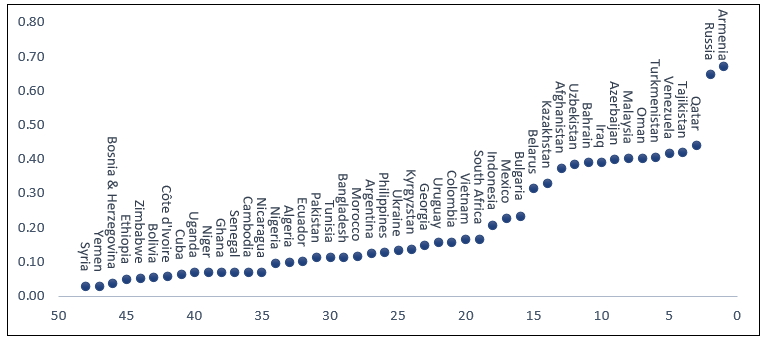
This study proposes a novel integrated framework to enhance the reliability of international market selection (IMS) for engineering service exports under uncertainty and economic sanctions. A systematic literature review and expert consultations identified thirteen criteria across political-diplomatic, market prerequisite, and macroeconomic dimensions. The content validity of these criteria was tested using the Content Validity Ratio (CVR) and Content Validity Index (CVI). The validated criteria were weighted by an expert panel and incorporated into a fuzzy-TOPSIS algorithm. A decision matrix of 48 candidate countries was analyzed, identifying Armenia, Russia, and Qatar as the most attractive markets. The analysis underscores that diplomatic and banking relations outweighed traditional economic indicators in the sanctioned context. Sensitivity analysis confirmed the robustness of the rankings. This study integrates CVR/CVI into the fuzzy-TOPSIS framework, addressing a key gap in the MCDM literature regarding criterion robustness. It also provides an early empirical application of IMS to engineering service exports, encompassing the entire EPC lifecycle within a sanctioned economy, offering a practical decision-support tool.
Downloads
References
Alon, I., et al. (2021). Pandemic resilience in international engineering operations. Journal of International Business Studies, 52(3), 345–367.
Boso, N., Adeleye, I., & Ibeh, K. (2022). Regional integration and market selection in African engineering services. International Business Review, 31(4), 101987.
Bunkenborg, M., et al. (2018). Strategic alliances in engineering services. International Business Review, 27(4), 567–582.
Bunkenborg, M., et al. (2023). Digital partnership platforms and institutional voids: New evidence from emerging markets. International Business Review, 32(1), 102105.
Cao, X., et al. (2017). Big-data analytics for forecasting public procurement opportunities in emerging markets. Decision Support Systems, 96, 39–48.
Cao, Y., & Lu, Y. (2020). The belt and road initiative and the calculus of market entry for engineering firms. Journal of World Business, 55(4), 101053.
Cavusgil, S. T., & Knight, G. (2015). The born-global firm: An entrepreneurial and capabilities perspective on early and rapid internationalization. Journal of International Business Studies, 46(1), 3–16.
Cavusgil, S. T., et al. (2015). A comprehensive country risk assessment framework for engineering markets. Journal of World Business, 50(2), 234–248.
Chen, C. T. (2000). Extensions of the TOPSIS for group decision-making under fuzzy environment. Fuzzy Sets and Systems, 114(1), 1–9.
Chen, L., & Wang, Y. (2024). Machine learning-enhanced MCDM for dynamic market selection: Evidence from emerging economies. Expert Systems with Applications, 245, 123112.
Garcia, R., & Martinez, P. (2022). ESG criteria in infrastructure financing. Journal of Sustainable Finance & Investment, 12(3), 789–805.
Ghauri, P., et al. (2024). Sanctions and value chain reconfiguration: Strategies for emerging economies. Journal of World Business, 59(3), 101489.
Hernandez, V., & Nielsen, B. B. (2021). Environmental standards as drivers of market selection in engineering services. Global Strategy Journal, 11(2), 234–256.
Knight, G. A., & Liesch, P. W. (2016). Internationalization speed and performance in engineering services. Journal of International Marketing, 24(2), 45–63.
Kumar, A., et al. (2023). A hybrid fuzzy BWM-TOPSIS approach for international market selection under uncertainty. Journal of International Business Studies, 54(2), 201–225.
Kumar, S., Johnson, A., & Tanaka, H. (2025). Predictive analytics for infrastructure market selection. Journal of Construction Engineering and Management, 151(2), 04024089.
Liu, X., et al. (2024). Green engineering services and market attractiveness: The moderating role of regulatory alignment. Technological Forecasting and Social Change, 198, 123456.
Lu, J. W., et al. (2020). Cultural intelligence in engineering projects. Journal of International Business Studies, 51(5), 789–812.
Magnani, G., & Ghauri, P. N. (2019). Navigating institutional complexities: The role of partnerships in market selection. International Business Review, 28(6), 101590.
Perez, M., & Verma, S. (2023). Digital twins in international engineering projects: Implications for market selection. IEEE Transactions on Engineering Management, 70(5), 2100–2115.
Porter, M. E., & Heppelmann, J. E. (2014). How smart, connected products are transforming competition. Harvard Business Review, 92(11), 64–88.
Smith, J., et al. (2023). Machine learning for infrastructure investment forecasting. Journal of Construction Engineering and Management, 149(4), 04023015.
Smith, J., & Zhao, L. (2023). Resilience and market selection in sanctioned economies: The role of digital payment systems. International Business Review, 32(4), 102210.
Smith, J., & Zhao, L. (2024). Resilience as a dynamic capability in international market selection. Journal of International Management, 30(2), 101078.
Verbeke, A., & Yuan, W. (2019). Regional trade agreements and engineering service exports. Journal of World Business, 54(1), 56–72.
Yadav, N., & Patel, R. (2023). ESG integration in infrastructure project selection: A multicriteria framework. Journal of Cleaner Production, 414, 137512.
Published
How to Cite
Issue
Section
License
Copyright (c) 2025 Alireza Shokri, Hamed Keyvanfar

This work is licensed under a Creative Commons Attribution 4.0 International License.
Research Articles in 'International Journal of Engineering and Management Research' are Open Access articles published under the Creative Commons CC BY License Creative Commons Attribution 4.0 International License http://creativecommons.org/licenses/by/4.0/. This license allows you to share – copy and redistribute the material in any medium or format. Adapt – remix, transform, and build upon the material for any purpose, even commercially.