Global Trend Analysis and Forecasting Model Construction of Mineral Resource Markets
DOI:
https://doi.org/10.5281/zenodo.17627480Keywords:
Strategic Mineral Market, Trend Analysis, Demand Forecasting, Econometrics, Machine Learning (ML), Green Technology ImpactAbstract
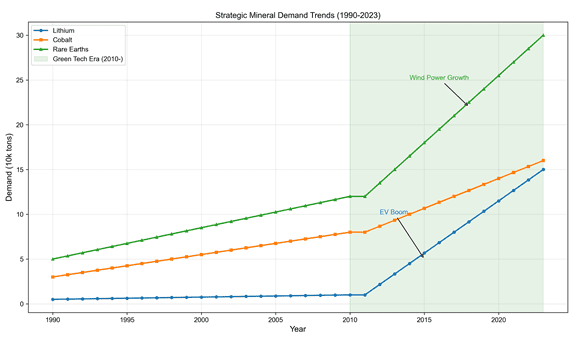
Global economic expansion and technological innovation have driven sustained growth in demand for mineral resources, making accurate analysis and forecasting of their market trends a core need for policymakers, investors, and industry practitioners. This study focuses exclusively on strategic minerals (lithium, cobalt, rare earths)—core raw materials for green technologies such as electric vehicle batteries and wind power equipment—and proposes a specialized forecasting model integrating econometrics and machine learning to provide targeted decision support for stakeholders.
First, based on 1990–2023 specialized data from authoritative institutions (World Bank, IMF, USGS, IEA), including production, consumption, trade, prices of strategic minerals, and green technology indicators (e.g., electric vehicle sales, wind power installed capacity), this study uses econometric methods to systematically analyze consumption patterns and trade characteristics of the three minerals. Second, key empirical findings are embedded into a machine learning framework, integrating three core factors—green technology penetration, resource-country geopolitical policies, and macroeconomic indicators (U.S. dollar index, global GDP)—to optimize short-term (1–3 years) and long-term (5–10 years) forecasting accuracy.
The model clarifies quantitative impacts of green technologies on demand (e.g., a 10% increase in electric vehicle penetration drives a 15%±2% growth in lithium demand). Two scenarios—"EU carbon tariff adjustment" and "Congo (Kinshasa) cobalt supply disruption"—are designed, combined with historical cases (2022 cobalt mine ban in Congo, 2021 China rare earth export quota adjustment) to quantify market resilience. Finally, a risk assessment tool for strategic minerals is developed, providing scientific and practical references for global mineral resource management and investment decisions.
Downloads
References
Mendelsohn, R. S. (2013). Trend forecasting with intermarket analysis: Predicting global markets with technical analysis. Hoboken: John Wiley & Sons.
Cao, W., Zhu, W., & Demazeau, Y. (2019). Multi-layer coupled hidden markov model for cross-market behavior analysis and trend forecasting. IEEE Access, 7, 165423–165432.
IEA. (2021). The role of critical minerals in clean energy transitions. Paris: International Energy Agency.
USGS. (2023). Mineral commodity summaries 2023. Reston: U.S. Geological Survey.
Slade, M. E. (1982). Trends in natural resource commodity prices: A review of the literature and some new evidence. Resources Policy, 8(4), 289–304.
Murphy, J. (1999). Technical analysis of the financial markets: A comprehensive guide to trading methods and applications. New York: New York Institute of Finance.
European Commission. (2023). Impact assessment report on the critical raw materials act (CBAM). Brussels: European Commission.
China Association of Automobile Manufacturers. (2023). 2023 development report on China's electric vehicle industry. Beijing: CAAM.
Global Wind Energy Council. (2023). 2023 global wind power development report. Brussels: GWEC.
Ministry of Mining, Democratic Republic of the Congo. (2023). 2023 white paper on cobalt mining policy. Kinshasa: Ministry of Mining.
Ministry of Mining, Chile. (2023). Implementation rules for the lithium mine nationalization act. Santiago: Ministry of Mining.
Published
How to Cite
Issue
Section
License
Copyright (c) 2025 Wang Qiu, Ahmed Razman Abdul Latiff

This work is licensed under a Creative Commons Attribution 4.0 International License.
Research Articles in 'International Journal of Engineering and Management Research' are Open Access articles published under the Creative Commons CC BY License Creative Commons Attribution 4.0 International License http://creativecommons.org/licenses/by/4.0/. This license allows you to share – copy and redistribute the material in any medium or format. Adapt – remix, transform, and build upon the material for any purpose, even commercially.