Estimation of Delay in Prefabricated Projects Using Modern Machine Learning Approaches (Case Study: Baghdad)
DOI:
https://doi.org/10.5281/zenodo.18013341Keywords:
Estimation, Delay, Project, Prefabricated, Utilization, New Approaches, Machine Learning, BaghdadAbstract
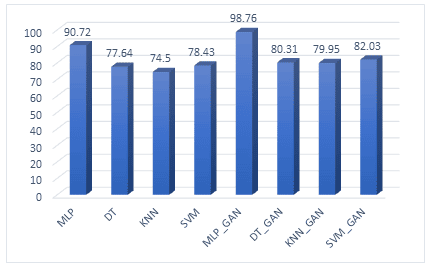
We analyzed the prior literature on estimating delays in project time in the presentation section, and we found that data uncertainty could be minimized using generative adversarial network (GAN) to augment our dataset, which uses data to produce findings that mimicked actual world circumstances. We organized the findings accordingly. In the initial finding, we utilized four (4) algorithms on a dataset of twenty-one features containing 284,807 transactions i.e. multilayer perceptron (MLP) neural network, support vector machine (SVM), decision tree, and k-nearest neighbor (KNN). The findings established that MLP neural network produced the largest accuracy value of (90.72%), followed with SVM (78.43%), Decision Tree (77.64%), and KNN (74.5%).
Next, the GAN was used to augment the dataset to a total of 400,00 transactions, allowing the augmented dataset to result in a number of delay samples of 609. The four (4) algorithms were subsequently re-evaluated with the expanded dataset to classify and identify project delays in the dataset. The results indicated that augmentation using GAN enhanced the accuracy of the models overall. From the first process, using the MLP neural network reached an accuracy of 98.76% and SVM was 82.03%, decision tree was 80.31% and KNN was 79.95%.
Downloads
References
Agyekum-Mensah, G., & Knight, A. D. (2017). The professionals’ perspective on the causes of project delay in the construction industry. Engineering, Construction and Architectural Management, 24(5), 828–841.
Arantes, B. F., De Oliveira Mendonça, L., Palma-Dibb, R. G., Faraoni, J. J., De Castro, D. T., Geraldo-Martins, V. R., & Lepri, C. P. (2019). Influence of Er,Cr:YSGG laser, associated or not to desensitizing agents, in the prevention of acid erosion in bovine root dentin. Lasers in Medical Science, 34(5), 893–900. https://doi.org/10.1007/s10103-018-2669-4
Creswell, A., White, T., Dumoulin, V., Arulkumaran, K., Sengupta, B., & Bharath, A. A. (2018). Generative adversarial networks: An overview. IEEE Signal Processing Magazine, 35(1), 53–65.
Fleischman, R. B., & Seeber, K. (2016). New construction for resilient cities: The argument for sustainable low damage precast/prestressed concrete building structures in the 21st century. Scientia Iranica, 23(4), 1578–1593. https://doi.org/10.24200/sci.2016.2230
Hastie, T., Tibshirani, R., & Friedman, J. (2009). The elements of statistical learning. Springer Series in Statistics. https://www.academia.edu/download/31156736/10.1.1.158.8831.pdf
Jakkula, V. (n.d.). Tutorial on Support Vector Machine (SVM).
Kim, K. G. (2016). Book review: Deep learning. Healthcare Informatics Research, 22(4), 351. https://doi.org/10.4258/hir.2016.22.4.351
Lee, C., Hasegawa, H., & Gao, S. (2022). Complex-valued neural networks: A comprehensive survey. IEEE/CAA Journal of Automatica Sinica, 9(8), 1406–1426. https://doi.org/10.1109/JAS.2022.105743
Liu, J., & Lu, M. (2019). Robust dual-level optimization framework for resource-constrained multiproject scheduling for a prefabrication facility in construction. Journal of Computing in Civil Engineering, 33(2), 04018067. https://doi.org/10.1061/(ASCE)CP.1943-5487.0000816
Mensah, I., Nani, G., & Adjei-Kumi, T. (2016). Development of a model for estimating the duration of bridge construction projects in Ghana. International Journal of Construction Engineering and Management, 5(2), 55–64.
Mitchell, T. M. (1999). Machine learning and data mining. Communications of the ACM, 42(11), 30–36. https://doi.org/10.1145/319382.319388
Mohammadipour, F., & Sadjadi, S. J. (2016). Project cost–quality–risk tradeoff analysis in a time-constrained problem. Computers & Industrial Engineering, 95, 111–121.
Quaranta, L., Calefato, F., & Lanubile, F. (2021). KGTorrent: A dataset of Python jupyter notebooks from Kaggle. IEEE/ACM 18th International Conference on Mining Software Repositories (MSR), pp. 550–554. https://doi.org/10.1109/MSR52588.2021.00072
Ramadhan, I., Sukarno, P., & Nugroho, M. A. (2020). Comparative analysis of K-nearest neighbor and decision tree in detecting distributed denial of service. 8th International Conference on Information and Communication Technology (ICoICT), pp. 1–4. https://doi.org/10.1109/ICoICT49345.2020.9166380
Samanataray, S., & Sahoo, A. (2021). A comparative study on prediction of monthly streamflow using hybrid ANFIS-PSO approaches. KSCE Journal of Civil Engineering, 25(10), 4032–4043. https://doi.org/10.1007/s12205-021-2223-y
Shash, A. A., & Musabih, A. J. (n.d.). Delays in commercial buildings and their impact on stakeholders. Retrieved September 20, 2025, from http://irjaes.com/wp-content/uploads/2022/10/IRJAES-V7N4P70Y22.pdf
Suk, S. J., Chi, S., Mulva, S. P., Caldas, C. H., & An, S.-H. (2017). Quantifying combination effects of project management practices on cost performance. KSCE Journal of Civil Engineering, 21(3), 603–615. https://doi.org/10.1007/s12205-016-0499-0
Yaseen, Z. M., Ali, Z. H., Salih, S. Q., & Al-Ansari, N. (2020). Prediction of risk delay in construction projects using a hybrid artificial intelligence model. Sustainability, 12(4), 1514.
Published
How to Cite
Issue
Section
License
Copyright (c) 2025 Hayder M. Mansoor, Ruqaya A. Muter, Ali Ahmed Mutar, Zahraa Emad Fadel

This work is licensed under a Creative Commons Attribution 4.0 International License.
Research Articles in 'International Journal of Engineering and Management Research' are Open Access articles published under the Creative Commons CC BY License Creative Commons Attribution 4.0 International License http://creativecommons.org/licenses/by/4.0/. This license allows you to share – copy and redistribute the material in any medium or format. Adapt – remix, transform, and build upon the material for any purpose, even commercially.