A Study on the Role of Fintech Adoption on Employee Engagement in NBFCs: Challenges and Opportunities
DOI:
https://doi.org/10.5281/zenodo.18029458Keywords:
Fintech Adoption, Employee Engagement, Non-Banking Financial Companies (NBFCs), Digital TransformationAbstract
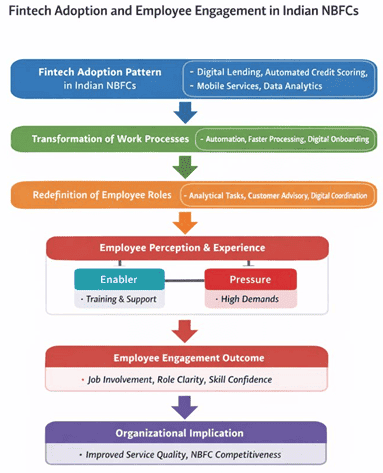
In the Indian financial services industry, fintech has become a disruptive force, with non-banking financial companies depending more and more on digital technologies to improve productivity, reach, and competitiveness. This study looks at how fintech adoption affects employee engagement in Indian NBFCs, focusing on adoption trends, implementation difficulties, and engagement-related prospects. The study, which employs a conceptual and descriptive research approach, is founded on a methodical thematic examination of pertinent secondary literature on employee engagement, fintech, and digital transformation. The results show that the adoption of fintech alters work procedures and employee responsibilities, which in turn affects engagement through modifications to job descriptions, skill requirements, and work experiences. While fintech provides chances for job enrichment, learning, and enhanced performance, it also introduces new issues such as uneven digital preparation, technostress, and aversion to change. The study found that fintech improves employee engagement when combined with excellent training, communication, and human-centered change management. The report concludes by underlining the need of NBFCs aligning technological initiatives with staff development, as well as proposing further empirical research to investigate employee-centric outcomes of fintech adoption across varied organizational contexts.
Downloads
References
Akansha, A., Anupam, D., & Deep, A. (2025). The role of fintech in disrupting traditional banking systems: Opportunities and challenges. International Journal of Environmental Sciences, Special Issue, pp. 3636–3645. https://doi.org/10.64252/8tvypf36
Albuainain, A., & Ashby, S. (2025). Enablers and barriers in FinTech adoption: A systematic literature review of customer adoption and its impact on bank performance. FinTech, 4(3), 49. https://doi.org/10.3390/fintech4030049
Annisa, S., Siahaan, E., & Lumbanraja, P. (2024). Impact of digital transformation on banking employee performance with self-efficacy as a mediator. Problems and Perspectives in Management, 22(4), 523–531. http://dx.doi.org/10.21511/ppm.22(4).2024.39
Asiwe, D., Rothmann, S., Jorgensen, L., & Hill, C. (2017). Engagement of employees in a research organisation: A relational perspective. South African Journal of Economic and Management Sciences, 20(1). https://doi.org/10.4102/SAJEMS.V20I1.1534
Azam, Q. S., Siddiqui, M. Z., & Yosufzai, S. (2023). Financial technology adoption and organizational competitive performance: Mediating role of employee engagement. Journal of Social Research Development, 4(4), 729–737. https://doi.org/10.53664/JSRD/04-04-2023-07-729-737
Bhutto, S. A., Jamal, Y., & Ullah, S. (2023). FinTech adoption, HR competency potential, service innovation and firm growth in banking sector. Heliyon, 9(2), e13967.
https://doi.org/10.1016/j.heliyon.2023.e13967
Bondarouk, T., & Brewster, C. (2016). Conceptualising the future of HRM and technology research. The International Journal of Human Resource Management, 27(21), 2652–2671. https://doi.org/10.1080/09585192.2016.1232296
Dwivedi, P., Alabdooli, J. I., & Dwivedi, R. (2021). Role of FinTech adoption for competitiveness and performance of the bank: A study of banking industry in UAE. International Journal of Global Business and Competitiveness, 16, 130–138. https://doi.org/10.1007/s42943-021-00033-9
Gomber, P., Koch, J.-A., & Siering, M. (2017). Digital finance and FinTech: Current research and future research directions. Journal of Business Economics, 87(5), 537–580. https://doi.org/10.1007/s11573-017-0852-x
Harini, S., Prabhakaran, J., & Viji, R. (2024). Growth of fintech and its effect on bank employee job satisfaction. Library Progress International, 44(3), 5281–5299. https://doi.org/10.48165/bapas.2024.44.2.1
Jha, A. K. (2025). Manuscript writing on digital transformation in NBFC loan applications: An examination of effects on financial inclusion in India. Cuest, Fisoter, 54(2), 3502–3511.
Khan, H. U., Abbas, M., Nazir, S., Khan, F., & Moon, Y.-k. (2025). The intersection of finTech adoption, HR competency potential, service innovation, and firm growth in the banking sectors using Entropy and TOPSIS. PLOS ONE, 20(1), e0313210. https://doi.org/10.1371/journal.pone.0313210
Lee, I., & Shin, Y. J. (2018). Fintech: Ecosystem, business models, investment decisions, and challenges. Business Horizons, 61(1), 35–46. https://doi.org/10.1016/j.bushor.2017.09.003
Lioliou, E., Zimmermann, A., Willcocks, L., & Gao, L. (2014). Formal and relational governance in IT outsourcing: Substitution, complementarity and the role of the psychological contract. Information Systems Journal, 24(6), 503–535. https://doi.org/10.1111/isj.12038
Miriyam, V., & Lavakumar, E. (2025). A study on the role of fintech in the banking sector in India: Opportunities and challenges. IOSR Journal of Business and Management, Conference Issue, pp. 14–17. https://doi.org/10.9790/487X-conf1417
Montero-Guerra, J. M., Danvila-del-Valle, I., & Méndez-Suárez, M. (2023). The impact of digital transformation on talent management. Technological Forecasting and Social Change, 188, 122291. https://doi.org/10.1016/j.techfore.2022.122291
Murinde, V., Rizopoulos, E., & Zachariadis, M. (2022). The impact of the FinTech revolution on the future of banking: Opportunities and risks. International Review of Financial Analysis, 81, 102103. https://doi.org/10.1016/j.irfa.2022.102103
Pires da Silva, F., Mosquera, P., & Soares, M. E. (2022). Factors influencing knowledge sharing among IT geographically dispersed teams. Technological Forecasting and Social Change, 174, 121299. https://doi.org/10.1016/j.techfore.2021.121299
Ragu-Nathan, T. S., Tarafdar, M., Ragu-Nathan, B. S., & Tu, Q. (2008). The consequences of technostress for end users in organizations: Conceptual development and empirical validation. Information Systems Research, 19(4), 417–433. https://doi.org/10.1287/isre.1070.0165
Rameshkumar, M. (2020). Employee engagement as an antecedent of organizational commitment – A study on Indian seafaring officers. Asian Journal of Shipping and Logistics, 36(3), 105–112. https://doi.org/10.1016/j.ajsl.2019.11.003
Riaz, N., Riaz, A., Tariq, R., & Talha, M. (2023). The nexus between fintech adoption and bank performance: The role of competitiveness. Pakistan Journal of Humanities and Social Sciences, 11(4), 668–676. https://doi.org/10.52131/pjhss.2023.1104.0668
Saks, A. M. (2006). Antecedents and consequences of employee engagement. Journal of Managerial Psychology, 21(7), 600–619. https://doi.org/10.1108/02683940610690169
Sandhyadevi, J., & Sreepal, V. (2020). Fintech adoption in non-banking sector: A Technology Acceptance Model perspective. International Journal of Recent Technology and Engineering, 9(1). https://doi.org/10.35940/ijrte.A1904.059120
Sarbhai, A., & Khare, V. (2023). Prospects and challenges: FinTech and big data in the Indian finance industry. International Journal of Novel Research and Development, 8(12), 155–164.
Sarkar, M., Gupta, D., Daash, D., Naveen, D., & Samantaray, D. (2025). A study on the impact of digitalization on employee well-being and sustainable HR practices: Benefits and challenges in the digital era. Lex Localis – Journal of Local Self-Government, 23, 6006–6034. https://doi.org/10.52152/ebs4fp53
Thakor, A. V. (2020). Fintech and banking: What do we know?. Journal of Financial Intermediation, 41, 100833. https://doi.org/10.1016/j.jfi.2019.100833
Thepdawala, M. M. (2025). Impact of fintech adoption on corporate financial structure and performance: A cross-country study of NBFCs. Sustainable Business and Society in Emerging Economies, 7(2), 263–274. https://doi.org/10.26710/sbsee.v7i2.3381
Thileepan, J., & Raveendran, T. (2022). Impact of digital transformation on employee engagement at Ceylon Electricity Board in the Northern Province of Sri Lanka. Journal of Management Matters, 9(1), 53–81. https://doi.org/10.4038/jmm.v9i1.32
Verhoef, P. C., Broekhuizen, T., Bart, Y., Bhattacharya, A., Dong, J. Q., Fabian, N., & Haenlein, M. (2021). Digital transformation: A multidisciplinary reflection and research agenda. Journal of Business Research, 122, 889–901. https://doi.org/10.1016/j.jbusres.2019.09.022
Vives, X. (2019). Digital disruption in banking. Annual Review of Financial Economics, 11, 243–272. https://doi.org/10.1146/annurev-financial-100719-120854
Yadav, S. (2025). The rise of digital credit: An analysis of fintech NBFCs in India’s personal credit market. International Research Journal of Modernization in Engineering, Technology and Science, 7(1), 1661–1672. https://doi.org/10.56726/IRJMETS72100
Yomboi, J., Abubakari, A.-R., Mohammed, M., & Alhassan, N. (2025). The theoretical perspective of the adoption of fintech in the financial services industry. In: The theoretical perspective of the adoption of fintech in the financial services industry. Bentham Science Publishers. https://doi.org/10.2174/9789815324907125010004
Published
How to Cite
Issue
Section
License
Copyright (c) 2025 Pooja Singh, Alok Singh

This work is licensed under a Creative Commons Attribution 4.0 International License.
Research Articles in 'International Journal of Engineering and Management Research' are Open Access articles published under the Creative Commons CC BY License Creative Commons Attribution 4.0 International License http://creativecommons.org/licenses/by/4.0/. This license allows you to share – copy and redistribute the material in any medium or format. Adapt – remix, transform, and build upon the material for any purpose, even commercially.