BMS For Self-Charging E-Vehicle
DOI:
https://doi.org/10.31033/15.6.2025.1829Keywords:
E-Vehicle, Battery, Pollution, EnvironmentAbstract
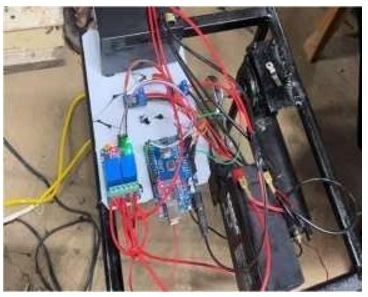
The growth of electric vehicles (EVs) has sparked creative methods for increasing battery life and improving energy efficiency. In this work, a Battery Management System (BMS) for self-charging electric vehicles (SCEVs) is presented. The suggested solution comprises of a BLDC or induction motor for propulsion attached to the back wheel while an alternator is attached to the front tire that produces power while the vehicle runs. A pole switch is used for smooth transitioning between the two battery packs A and B. This aims in providing continuous vehicle motion while the alternator's activity charges the battery attached to the motor. The BMS is an essential part of this system since it not only stops overcharging but also uses active cell balancing technique during discharging and passive cell balancing technique during charging to maximize battery performance. This study demonstrates how well the suggested BMS works to extend the life SCEVs, providing a viable option for the development of EVs in the future.
Downloads
References
Al-otaibi, M. S. (2020). Self-charging electric cars. European Patent Office (EPO).
Farzan Moghaddam, A & Van den Bossche, A. (2018). A cell equalization method based on resonant switched capacitor balancing for Lithum ion batteries. Presented at the 9th International Conference on Mechanical and Aerospace Engineering (ICMAE), IEEE, pp. 337-341.
S. Narayanaswamy, et al. (2017). Modular active charge balancing for scalable battery packs. IEEE Transactions on Very Large-Scale Integration (VLSI) Systems, 25(3), 974- 987.
Ramkumar, M. S., Reddy, C., Ramakrishnan, A., Raja, K., Pushpa, S., Jose, S., & Jayakumar, M. (2022). Review on li-ion battery with battery management system in electrical vehicle. Advances in Materials Science and Engineering.
Gabbar, H.A., Othman, A.M, Abdussami, M.R. (1998). Review of battery management systems (BMS) development and industrial standards.
Namadmalan. (2016). Self-oscillating tuning loops for series resonant inductive power transfer systems. IEEE Trans. Power Electron., 31(10), 7320-7327.
Hannan M. A, Hoque M. M, Hussain A, Yusof Y, & Ker P. I. (2018). State-of-the-art and energy management system of lithium-ion batteries in electric vehicle applications: Issues and recommendations. IEEE Access, 6, 19362-19378.
K. Baghel, & P. Kumar. (2015). Scenario of electric and hybrid electric vehicles by 2030. IEEE Int. Transp. Electric. Conf. ITEC-India, pp. 1-5. DOI: 10.1109/ITEC-India.2015.7386914.
Tang, X. Zhang, B. Koch, & D. Frisch. (2008). Modeling and estimation of nickel metal hydride battery hysteresis for SOC estimation.
P. S. Tomar, M. Srivastava, & A. K. Verma. (2018). An efficient bi-directional DC/DC charger for electric vehicle battery charging. 2nd International Conference Energy, Power Environ. Towar, Smart Technology, pp. 1-9. DOI: 10.1109/EPETSG.2018.8658467.
Published
How to Cite
Issue
Section
License
Copyright (c) 2025 N.Nithya Rani ME, Nagammai S, Reshma M U, Pugazhenthi V

This work is licensed under a Creative Commons Attribution 4.0 International License.
Research Articles in 'International Journal of Engineering and Management Research' are Open Access articles published under the Creative Commons CC BY License Creative Commons Attribution 4.0 International License http://creativecommons.org/licenses/by/4.0/. This license allows you to share – copy and redistribute the material in any medium or format. Adapt – remix, transform, and build upon the material for any purpose, even commercially.