Exploring the Dynamics of Financial Inclusion in Enhancing Economic Empowerment among the Physically Disabled: An Empirical Investigation
DOI:
https://doi.org/10.31033/IJEMR/16.2.2026.1874Keywords:
Economic Empowerment, Financial Access, Financial Literacy, Financial Inclusion, DigitalAbstract
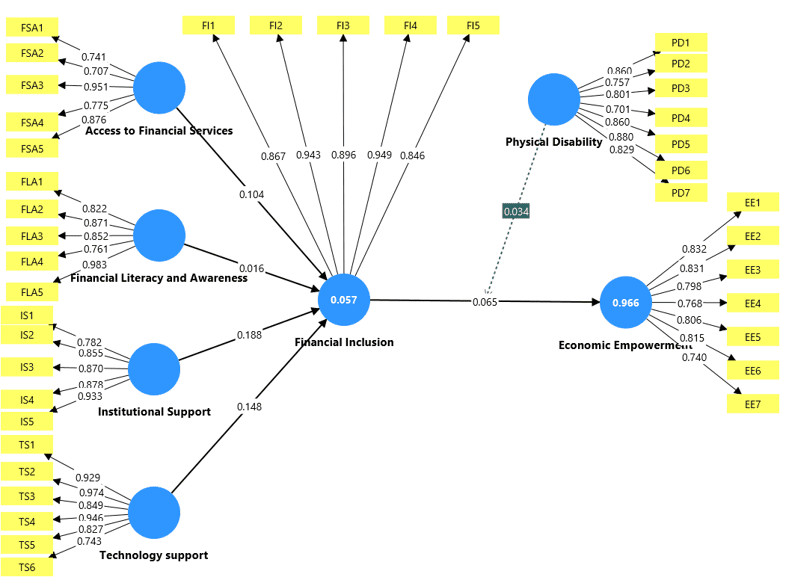
This study examines the critical role of financial inclusion in enhancing the economic empowerment of individuals with physical disabilities, a group often marginalized due to systemic barriers within financial ecosystems. While financial inclusion is widely recognized for advancing access to services and fostering socio-economic agency, the specific challenges faced by physically disabled individuals, such as mobility limitations, social stigma, inadequate policy support and inaccessible infrastructure remain underexplored in empirical research. Drawing on a survey of 519 respondents, the study reveals that access to financial services, institutional mechanisms and technology support are essential drivers of financial inclusion, while financial literacy alone does not significantly impact inclusion without corresponding infrastructural support. Structural model findings further confirm that financial inclusion positively influences economic empowerment and physical disability features of the person itself moderates the relationship between financial inclusion and economic empowerment, suggesting its potential as a transformative tool for reducing socio-economic disparities. The study advocates for comprehensive, inclusive policy interventions that integrate accessible service delivery, digital infrastructure and institutional reform alongside financial education to promote financial equity. The research findings enhance the discussion about inclusive development by demonstrating how specific financial approaches can reduce institutional barriers to enable physical disability empowerment.
Downloads
References
Ahsan, N., & Ahmed, M. (2023). Empowering communities: enhancing financial literacy and inclusion across Asia. In: Financial Inclusion Across Asia: Bringing Opportunities for Businesses, pp. 97-107. Emerald Publishing Limited.
Ajide, F. M. (2020). Financial inclusion in Africa: does it promote entrepreneurship?. Journal of Financial Economic Policy, 12(4), 687-706.
Akanfe, O., Bhatt, P., & Lawong, D. A. (2025). Technology advancements shaping the financial inclusion landscape: Present interventions, emergence of artificial intelligence and future directions. Information Systems Frontiers, 1-24.
Allen, F., Demirgüç-Kunt, A., Klapper, L., & Peria, M. S. M. (2016). The foundations of financial inclusion: Understanding ownership and use of formal accounts. Journal of Financial Intermediation, 27, 1–30.
Arun, S., Annim, S. K., & Arun, T. (2013). Overcoming household shocks: Do asset-accumulation strategies matter?. Review of Social Economy, 71(3), 281-305.
Beck, T., Demirgüç-Kunt, A., & Levine, R. (2007). Finance, inequality and the poor. Journal of Economic Growth, 12(1), 27–49.
Bhatia, S., & Dawar, G. (2024). The impact of financial inclusion on social and political empowerment: Mediating role of economic empowerment. Journal of the Knowledge Economy, 15(3), 13727–13744.
Bongomin, G. O. C., Munene, J. C., Ntayi, J. M., & Malinga, C. A. (2018). Analyzing the relationship between institutional framework and financial inclusion in rural Uganda: A social network perspective. International Journal of Emerging Markets, 13(4), 606–630.
Bongomin, G. O. C., Ntayi, J. M., & Munene, J. C. (2017). Institutional framing and financial inclusion: Testing the mediating effect of financial literacy using SEM bootstrap approach. International Journal of Social Economics, 44(12), 1727–1744.
Demirgüç-Kunt, A., Klapper, L., Singer, D., Ansar, S., & Hess, J. (2022). The Global Findex Database 2021: Financial Inclusion, Digital Payments, and Resilience in the Age of COVID-19. World Bank Publications.
Dos Santos, P. L., & Harvold Kvangraven, I. (2017). Better than cash, but beware the costs: electronic payments systems and financial inclusion in developing economies. Development and Change, 48(2), 205-227.
Eldomiaty, T., Hammam, R., & El Bakry, R. (2020). Institutional determinants of financial inclusion: Evidence from world economies. International Journal of Development Issues, 19(2), 217–228.
Gafoor, A., & Amilan, S. (2024). Fintech adoption and financial well-being of persons with disabilities: the mediating role of financial access, financial knowledge and financial behaviour. International Journal of Social Economics, 51(11), 1388–1401.
Grohmann, A., Klühs, T., & Menkhoff, L. (2018). Does financial literacy improve financial inclusion? Cross country evidence. World Development, 111, 84–96.
Gupta, V., & Suisse, C. (2014). Making microfinance accessible to persons with disabilities: awareness and attitudes among Indian microfinance institutions. Center for Financial Inclusion, Accion, USA.
Hair, J. F., Black, W. C., Babin, B. J., & Anderson, R. E. (2021). Multivariate data analysis. (8th ed.). Cengage Learning.
Hanafi, H. B., Abdullah, N. B., & Safu'an, M. N. A. B. (2025). Financial inclusion: Policies and challenges for people with disability in Malaysia. Austl. J. Asian L., 26, 55.
Hasan, R., Ashfaq, M., Parveen, T., & Gunardi, A. (2023). Financial inclusion–does digital financial literacy matter for women entrepreneurs?. International Journal of Social Economics, 50(8), 1085-1104.
Jiya, A. N., et al. (2022). Achieving financial inclusion for persons with disabilities: Exploring preparedness and accessibility in Malawi. Journal of Disability Policy Studies, 33(2), 92–102.
Kabeer, N. (1999). Resources, agency, achievements: Reflections on the measurement of women's empowerment. Development and Change, 30(3), 435–464.
Kadaba, D. M. K., Aithal, P. S., & KRS, S. (2023). Impact of Digital Financial Inclusion (DFI) initiatives on the self-help group: For sustainable development. International Journal of Management, Technology, and Social Sciences (IJMTS), 8(4), 20-39.
Khan, F., Siddiqui, M. A., & Imtiaz, S. (2022). Role of financial literacy in achieving financial inclusion: A review, synthesis and research agenda. Cogent Business & Management, 9(1), 2034236.
Lal, T. (2021). Impact of financial inclusion on economic development of marginalized communities through the mediation of social and economic empowerment. International Journal of Social Economics, 48(12), 1768-1793.
Lara-Rubio, J., et al. (2024). Analysing credit risk in persons with disabilities as an instrument of financial inclusion. Journal of Social and Economic Development, 1–23.
Lusardi, A., & Mitchell, O. S. (2014). The economic importance of financial literacy: Theory and evidence. American Economic Journal: Journal of Economic Literature, 52(1), 5-44.
Mitra, S., Posarac, A., & Vick, B. (2013). Disability and poverty in developing countries: A multidimensional study. World Development, 41, 1-18.
Ofoeda, I., Amoah, L., Anarfo, E. B., & Abor, J. Y. (2024). Financial inclusion and economic growth: What roles do institutions and financial regulation play? International Journal of Finance & Economics, 29(1), 832–848.
Ofori-Okyere, I., Edghiem, F., & Kumah, S. P. (2023). Marketing inclusive banking services to financially vulnerable consumers: a service design approach. Journal of Services Marketing, 37(2), 232-247.
Ozili, P. K. (2023). Big data and artificial intelligence for financial inclusion: benefits and issues. In: Artificial Intelligence, Fintech, and Financial Inclusion, pp. 1–10. CRC Press.
Pal, M., Gupta, H., & Joshi, Y. C. (2022). Social and economic empowerment of women through financial inclusion: empirical evidence from India. Equality, Diversity and Inclusion: An International Journal, 41(2), 294-305.
Prina, S. (2015). Banking the poor via savings accounts: Evidence from a field experiment. Journal of Development Economics, 115, 16–31.
Puli, L., Layton, N., Bell, D., & Shahriar, A. Z. (2024). Financial inclusion for people with disability: a scoping review. Global Health Action, 17(1), 2342634.
Rachmad, Y. E. (2025). Digital financial inclusion: How CBDCs can be the solution. The United Nations and the Nobel Peace Prize Awards.
Reserve Bank of India (2024). Handbook of statistics on Indian economy 2023-24. Appendix Table IV.12.
Reserve Bank of India. (2017). Banking facilities for persons with disabilities.
Sarker, D., & Khan, M. A. (2024). Microfinance and economic and social empowerment of people with disabilities: Lessons from Bangladesh. Development Policy Review, 42(5), e12799.
Sarma, M. (2016). Measuring financial inclusion for Asian economies. In: Financial Inclusion in Asia: Issues and Policy Concerns, pp. 3-34. London: Palgrave Macmillan UK.
Tsatsou, P. (2022). Vulnerable people’s digital inclusion: intersectionality patterns and associated lessons. Information, Communication & Society, 25(10), 1475-1494.
Vo, D. H. (2024). Does institutional quality matter for financial inclusion? International evidence. PLOS ONE, 19(2), e0297431.
Wann, C. R., & Burke-Smalley, L. (2023). Differences in financial inclusion by disability type. International Journal of Bank Marketing, 41(5), 1104–1135.
Xu, L., & Zia, B. (2012). Financial literacy around the world: An overview of the evidence with practical suggestions for the way forward. World Bank Policy Research Working Paper, (6107).
Zeqiraj, V., Sohag, K., & Hammoudeh, S. (2022). Financial inclusion in developing countries: Do quality institutions matter?. Journal of International Financial Markets, Institutions and Money, 81, 101677.
Handani, N. D. (2024). User experience of mobile banking application in Indonesia: New technology of banking. Global Business & Finance Review (GBFR), 29(2), 127-141.
Muuo, S. W., Virendrakumar, B., Okello, G., Chege, M., Angwenyi, V., Gichohi, K., ... & Jolley, E. (2025). Financial inclusion for persons with disabilities: Experiences of providers and users of financial products and services in Kenya. PloS one, 20(4), e0321493.
Sarstedt, M., Hair, J. F., Pick, M., Liengaard, B. D., Radomir, L., & Ringle, C. M. (2022). Progress in partial least squares structural equation modeling use in marketing research in the last decade. Psychology & Marketing, 39(5), 1035-1064.
Published
How to Cite
Issue
Section
License
Copyright (c) 2026 Himanshu Arora, Shikha Gupta

This work is licensed under a Creative Commons Attribution 4.0 International License.
Research Articles in 'International Journal of Engineering and Management Research' are Open Access articles published under the Creative Commons CC BY License Creative Commons Attribution 4.0 International License http://creativecommons.org/licenses/by/4.0/. This license allows you to share – copy and redistribute the material in any medium or format. Adapt – remix, transform, and build upon the material for any purpose, even commercially.


