Sustainable Stabilization of Expansive Black Cotton Soils Utilizing Industrial, Agricultural, and Municipal Solid Wastes A Comprehensive Review
DOI:
https://doi.org/10.31033/IJEMR/16.2.2026.1898Keywords:
Black Cotton Soil, Soil Stabilization, Waste Glass Powder, WasteAbstract
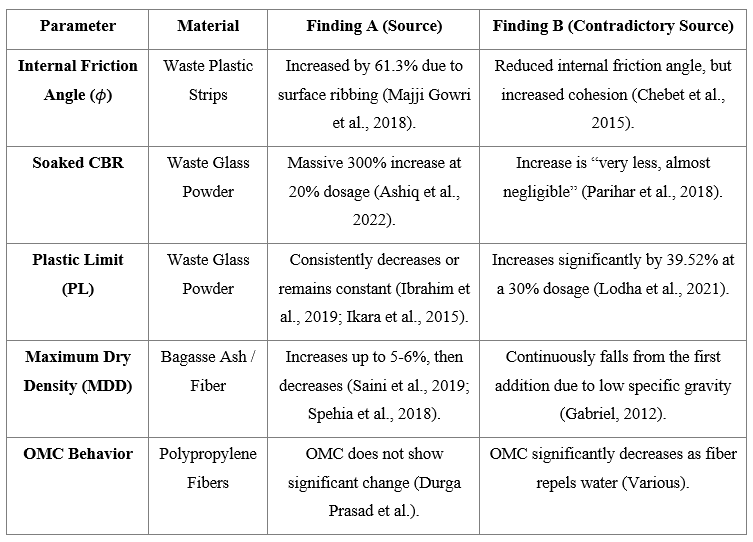
The stabilization of highly expansive Black Cotton Soil (BCS) presents a significant challenge in geotechnical engineering, primarily due to montmorillonite, a clay mineral that causes considerable volumetric instability with changes in moisture levels. This review examines recent literature on stabilization methods using industrial by-products, agricultural residues, polymeric reinforcements, and municipal solid wastes. Conventional chemical stabilizers such as Ordinary Portland Cement (OPC) and lime are increasingly viewed as environmentally harmful, costly, and unsustainable for large-scale infrastructure projects. This paper explores sustainable alternatives, including Waste Glass Powder (WGP), Construction and Demolition (C&D) waste, Sugarcane Bagasse Ash (SBA), Rice Husk Ash (RHA), Municipal Solid Waste Incineration (MSWI) ash, Eggshell Powder (ESP), industrial slags, and polymeric reinforcements like Polyethylene Terephthalate (PET) and glass fibers. By compiling experimental data, microstructural analyses, and predictive modeling techniques (such as Artificial Neural Networks and Multiple Linear Regression), this review identifies both consistencies and contradictions in material behaviors, especially in compaction characteristics, optimum moisture requirements, and shear strength. The results show that hybrid stabilization, combining pozzolanic wastes for chemical strength with fibrous/polymeric wastes for tensile flexibility, improves the California Bearing Ratio (CBR) and Unconfined Compressive Strength (UCS). The review identifies existing research gaps, particularly the absence of dynamic cyclic loading data and thorough life-cycle energy assessments, and suggests future pathways to incorporate these eco-friendly subgrade treatments into standardized construction methodologies.
Downloads
References
Abd.El-Aziz. (2004). The effect of lime-silica fume stabilizer on engineering properties of clayey subgrade. Fourth Mansoura International Engineering Conference.
Abdulnafaa, M., Awad, M., Cabalar, A., Akbulut, N., & Ozufacik, B. (2021). Hydraulic conductivity and undrained shear strength of clay-construction and demolition solid waste materials mixtures. Soils and Rocks, 44(2), 1–9.
Abdulrahman, S.M., et al. (2007). Assessment of black cotton based soil based constructions in Iraq.
Adetayo, O., et al. (2021). Evaluation of pulverized cow bone ash and waste glass powder on the geotechnical properties of tropical laterite. Silicon.
Adeyanju, E.A., & Okeke, C.A. (2019). Clay soil stabilization using cement kiln dust. IOP Conference Series: Materials Science and Engineering, 640(1).
Afrin, H. (2017). A review on different types soil stabilization techniques. International Journal of Transportation Engineering and Technology, 3(2), 19-24.
Ahalya, A., & Prasad, K. S. R. (2023). Stabilization of black cotton soil with waste plastic and admixtures. IOP Conference Series: Earth and Environmental Science, 1130, 012038.
Ahmad, S., Iqbal, M.M., Wani, M.B., & Ahmad, R. (2013). Study of concrete involving use of waste paper sludge ash as partial replacement of cement. International organization of Scientific Research, 3(11), 06-15.
Alelgn. (2025). Strength improvement of black cotton soil with cement and waste glass. Advances in Civil Engineering.
Al-Neami, M. A., Alsoudany, K., Dawod, A., & Ehsan, E. A. (2015). Remediation of cohesive soils using waste glass. Conference of the International Journal of Arts & Sciences.
Alqaisi, R., Le, T.M., & Khabbaz, H. (2020). Applications of recycled sustainable materials and by-products in soil stabilization. Springer International Publishing, pp. 91–117.
Amena, S., & Chakeri, D. (2022). A study on the effects of plastic waste strips and lime on strength characteristics of expansive soil. Advances in Civil Engineering.
Amu, O. O., Fajobi, A. B., & Oke, B. O. (2005). Effect of eggshell powder on the stabilizing potential of lime on an expansive clay soil. Journal of Applied Sciences, 5(8), 1474-1478.
Anand, J. C., Jain, M., Kalyan, T. H., Rao, N. V. L., & Chamberlin, K. S. (2020). Stabilization of black cotton soil by using quarry dust and lime. International Journal of Innovative Technology and Exploring Engineering.
Anoop, S. P., et al. (2009). Features of soil stabilization with the replacement of lime with eggshell fillers.
Arabani, M., Sharafi, H., Habibi, M.R., & Haghshenas, E. (2012). Laboratory evaluation of cement stabilized crushed glass-sand blends. Electronic Journal of Geotechnical Engineering, 17, 1777–1792.
Arthi, P.D., et al. (2017). Stabilization of black cotton soil using coir pith. International Research Journal of Engineering and Technology.
Ashiq, S. Z., Akbar, A., Farooq, K., & Mujtaba, H. (2022). Sustainable improvement in engineering behavior of Siwalik Clay using industrial waste glass powder as additive. Case Studies in Construction Materials, 16, e00883.
Atsuko, S., Satoru, K.A., Hata, T., S., & Hayashi, T. (2016). Possibility for solidification of peaty soil by using microbes. International Journal of GEOMATE, 10(22), 2071-2076.
Ayeni, P., Babatunde, O.A., & Dahunsi, B.O. (2019). Partial replacement of granites with glass chips (Glassorazzo) in concrete tiles. International Journal of Scientific & Research, 10(1).
Aziz, S. Q., Aziz, H. A., Bashir, M. J. K., & Yusoff, M. S. (2011). Appraisal of domestic solid waste generation, components, and the feasibility of recycling in Erbil, Iraq. Waste Management & Research, 29(8), 880–887.
Babatunde, O. A., Sani, J. E., & Sambo, A. H. (2019). Reliability estimation of strength properties in black cotton soils stabilized with glass powder. International Journal of Innovative Research in Science, Engineering and Technology, 8(3).
Bagriacik, B. (2021). Utilization of alkali-activated construction demolition waste for sandy soil improvement with large-scale laboratory experiments. Construction and Building Materials, 302.
Bahlakeh, G., Ramezanzadeh, B., & Ramezanzadeh, M. (2018). New detailed insights on the role of a novel praseodymium nanofilm on the polymer/steel interfacial adhesion bonds. J Taiwan Inst Chem Eng, 85, 221–236.
Bandipally, S., Naresh, T., Kumar, V.V.P., Skrzypkowski, K., Prasad, N.S.S., Zagórski, K., Zagórska, A., & Madziarz, M. (2025). Experimental and energy accounting study on waste glass powder soil stabilisation for low-carbon mining infrastructure. Energies, 18, 6416.
Barazesh, A., Saba, H., Gharib, M., & Rad, M.Y. (2012). Laboratory investigation of the effect of eggshell on soil.
Baruah, D., Goel, S., Gupta, C., & Sahu, A. K. (2020). Ground improvement using municipal solid waste ash. Springer Singapore, 271-280.
Benny, J. R., Joseph, J. K., Sebastian, J. M., & Thomas, M. (2017). Effect of glass powder on engineering properties of clayey soil. International Journal of Engineering Research & Technology, 6(5), 228-231.
Bhadoriya, A., & Kansal, R. (2018). Black cotton soil stabilization using plastic and glass fibres. International Research Journal of Engineering and Technology (IRJET), 5(11).
Boraste, T. H. (2026). Soil stabilization using waste materials. Journal of Engineering Science and Technology.
Bordoloi, S., Garg, A., & Sekharan, S. (2017). A review of physio-biochemical properties of natural fibers and their application in soil reinforcement. Advances in Civil Engineering Materials, 6(1), 323-359.
Cabalar, A.F., Hassan, D.I., & Abdulnafaa, M.D. (2017). Use of waste ceramic tiles for road pavement subgrade. Road Materials and Pavement Design, 18(4).
Chen, F.H. (1988). Foundations on expansive soils. Developments in Geotechnical Engineering, 54, Elsevier Science Publishing.
Daraei, A., Herki, B., Sherwani, A.F.H., & Zare, S. (2018). Slope stability in swelling soils using cement grout: a case study. Int. J. Geosynth. Ground Eng., 4(1).
Darweesh, S. Y., & Munef, R. A. (2025). Mechanical properties of composites and equipment tolerance. Period Polytech Civ Eng.
Dash, S. K., & Hussain, M. (2012). Lime stabilization of soils: reappraisal. Journal of Materials in Civil Engineering, 24(6), 707-714.
Dhananjaya, A. S., Warade, T. G., Wankhede, A. S., Raghuvanshi, S. N., & Tandale, K. H. (2019). Stabilization of black cotton soil by using construction and demolition waste. MAT Journals, 4(2), 26-32.
Dontriros, S., Likitlersuang, S., & Janjaroen, D. (2020). Mechanisms of chloride and sulfate removal from municipal-solid-waste-incineration fly ash (MSWI FA). Waste Manage., 101, 44-53.
Dyer, T.D., & Dhir, R.K. (2001). Chemical reactions of glass cullet used as cement component. Journal of Materials in Civil Engineering.
Gaikwad, M. V. (2024). Use of e-waste material for improving the properties of black cotton soil. IRJET.
Gaw, B., Zamora, S., Albano, L.D., & Tao, M. (2011). Soil reinforcement with natural fibers for low-income housing communities. Bachelor’s Thesis, Worcester Polytechnic Institute.
Ghosha, S.K., Bhattacharyya, R., & Mondal, M.M. (2017). Potential applications of open weave jute geotextile (Soil Saver) in meeting geotechnical difficulties. Procedia Engineering, 200, 200-205.
Gouda, J., Santosh, B., Sitarami Reddy, D., & Kakade, B. V. (2024). Enhancing subgrade properties of black cotton soil through the combined use of sugarcane bagasse ash and ceramic waste powder. IOP Conference Series: Earth and Environmental Science, 1326, 012118.
Gromko, G.J. (1974). Review of expansive soils. Journal of geotechnical Engineering Division, ASCE, 100, 667-687.
Hashmie, N., et al. (2020). Utilisation of recycled glass powder for the stabilization of black cotton soil by alkali activation. IOP Conference Series: Materials Science and Engineering, 955, p. 012063.
Hoque, M. A., et al. (2018). Modification of expansive soil using recycled plastic bottle chips. Journal of Geotechnical Studies, 4, 7-13.
Ibrahim, H. H., Mawlood, Y. I., & Alshkane, Y. M. (2019). Using waste glass powder for stabilizing high-plasticity clay in Erbil city-Iraq. International Journal of Geotechnical Engineering.
Ikara, I. A., Kundiri, A. M., & Mohammed, A. (2015). Effects of waste glass (WG) on the strength characteristics of cement stabilized expansive soil. American Journal of Engineering Research (AJER), 4, 33-41.
Ikara, I. A., Kundiri, A. M., & Mohammed, A. (2019). Predicting CBR values of black cotton soil stabilized with cement and waste glass admixture using regression model. American Journal of Traffic and Transportation Engineering, 4(1), 31-36.
Ikeagwuani, C. C., Obeta, I. N., & Agunwamba, J. C. (2019). Stabilization of black cotton soil subgrade using sawdust ash and lime. Soils and Foundations, 59(1), 162-175.
Ingle. (2021). Problems and treatments of black cotton soil. Indian Journal of Science and Technology, 14(26), 2206–2214.
Jalal, F. E., Xu, Y., Jamhiri, B., Memon, S. A., et al. (2022). On the recent trends in expansive soil stabilization using calcium-based stabilizer materials (CSMs): a comprehensive review. Case Studies in Construction Materials, 17, e01559.
Khatti, J., Jangid, A. K., & Grover, K. S. (2018). A detailed study of CBR method for flexible pavement design. International Journal of Advance Research in Science and Engineering, 7(2).
Kumawat, B. L., & Mathur, D. (2020). Use of waste plastic in flexible pavement. International Journal of Recent Research and Review, XIII(1).
Mai-Bade, U. Y., Chinade, A. U., Batari, A., & Saeed, S. M. (2021). Stabilization of black cotton soil using various admixtures: A review. Composite Materials, 5(2), 37-45.
Moses, G. K., & Osinubi, K. J. (2013). Influence of compactive efforts on cement-bagasse ash treatment of expansive black cotton soil. World Academy of Science, Engineering and Technology, 1559–1566.
MSc Thesis. (2020). Prediction of California bearing ratio of a black cotton soil stabilized with waste glass and eggshell powder using artificial neural network.
Niyomukiza, J. B., et al. (2021). Investigating the effect of PET plastic bottle strips on the strength and compressibility properties of clayey soil. IOP Conference Series: Earth and Environmental Science, 894(1).
Obeta, I. N., et al. (2019). Stability and durability of sawdust ash-lime stabilised black cotton soil. Nigerian Journal of Technology, 38(1).
Oza, J.B., & Gundaliya, P.J. (2013). Study of black cotton soil characteristics with cement waste dust and lime. Procedia Engineering, 51, 110–118.
Park, J. Y. (2014). Assessing determinants of industrial waste reuse: The case of coal ash in the United States. Resources, Conservation and Recycling, 92, 116-127.
Pinto-Cruz, M. C. (2025). Analytical and numerical solution of generalized static analysis of tall buildings: double-beam systems Timoshenko. Journal of the Brazilian Society of Mechanical Sciences and Engineering, 46(368).
Randhawa, K. S., & Chauhan, R. (2021). Enhancing the engineering properties of Indian black cotton soil with municipal solid waste incineration ash - A review. Journal of University of Shanghai for Science and Technology, 23(3), 159-178.
Sandeep, M., Sree Lakshmi, V., & Yateesh, K. (2025). Improvement of properties of black cotton soil by using construction and demolish waste. ARPN Journal of Engineering and Applied Sciences.
Sarde, U. S. (2018). Stabilization of black cotton soil using waste foundry sand & RBI grade 81. IOSR Journal of Mechanical and Civil Engineering (IOSR-JMCE), 15(6), 59-61.
Sheob, M., Sajid, M., Ansari, M. A., Rais, I., Sadique, M. R., & Ahmad, S. (2024). Using a blend of cement and waste glass powder to improve the properties of clayey soil. Materials Today: Proceedings.
Singh, D., et al. (2023). Assessment of effect of glass fiber on the geotechnical properties of black cotton soil. IOP Conference Series: Materials Science and Engineering, 1273, 012019.
Woldesenbet, T. T. (2023). Strength improvement of black cotton soil using plastic bottles and crushed glass wastes. Journal of Engineering, 2023.
Published
How to Cite
Issue
Section
License
Copyright (c) 2026 Udayram D Patil, Vilas T Patil, Manojkumar B. Bashire, Bhushan K. Datar, Darsh M. Sangale, Dnyaneshwar B. Shinde, Radhesham N. Tonge

This work is licensed under a Creative Commons Attribution 4.0 International License.
Research Articles in 'International Journal of Engineering and Management Research' are Open Access articles published under the Creative Commons CC BY License Creative Commons Attribution 4.0 International License http://creativecommons.org/licenses/by/4.0/. This license allows you to share – copy and redistribute the material in any medium or format. Adapt – remix, transform, and build upon the material for any purpose, even commercially.


