Comparative Analysis of Healthcare Service Quality in Public and Private Facilities in South Al Batinah Governorate, Oman
DOI:
https://doi.org/10.31033/IJEMR/16.2.2026.1910Keywords:
SERVQUAL, Healthcare Service Quality, Patient Satisfaction, Public vs. Private Hospitals, South Al Batinah, Gap Analysis, Oman Vision 2040Abstract
Background: Despite substantial infrastructure investment in Oman, rigorous patient-centred comparative evidence on healthcare service quality across public and private sectors at the governorate level remains limited.
Objective: To evaluate and compare perceived healthcare service quality in public and private healthcare facilities in South Al Batinah Governorate, Oman, using the SERVQUAL framework (N = 200).
Methods: A quantitative, cross-sectional survey of 200 adult patients (100 per sector) was conducted. Gap scores (Perception − Expectation) were computed across the five SERVQUAL dimensions: tangibles, reliability, responsiveness, assurance and empathy. One-sample t-tests assessed whether gap scores differed from zero within each sector. Welch’s independent-samples t-tests and two-way ANOVA examined sectoral and dimensional effects.
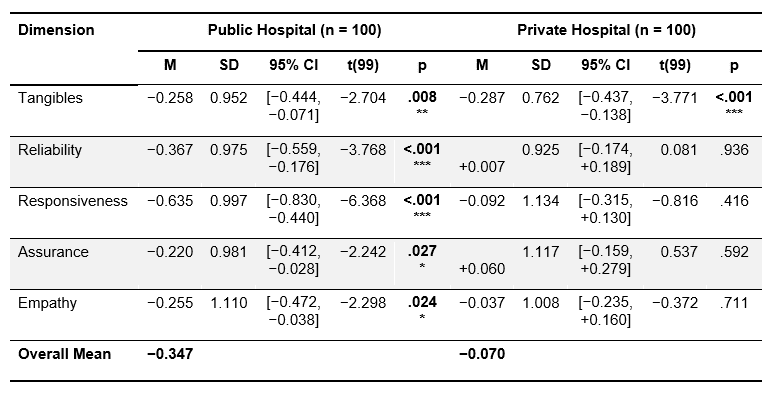
Results: Public hospital patients reported significant negative gap scores across all five dimensions: Tangibles (M = −0.258, p = .008), Reliability (M = −0.367, p < .001), Responsiveness (M = −0.635, p < .001), Assurance (M = −0.220, p = .027) and Empathy (M = −0.255, p = .024). Private hospital patients showed significant negative gaps only in Tangibles (M = −0.287, p < .001); gaps in Reliability, Responsiveness, Assurance and Empathy were non-significant, indicating expectations are broadly met in service-delivery processes. Welch’s t-tests confirmed significant public–private differences in Reliability (t(197.4) = −2.790, p = .006, d = 0.395) and Responsiveness (t(194.8) = −3.593, p < .001, d = 0.508). Two-way ANOVA confirmed a significant main effect for sector (F(1, 990) = 19.123, p < .001, η² = .019) and dimension (F(4, 990) = 2.462, p = .044, η² = .010).
Conclusion: Private facilities substantially outperform public facilities in Reliability and Responsiveness — the two dimensions most strongly linked to patient satisfaction. The service quality gap is a process gap, not a facilities gap. Public providers in South Al Batinah must urgently prioritise process-level reforms aligned with Oman Vision 2040.
Downloads
References
Al-Balushi, A. (2014). Patient satisfaction survey as a tool towards quality improvement in an Omani tertiary hospital. Oman Medical Journal, 29(3), 215–220. https://doi.org/10.5001/omj.2014.55
Al-Jabri, N., & Al-Baqlani, S. (2018). Staff perception of relative importance of quality dimensions in Omani hospitals. Journal of Healthcare Quality, 40(2), 95–104.
Al-Kindi, H., & Al-Balushi, M. (2022). Measuring the effect of healthcare service quality on patient satisfaction: Evidence from the Gulf region. Service Economics and Management, 9(1), 85–99.
Al-Lawati, J. A., & Al-Kharusi, A. (2024). Oman 2040: A bold vision for a transformed healthcare landscape. Oman Observer.
Boshoff, C., & Gray, B. (2004). The relationships between service quality, customer satisfaction and buying intentions in the private hospital industry. South African Journal of Business Management, 35(4), 27–37.
Bryman, A. (2016). Social research methods. (5th ed.). Oxford University Press.
Creswell, J. W., & Creswell, J. D. (2018). Research design: Qualitative, quantitative, and mixed methods approaches. (5th ed.). SAGE.
Ministry of Health. (2020). Rustaq hospital. Ministry of Health, Sultanate of Oman. https://moh.gov.om/en/hospitals-directorates/hospitals/rustaq-hospital/
Mohamed, M. (2014). Role of service quality measurements in inpatient hospital services: Evidence from Oman. International Journal of Health Care Quality Assurance, 27(5), 444–458.
Mosadeghrad, A. M. (2014). Factors influencing healthcare service quality. International Journal of Health Policy and Management, 3(2), 77–89.
Oman Vision 2040 Implementation Follow-up Office. (2025). Oman Vision 2040: Implementation framework for the health sector. Government of Oman.
Parasuraman, A., Zeithaml, V. A., & Berry, L. L. (1988). SERVQUAL: A multiple-item scale for measuring consumer perceptions of service quality. Journal of Retailing, 64(1), 12–40.
Saif, N., & Al-Harbi, A. (2020). Measuring patients’ expectations and realizations using SERVQUAL in a tertiary care hospital. International Journal of Health Care Quality Assurance, 33(4), 321–336.
Uddin, M. B., Rahman, M. M., & Howlader, M. H. (2020). Results of mapping patients’ expectations using SERVQUAL in hospital services. Journal of Healthcare Quality Research, 35(4), 213–221.
World Health Organization. (2010). Health system profile: Oman. WHO Regional Office for the Eastern Mediterranean.
Published
How to Cite
Issue
Section
License
Copyright (c) 2026 Dhanalakshmi Saravanan, Talal Mohammed Ashraf Albalushi, Ali Abdallah Nasser Alfadhali, Rawan Masaaod Thunai Sloum Alabri, Shafa Khalfan Said Khalfan Alabri, Sharifa Abdulhakeem Abdallah Alzadjali

This work is licensed under a Creative Commons Attribution 4.0 International License.
Research Articles in 'International Journal of Engineering and Management Research' are Open Access articles published under the Creative Commons CC BY License Creative Commons Attribution 4.0 International License http://creativecommons.org/licenses/by/4.0/. This license allows you to share – copy and redistribute the material in any medium or format. Adapt – remix, transform, and build upon the material for any purpose, even commercially.


