Ethical and Practical Implications of Artificial Intelligence in Assistive Technologies: Challenges, Opportunities, and Inclusive Development
DOI:
https://doi.org/10.31033/IJEMR/16.3.2026.1911Keywords:
Artificial Intelligence, Assistive Technologies, Ethical AI, Accessibility, Inclusive Design, Visual Impairment, India, AI GovernanceAbstract
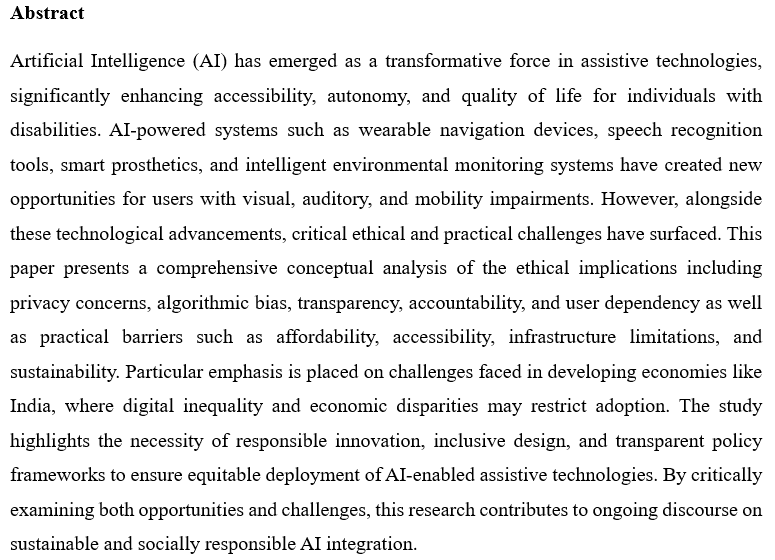
Artificial Intelligence (AI) has emerged as a transformative force in assistive technologies, significantly enhancing accessibility, autonomy, and quality of life for individuals with disabilities. AI-powered systems such as wearable navigation devices, speech recognition tools, smart prosthetics, and intelligent monitoring systems offer substantial benefits for visually impaired and differently-abled users. However, these advancements also introduce ethical concerns including privacy risks, algorithmic bias, transparency limitations, and accountability challenges. Practical barriers such as affordability, infrastructure limitations, and accessibility disparities further affect widespread implementation, particularly in developing nations like India. This conceptual paper critically examines the ethical and practical implications of AI in assistive technologies and emphasizes the importance of inclusive design, equitable deployment, and transparent governance frameworks. The study contributes to the broader discourse on sustainable and socially responsible AI integration.
Downloads
References
Borenstein, J., & Ulrich, I. (1997). The guidecane—A computerized travel aid for the active guidance of blind pedestrians. IEEE International Conference on Robotics and Automation, pp. 1283–1288.
Dakopoulos, D., & Bourbakis, N. G. (2010). Wearable obstacle avoidance electronic travel aids for blind: A survey. IEEE Transactions on Systems, Man, and Cybernetics, 40(1), 25–35.
Dignum, V. (2019). Responsible artificial intelligence: How to develop and use AI in a responsible way. Springer.
European Commission. (2019). Ethics guidelines for trustworthy AI. Publications Office of the European Union.
Floridi, L., et al. (2018). AI4People—An ethical framework for a good AI society. Minds and Machines, 28(4), 689–707.
Goodfellow, I., Bengio, Y., & Courville, A. (2016). Deep learning. MIT Press.
Gubbi, J., Buyya, R., Marusic, S., & Palaniswami, M. (2013). Internet of Things (IoT): A vision, architectural elements, and future directions. Future Generation Computer Systems, 29(7), 1645–1660.
Holzinger, A., et al. (2019). Explainable AI: The quest for transparency. Information Fusion, 61, 86–98.
Krizhevsky, A., Sutskever, I., & Hinton, G. E. (2012). ImageNet classification with deep convolutional neural networks. Advances in Neural Information Processing Systems, 25, 1097–1105.
Reddy, S., Allan, S., Coghlan, S., & Cooper, P. (2020). A governance model for AI in healthcare. Journal of the American Medical Informatics Association, 27(3), 491–497.
Shneiderman, B. (2020). Human-centered artificial intelligence: Reliable, safe & trustworthy. International Journal of Human–Computer Interaction, 36(6), 495–504.
World Health Organization. (2019). World report on vision. WHO Press.
Zhang, T., Kushwaha, V., & Bhuyan, M. (2020). AI-based assistive technologies for visually impaired: A review. Journal of Ambient Intelligence and Humanized Computing, 11(11), 1–15.
Published
How to Cite
Issue
Section
License
Copyright (c) 2026 Trupti Thakur

This work is licensed under a Creative Commons Attribution 4.0 International License.
Research Articles in 'International Journal of Engineering and Management Research' are Open Access articles published under the Creative Commons CC BY License Creative Commons Attribution 4.0 International License http://creativecommons.org/licenses/by/4.0/. This license allows you to share – copy and redistribute the material in any medium or format. Adapt – remix, transform, and build upon the material for any purpose, even commercially.


