Determinants of Intention to use Mobile Payment Services: A Systematic Literature Review
DOI:
https://doi.org/10.31033/IJEMR/16.3.2026.1914Keywords:
Mobile Payment Services, Behavioral Intention, Continuance Intention, Adoption IntentionAbstract
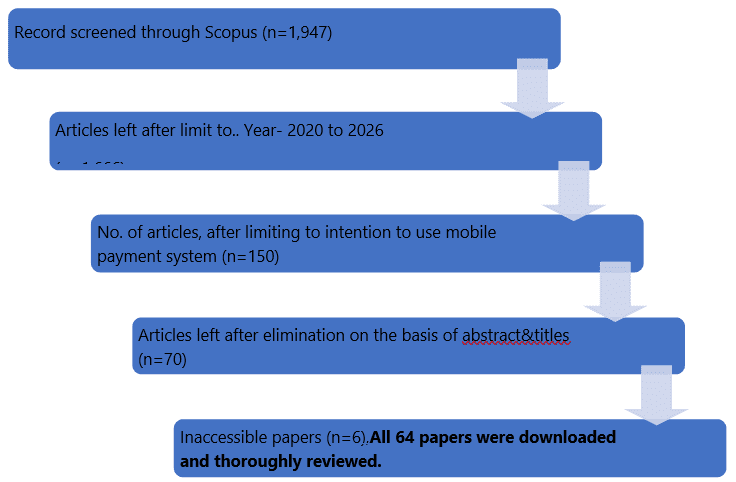
As we know that mobile payment services has gained a significant importance in this world. Whether it is tier one city or any town or village, mobile payment services is proving out to be a useful solution for everyone, be it a businessman or a consumer, mobile payment services (MPS) is standing out to be a convenient option for both. It is not just making our life easy but has been equally contributing towards financial inclusion on a large scale. And mobile payment services has gained importance post COVID 19 significantly, so this research article has chosen the time period of post the pandemic. Hence, this study has conducted a systematic literature review (SLR) to study the determinants of intention to use mobile payment services (MPS), where the construct “intention to use” has been broken into three parts: intention to use MPS, continuance intention to use MPS and adoption intention of MPS. Using PRISMA technique and choosing a timeframe of year 2020 to 2026, systematic review has been done. It has identified the research gap by finding out the key factors behind the usage of the mobile payment system. Significant determinants of usage intention of mobile payment services have been discussed in this paper. Future researchers may conduct location specific studies. Findings of the study can help the providers of mobile payment services to develop their applications constructively.
Downloads
References
Abbasi, G. A., Sandran, T., Ganesan, Y., & Iranmanesh, M. (2022). Go cashless! Determinants of continuance intention to use E-wallet apps: A hybrid approach using PLS-SEM and fsQCA. Technology in Society, 68, 101937. https://doi.org/10.1016/j.techsoc.2022.101937
Ahmad, S., Tajul Urus, S., & Syed Mustapha Nazri, S. N. F. (2021). Technology acceptance of financial technology (fintech) for payment services among employed fresh graduates. Asia-Pacific Management Accounting Journal (APMAJ), 16(2), 27-58. https://doi.org/10.24191/APMAJ.V16i2-02
Almajali, D., Al-Okaily, M., Al-Daoud, K., Weshah, S., & Shaikh, A. A. (2022). Go cashless! Mobile payment apps acceptance in developing countries: the Jordanian context perspective. Sustainability, 14(20), 13524. https://doi.org/10.3390/su142013524
Al-Qudah, A. A., Al-Okaily, M., Alqudah, G., & Ghazlat, A. (2024). Mobile payment adoption in the time of the COVID-19 pandemic. Electronic Commerce Research, 24(1), 427-451. https://doi.org/10.1007/s10660-022-09577-1
Al-Saedi, K., Al-Emran, M., Ramayah, T., & Abusham, E. (2020). Developing a general extended UTAUT model for M-payment adoption. Technology in Society, 62, 101293. https://doi.org/10.1016/j.techsoc.2020.101293
Carbonell, P., & Rodriguez Escudero, A. I. (2025). Understanding mobile money adoption in rural subsistence markets: a construal-based perspective. International Journal of Bank Marketing, 43(7), 1413-1440. https://doi.org/10.1108/IJBM-09-2024-0579
Changchit, C., Changchit, C., Cutshall, R., Pham, L., & Rao, M. (2023). Understanding the determinants of customer intention to use mobile payment: The Vietnamese perspective. Journal of Global Information Management (JGIM), 31(1), 1-27. DOI: 10.4018/JGIM.319740
Chang, A., Gunawan, T., & Sumarwan, U. (2023). A conceptual framework of mobile payment system adoption and use in Southeast Asia. Journal of ASEAN Studies, 11(2), 417-433. https://doi.org/10.21512/jas.v11i2.8815
Chawla, D., & Joshi, H. (2017). Consumer perspectives about mobile banking adoption in India–a cluster analysis. International Journal of Bank Marketing, 35(4), 616-636. https://doi.org/10.1108/IJBM-03-2016-0037
Chawla, D., & Joshi, H. (2019). Consumer attitude and intention to adopt mobile wallet in India–An empirical study. International Journal of Bank Marketing, 37(7), 1590-1618. https://doi.org/10.1108/IJBM-09-2018-0256
Davis, F. D. (1989). Perceived usefulness, perceived ease of use, and user acceptance of information technology. MIS Quarterly, 13(3), 319-340. https://doi.org/10.2307/249008
Featherman, M. S., & Pavlou, P. A. (2003). Predicting e-services adoption: a perceived risk facets perspective. International journal of human-computer studies, 59(4), 451-474. https://doi.org/10.1016/S1071-5819(03)00111-3
Gefen, D., & Straub, D. W. (2004). Consumer trust in B2C e-Commerce and the importance of social presence: experiments in e-Products and e-Services. Omega, 32(6), 407-424. https://doi.org/10.1016/j.omega.2004.01.006
Ha, M. T., Tran, K. T., Sakka, G., & Ahmed, Z. U. (2024). Understanding perceived risk factors toward mobile payment usage by employing extended technology continuance theory: a Vietnamese consumers’ perspective. Journal of Asia Business Studies, 18(1), 158-182. https://doi.org/10.1108/JABS-01-2023-0025
https://razorpay.com/learn/mobile-payment/ (Retrieved on June 1, 2026)
https://thepaymentsassociation.org/article/evolution-of-payments-the-rise-and-future-of-mobile-transactions/ (Retrieved on June 1, 2026)
https://www.academia.edu/5345600/Literature_Review_Intention_to_use?auto=download&auto_download_source=social-news (Retrieved on June 2, 2026)
https://www.worldbank.org/en/news/press-release/2022/06/29/covid-19-drives-global-surge-in-use-of-digital-payments (Retrieved on June 2, 2026)
Huang, J. H., Lee, B. C., & Hsun Ho, S. (2004). Consumer attitude toward gray market goods. International marketing review, 21(6), 598-614. https://doi.org/10.1108/02651330410568033
Kınış, F., & Tanova, C. (2022). Can I trust my phone to replace My wallet? The determinants of E-wallet adoption in North Cyprus. Journal of Theoretical and Applied Electronic Commerce Research, 17(4), 1696-1715. https://doi.org/10.3390/jtaer17040086
Lee, E. T., & Li, X. (2024). Breaking status-quo inertial use of incumbent payment to adopt mobile payment: A contingency perspective. International Journal of Human–Computer Interaction, 40(16), 4275-4287. https://doi.org/10.1080/10447318.2023.2212219
Liébana-Cabanillas, F., Japutra, A., Molinillo, S., Singh, N., & Sinha, N. (2020). Assessment of mobile technology use in the emerging market: Analyzing intention to use m-payment services in India. Telecommunications Policy, 44(9), 102009. https://doi.org/10.1016/j.telpol.2020.102009
Lui, T. K., Zainuldin, M. H., Yii, K. J., Lau, L. S., & Go, Y. H. (2021). Consumer adoption of alipay in Malaysia: The mediation effect of perceived ease of use and perceived usefulness. Pertanika Journal of Social Sciences&Humanities, 29(1). https://doi.org/10.47836/pjssh.29.1.22
Mobarak, A. M., Dakrory, M. I., Elsotouhy, M. M., Ghonim, M. A., & Khashan, M. A. (2024). Drivers of mobile payment services adoption: a behavioral reasoning theory perspective. International Journal of Human–Computer Interaction, 40(7), 1518-1531. https://doi.org/10.1080/10447318.2022.2144122
Meyll, T., & Walter, A. (2019). Tapping and waving to debt: Mobile payments and credit card behavior. Finance Research Letters, 28, 381-387. https://doi.org/10.1016/j.frl.2018.06.009
Nandru, P., SA, S. K., & Chendragiri, M. (2024). Adoption intention of mobile QR code payment system among marginalized street vendors: an empirical investigation from an emerging economy. Journal of Science and Technology Policy Management, 15(6), 1709-1733. https://doi.org/10.1108/JSTPM-03-2023-0035
Pal, D., Vanijja, V., & Papasratorn, B. (2015). An empirical analysis towards the adoption of NFC mobile payment system by the end user. Procedia Computer Science, 69, 13-25. https://doi.org/10.1016/j.procs.2015.10.002
Pavlou, P. A., & Gefen, D. (2004). Building effective online marketplaces with institution-based trust. Information systems research, 15(1), 37-59. https://doi.org/10.1287/isre.1040.0015
Rahi, S., Othman Mansour, M. M., Alghizzawi, M., & Alnaser, F. M. (2019). Integration of UTAUT model in internet banking adoption context: The mediating role of performance expectancy and effort expectancy. Journal of Research in Interactive Marketing, 13(3), 411-435. https://doi.org/10.1108/JRIM-02-2018-0032
Ramos de Luna, I., Montoro-Ríos, F., Molinillo, S., & Liébana-Cabanillas, F. (2024). Consumer behaviour and mobile payments in the point of sale: Exploring the determinants of intention to adopt it. International Journal of Human–Computer Interaction, 40(18), 5350-5372. https://doi.org/10.1080/10447318.2023.2233135
Remolina, N. (2020). Towards a data-driven financial system: the impact of COVID-19. SMU centre for AI&data governance research paper, (2020/08). https://dx.doi.org/10.2139/ssrn.3660874
Sarmah, R., Dhiman, N., & Kanojia, H. (2021). Understanding intentions and actual use of mobile wallets by millennial: an extended TAM model perspective. Journal of Indian Business Research, 13(3), 361-381. https://doi.org/10.1108/JIBR-06-2020-0214
Sinha, N., Paul, J., & Singh, N. (2024). Mobile payments for bottom of the pyramid: Towards a positive social change. Technological Forecasting and Social Change, 202, 123313. https://doi.org/10.1016/j.techfore.2024.123313
Srivastava, S., & Shunmugasundaram, V. (2025). Mobile payment FinTech services adoption: comparing three models. Management Decision, 1-29. https://doi.org/10.1108/MD-02-2025-0338
Tan, K. L., Leong, C. M., & Richter, N. F. (2025). Navigating trust in mobile payments: Using necessary condition analysis to identify must-have factors for user acceptance. International Journal of Human–Computer Interaction, 41(5), 3325-3339. https://doi.org/10.1080/10447318.2024.2338319
Thi, T. H. V. (2024). Research on the role of the attitudes of Vietnamese consumers towards their intentions to use mobile money. Global Business&Finance Review (GBFR), 29(2), 85-99. https://hdl.handle.net/10419/305961
Tian, Y., & Chan, T. J. (2024). Predictors of mobile payment use applications from the extended technology acceptance model: does self-efficacy and trust matter?. Sage Open, 14(4), 21582440241292525. https://doi.org/10.1177/21582440241292525
Türker, C., Altay, B. C., & Okumuş, A. (2022). Understanding user acceptance of QR code mobile payment systems in Turkey: An extended TAM. Technological Forecasting and Social Change, 184, 121968. https://doi.org/10.1016/j.techfore.2022.121968
Wang, X., Gao, Q., Huang, Y., & Yang, M. (2025). Perceived Risk in Mobile Payment Services Among Chinese Older People: The Influence of Age and Experience. International Journal of Human–Computer Interaction, 41(22), 13923-13939. https://doi.org/10.1080/10447318.2025.2478267
Published
How to Cite
Issue
Section
License
Copyright (c) 2026 Chayanika Saha, Dr. Priyanka Bhaskar

This work is licensed under a Creative Commons Attribution 4.0 International License.
Research Articles in 'International Journal of Engineering and Management Research' are Open Access articles published under the Creative Commons CC BY License Creative Commons Attribution 4.0 International License http://creativecommons.org/licenses/by/4.0/. This license allows you to share – copy and redistribute the material in any medium or format. Adapt – remix, transform, and build upon the material for any purpose, even commercially.


