LightSecurePUF: A Lightweight PUF-Based Mutual Authentication and Session Key Establishment Protocol for Secure UAV-Ground Station Communications
DOI:
https://doi.org/10.31033/IJEMR/16.3.2026.1930Keywords:
UAV Security, Physically Unclonable Function, Session Key Establishment, Lightweight Cryptography, HMAC, Scyther Verification, Internet of ThingsAbstract
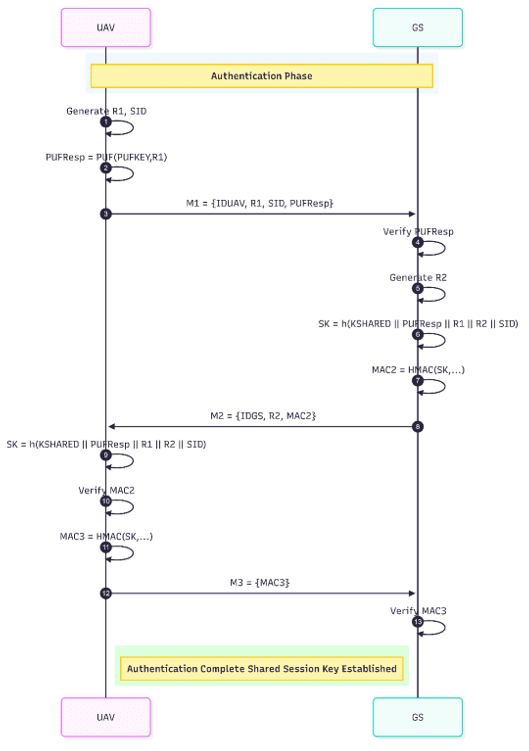
The rapid deployment of Unmanned Aerial Vehicles (UAVs) in military, surveillance, disaster management, precision agriculture, and intelligent transportation systems has significantly increased the demand for secure and lightweight authentication mechanisms. Due to the limited computational capability and energy constraints of UAV platforms, conventional public-key cryptographic protocols often impose excessive computational and communication overhead. Furthermore, wireless UAV-Ground Station (GS) communication is vulnerable to replay, impersonation, man-in-the-middle, and session hijacking attacks. To address these challenges, this paper proposes LightSecurePUF, a lightweight mutual authentication and session key establishment protocol based on Physically Unclonable Functions (PUFs), cryptographic hash functions, and Hash-based Message Authentication Codes (HMACs). The proposed protocol employs a challenge-response PUF mechanism to uniquely authenticate UAV devices while deriving a fresh session key from the long-term shared secret, PUF response, random nonces, and session identifier. Consequently, each communication session establishes an independent session key without increasing computational complexity. The security of the proposed protocol is formally verified using the Scyther protocol verification tool under the Dolev-Yao adversarial model. The verification results demonstrate that the protocol satisfies secrecy, mutual authentication, non-injective agreement, synchronization, and key confirmation properties, with no attacks detected within the verification bounds. Furthermore, the protocol achieves lower computational and communication overhead than existing authentication schemes, making it suitable for resource-constrained UAV-assisted Internet of Things (IoT) and cyber-physical systems.
Downloads
References
Mekdad, Y., Aris, A., Acar, A., et al. (2024). A comprehensive security and performance assessment of UAV authentication schemes. Security and Privacy, 7(1), e338, 2024.
Adil, M., Abulkasim, H., Farouk, A., & Song, H. (2024). R3ACWU: A lightweight, trustworthy authentication scheme for UAV-assisted iot applications. IEEE Transactions on Intelligent Transportation Systems, 25(6), pp. 6161-6172.
Zhang, Z., Hsu, C., Au, & M. H., et al. (2024). PRLAP-IoD: A PUF-based robust and lightweight authentication protocol for internet of drones. Computer Networks, 238, 110118.
Singh, M. et al. (2021). CoMSeC++: PUF-based secured light-weight mutual authentication protocol for Drone-enabled WSN. Computer Networks.
Alkatheiri, M. S., Saleem, S., & Alqarni, M. A., et al. (2022). A lightweight authentication scheme for a network of unmanned aerial vehicles using physical unclonable functions. Electronics, 11(18), 2921.
Zhang, X. et al. (2022). A PUF-based lightweight authentication and key agreement protocol for smart UAV networks. IET Communications.
Choi, J., Kwon, D., Son, S., Park, Y., Das, A. K., & Park, Y. (2025). A PUF-based lightweight authentication scheme for UAV-assisted internet of vehicles. IEEE Transactions on Intelligent Transportation Systems.
Xie, Q., & Wang, H. (2025). PUF-based secure and efficient anonymous authentication protocol for UAV towards cross-domain environments. Drones.
Yu, S., Das, A. K., & Park, Y. (2024). RLBA-UAV: A robust and lightweight blockchain-based authentication and key agreement scheme for PUF-enabled UAVs.
Kumar, N. et al. (2026). LiteWTAKA: Authenticating UAV-GCS and UAV-UAV communication using secure and lightweight mechanism based on PUF. Journal of Network and Computer Applications.
D. Dolev, & A. Yao. (2003). On the security of public key protocols. IEEE Transactions on Information Theory, 29(2), 198-208.
Published
How to Cite
Issue
Section
License
Copyright (c) 2026 Anjali Singh

This work is licensed under a Creative Commons Attribution 4.0 International License.
Research Articles in 'International Journal of Engineering and Management Research' are Open Access articles published under the Creative Commons CC BY License Creative Commons Attribution 4.0 International License http://creativecommons.org/licenses/by/4.0/. This license allows you to share – copy and redistribute the material in any medium or format. Adapt – remix, transform, and build upon the material for any purpose, even commercially.


