Low Beta Is Not Low Risk: Evidence and Investor Implications from Five Indian Pharmaceutical Stocks, 2021–2025
DOI:
https://doi.org/10.31033/IJEMR/16.3.2026.1941Keywords:
Indian Pharmaceutical Stocks, SENSEX 50, Market Beta, Portfolio Diversification, Drawdown Risk, Data Verification, Investor Protection, Riskometer DisclosureAbstract
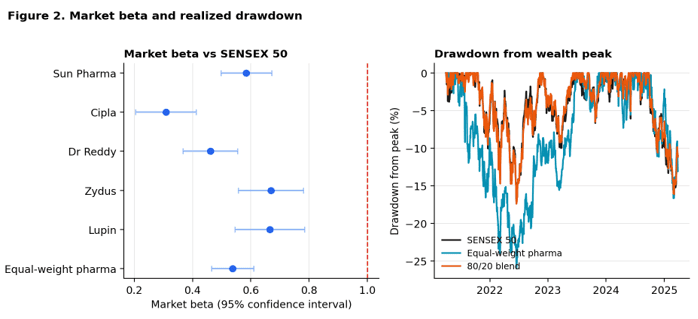
Pharmaceutical stocks are often called defensive, but “low risk” can mean a modest response to market swings, low volatility, or protection of capital when markets fall – three different claims. This study separates them for five Indian pharmaceutical companies (Sun Pharma, Cipla, Dr. Reddy's, Zydus and Lupin) over four fiscal years, April 2021–March 2025. Before analysis, the price data was audited against official exchange records, which uncovered a two-year benchmark-duplication error in the Sun Pharma series, an unadjusted Dr. Reddy's stock split, and an unbridged Zydus ticker change – all corrected using official NSE and BSE sources. Using ordinary least-squares regression, correlation and descriptive statistics, all five stocks show a market beta below one against BSE SENSEX 50 (0.31–0.67), yet every stock is more volatile (20.8%–28.1% a year) than the index (13.8%), and four of five lost more than a quarter of their value at some point. An equal-weight portfolio has a beta of 0.54, but its maximum drawdown (26.0%) exceeds the index's (17.1%) and stays negative on 88% of the market's fifty worst days despite losing less than the index on average. An 80/20 index–pharma blend lowers historical variance by about 12%, stable across sub-periods, though its own drawdown is marginally deeper than the index's. Repeating the analysis on the uncorrected data reverses the headline beta finding, showing that data verification mattered more than any statistical technique here. Beyond this sample, the paper documents a reproducible data-integrity case and translates its findings into guidance for retail investors, advisers, fund managers and investor-education policy on what a “defensive” label can and cannot support.
Downloads
References
Ang, A., Chen, J., & Xing, Y. (2006). Downside risk. The Review of Financial Studies, 19(4), 1191–1239. https://doi.org/10.1093/rfs/hhj035
Baur, D. G., & Lucey, B. M. (2010). Is gold a hedge or a safe haven? An analysis of stocks, bonds and gold. The Financial Review, 45(2), 217–229. https://doi.org/10.1111/j.1540-6288.2010.00244.x
Behera, C., & Rath, B. N. (2021). The COVID-19 pandemic and Indian pharmaceutical companies: An event study analysis. Bulletin of Monetary Economics and Banking, 24(Special Issue), 1–14. https://doi.org/10.21098/bemp.v24i0.1483
BSE Indices. (n.d.). BSE SENSEX 50: Index information and historical values [Data set]. Retrieved September 9, 2026, from https://www.bseindices.com/indices-details/code/98
Business Standard. (2025, July 15). Retail participation in mkts increase; demat accounts surge to 194 mn: Sebi. https://www.business-standard.com/markets/news/retail-participation-in-mkts-increase-demat-accounts-surge-to-194-mn-sebi-125071500934_1.html
Dr. Reddy's Laboratories Limited. (2025). Quarterly report for the quarter ended December 31, 2024, Form 6-K, Note 14: Share capital. U.S. Securities and Exchange Commission. https://www.sec.gov/Archives/edgar/data/1135951/000157587225000080/drr0714_6k.htm
Dua, S., & Meena, S. (2024). Risk and return trade off: A study of Indian pharmaceutical sector's stocks. ANUSANDHAN – NDIM's Journal of Business and Management Research, 6(1), 51–62. https://doi.org/10.56411/anusandhan.2024.v6i1.51-62
Janani Sri, S., Kayal, P., & Balasubramanian, G. (2022). Can equity be safe-haven for investment?. Journal of Emerging Market Finance, 21(1), 32–63. https://doi.org/10.1177/09726527211068411
Kaur, A., & Chavali, K. (2025). Deciphering the risk–return dynamics of pharmaceutical companies using the GARCH-M model. Risks, 13(5), Article 87. https://doi.org/10.3390/risks13050087
Kumari, V., Rai, V. K., & Pandey, D. K. (2023). Impact of novel coronavirus outbreak-related announcements on pharmaceutical stocks: Empirical evidence from an emerging market. International Journal of Monetary Economics and Finance, 16(1), 40–57. https://doi.org/10.1504/IJMEF.2023.130216
Lamba, A., Aggarwal, P., Gupta, S., & Joshipura, M. (2024). What determines the performance of pharmaceutical firms in India on account of COVID-19 interventions?. International Journal of Pharmaceutical and Healthcare Marketing, 18(3), 353–374. https://doi.org/10.1108/IJPHM-05-2023-0039
Markowitz, H. (1952). Portfolio selection. The Journal of Finance, 7(1), 77–91. https://doi.org/10.1111/j.1540-6261.1952.tb01525.x
National Stock Exchange of India. (2022, February 28). Change in name and symbol of Cadila Healthcare Limited (Circular NSE/CML/51455). https://archives.nseindia.com/content/circulars/CML51455.pdf
National Stock Exchange of India. (2024, December 13). Trading holidays for the calendar year 2025 (Circular NSE/CMTR/65587). https://nsearchives.nseindia.com/content/circulars/CMTR65587.pdf
National Stock Exchange of India. (n.d.-a). Security-wise price-volume data: SUNPHARMA, CIPLA, DRREDDY, ZYDUSLIFE and LUPIN, EQ series, March 31, 2021–March 31, 2025 [Data set]. Retrieved September 9, 2026, from https://www.nseindia.com/report-detail/eq_security
National Stock Exchange of India. (n.d.-b). Corporate actions: SUNPHARMA, CIPLA, DRREDDY, ZYDUSLIFE and LUPIN [Data set]. Retrieved September 9, 2026, from https://www.nseindia.com/companies-listing/corporate-filings-actions
Saraf, M., & Kayal, P. (2023). How much does volatility influence stock market returns? Empirical evidence from India. IIMB Management Review, 35(2), 108–123. https://doi.org/10.1016/j.iimb.2023.05.004
Securities and Exchange Board of India. (2021, August 5). Disclosure of risk-o-meter of scheme, benchmark and portfolio details to the investors (Circular SEBI/HO/IMD/DF3/CIR/P/2021/024). https://www.sebi.gov.in/legal/circulars/aug-2021/disclosure-of-risk-o-meter-of-scheme-benchmark-and-portfolio-details-to-the-investors_52262.html
Published
How to Cite
Issue
Section
License
Copyright (c) 2026 Dr. Mitulkumar T. Parmar

This work is licensed under a Creative Commons Attribution 4.0 International License.
Research Articles in 'International Journal of Engineering and Management Research' are Open Access articles published under the Creative Commons CC BY License Creative Commons Attribution 4.0 International License http://creativecommons.org/licenses/by/4.0/. This license allows you to share – copy and redistribute the material in any medium or format. Adapt – remix, transform, and build upon the material for any purpose, even commercially.


