Development and Performance Evaluation of Biochar–Fly Ash Concrete for Sustainable Construction Applications
DOI:
https://doi.org/10.31033/IJEMR/16.5.2026.1950Keywords:
Biochar, Coconut Shell, Fly Ash, Sustainable Concrete, Compressive Strength, Durability, Carbon Sequestration, EDXAbstract
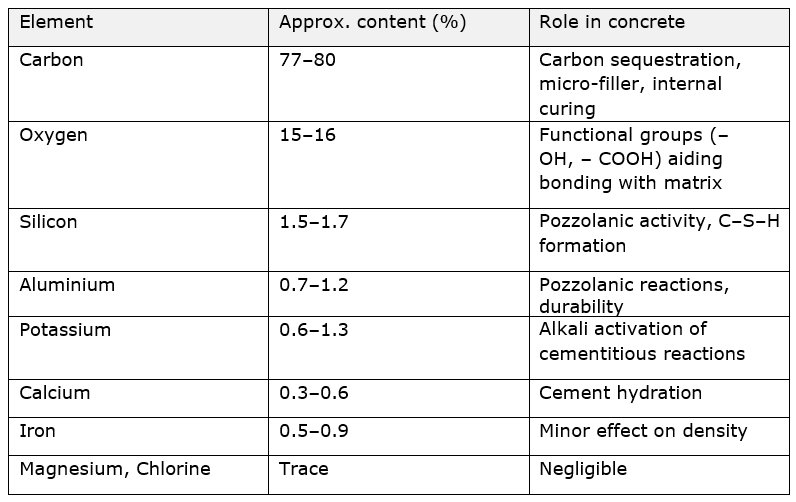
Portland cement production contributes roughly 7–8% of global CO₂ emissions, which has driven interest in supplementary cementitious materials and carbon-sequestering additives. This study evaluates coconut-shell-derived biochar, used as a cement-weight additive at 0–5%, in a fly ash blended concrete system. Biochar was characterized by EDX (carbon 77–80%, oxygen 15–16%) and physical tests (specific gravity 1.60, fineness modulus 1.83, water absorption 15.8%). Concrete specimens were tested for compressive, split tensile and flexural strength at 7, 14 and 28 days, and for strength loss after sulphate attack, chloride attack and alternate wet–dry cycles. A 1% biochar dose gave the highest 28-day compressive strength (33.8 MPa, +7.0% over the 31.6 MPa control), and 2% gave 33.2 MPa (+5.1%). Doses of 3% and above gave no gain or a reduction. Early-age (7- and 14-day) split tensile and flexural strength improved at 1–3%, but 28-day tensile and flexural strengths were below the control for all dosages. Durability was best at 2% biochar, where strength loss was 2.2% (sulphate), 1.8% (chloride) and 2.8% (wet–dry), against 8.5%, 7.0% and 9.0% for the control. The results indicate that a low biochar dosage of about 1–2% can improve compressive strength and durability, while higher dosages are detrimental.
Downloads
References
Senadheera, S. S., et al. (2023). Application of biochar in concrete – A review. Construction and Building Materials.
Barbhuiya, S. (2024). Biochar-concrete: A comprehensive review of properties.
Aman, A. M. N. (2022). Biochar as cement replacement to enhance concrete.
Room, S. (2024). Biochar-enhanced carbon-negative and sustainable cementitious composites. Sustainability.
Tee, K. F. (2023). Biochar in cementitious material: a review on physical, chemical, mechanical and durability aspects. AIMS Materials.
Mishra, G., et al. (2023). Optimization of biochar and fly ash to improve mechanical properties.
Praneeth, S., et al. (2025). Low carbon biochar amended fly ash–cement building blocks.
Wu, F., et al. (2025). Biochar modification enhances mechanical and durability properties.
Patel, R., et al. (2025). Study of biochar in cementitious materials. Scientific Reports.
Aman (2022–2024). Various tests on biochar as partial replacement.
Bhavana, K. Y., Usha, S., Mallesh, T. V., & Shiva Raju, G. D. (2024). Numerical simulation of eco sustainable construction and demolition waste (CDW) based geopolymer concrete blocks as coarse aggregates by using ANSYS software. IOP Conference Series: Earth and Environmental Science, 1327(1), p. 012016.
Usha, S., Shivaraju, G. D., Mallesh, T. V., Prathibha, R. T., & Navya, S. M. (2022). Performance assessment of fly-ash aggregates in concrete. International Journal of Health Sciences, 6(S9), 3858–3864.
Published
How to Cite
Issue
Section
License
Copyright (c) 2026 Mamathashree, Usha S., Shivaraju G.D.

This work is licensed under a Creative Commons Attribution 4.0 International License.
Research Articles in 'International Journal of Engineering and Management Research' are Open Access articles published under the Creative Commons CC BY License Creative Commons Attribution 4.0 International License http://creativecommons.org/licenses/by/4.0/. This license allows you to share – copy and redistribute the material in any medium or format. Adapt – remix, transform, and build upon the material for any purpose, even commercially.


