Operationalizing Pragmatism in Mixed-Methods Research- A Methodological Framework for Integrating Post-Positivist and Interpretivist Inquiry in Supply Chain Studies
DOI:
https://doi.org/10.31033/IJEMR/16.5.2026.1955Keywords:
Pragmatism, Explanatory Sequential Design, Mixed Methods Research, Public Procurement, Supply Chain ResilienceAbstract
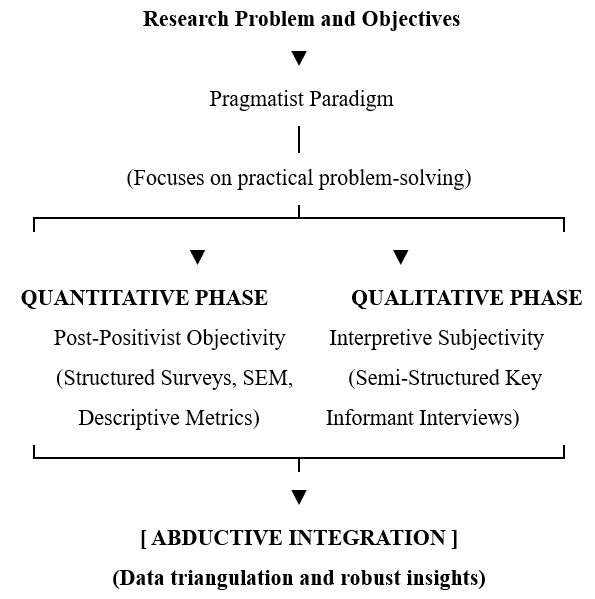
This research focuses on the methodological consistency and philosophy needed to conduct research within complicated supply chains and public procurement systems of emerging countries, using Zambia as the main context for case studies. Bridging the gap between objectivist positivism and subjectivist interpretivism as traditional epistemological perspectives, the study uses Pragmatism as the guiding philosophy, arguing that truth exists in what works when solving complicated problems. In order to link ontological and epistemological presumptions with their empirical application, the research implements a sequence of mixed methods (\text-QUAN \rightarrow \text-qual, which is explanatory in nature. Phase one involves a quantitative approach under the post-positivist framework by means of structured 5-point Likert scale questionnaires and operational documents analyzed using SPSS and SmartPLS. The second phase takes on a qualitative approach to interpretation, using semi-structured interviews with key-informants and institution documentation through the process of reflexive thematic analysis using NVivo until theoretical saturation. Through the process of data integration using data triangulation and the development of joint display tables in Chapters 4 and 5, meta-inferences are drawn and concrete policy recommendations are produced based on empirical evidence for regulatory compliance, digital e-procurement adoption, and infrastructure resilience.
Downloads
References
Biesta, G. (2010). Pragmatism and the philosophical foundations of mixed methods research. In A. Tashakkori & C. Teddlie (Eds.), SAGE Handbook of Mixed Methods in Social & Behavioral Research (2nd ed., pp. 95–118). SAGE. https://doi.org/10.4135/9781506335193.n4
Braun, V., & Clarke, V. (2019). Reflecting on reflexive thematic analysis. Qualitative Research in Sport, Exercise and Health, 11(4), 589–597. https://doi.org/10.1080/2159676X.2019.1628806
Braun, V., & Clarke, V. (2020). Comparing reflexive thematic analysis and other pattern-based qualitative analytic approaches. Counselling and Psychotherapy Research, 21(1), 37–47. https://doi.org/10.1002/capr.12360
Bryman, A. (2016). Social research methods. (5th ed.). Oxford University Press.
Comte, A. (1855). The positive philosophy of Auguste Comte (H. Martineau, Trans.). Calvin Blanchard.
Creswell, J. W., & Creswell, J. D. (2018). Research design: Qualitative, quantitative, and mixed methods approaches. (5th ed.). SAGE.
Creswell, J. W., & Plano Clark, V. L. (2018). Designing and conducting mixed methods research. (3rd ed.). SAGE.
Creswell, J. W., & Poth, C. N. (2018). Qualitative inquiry and research design: Choosing among five approaches. (4th ed.). SAGE.
Dewey, J. (1938). Logic: The theory of inquiry. Henry Holt and Company.
Fairclough, N. (2013). Critical discourse analysis: The critical study of language. (2nd ed.). Routledge.
Feilzer, M. Y. (2010). Doing mixed methods research pragmatically: Implications for the rediscovery of pragmatism as a research paradigm. Journal of Mixed Methods Research, 4(1), 6–16. https://doi.org/10.1177/1558689809349691
Field, A. (2018). Discovering statistics using IBM SPSS statistics. (5th ed.). SAGE.
Fischer, M., Lehner, R., & Weber, S. (2023). Empirical foundations of quantitative inquiry: Objectivity and measurement in social science research. Journal of Academic Research, 18(2), 112–128.
Flyvbjerg, B. (2001). Making social science matter: Why social inquiry fails and how it can succeed again. Cambridge University Press.
Foucault, M. (1980). Power/knowledge: Selected interviews and other writings, 1972–1977 (C. Gordon, Ed.). Pantheon Books.
Freire, P. (1970). Pedagogy of the oppressed. Herder and Herder.
Guba, E. G., & Lincoln, Y. S. (1994). Competing paradigms in qualitative research. In N. K. Denzin & Y. S. Lincoln (Eds.), Handbook of qualitative research (pp. 105–117). SAGE.
Habermas, J. (1984). The theory of communicative action: Reason and the rationalization of society (Vol. 1, T. McCarthy, Trans.). Beacon Press.
Hair, J. F., Black, W. C., Babin, B. J., & Anderson, R. E. (2019). Multivariate data analysis. (8th ed.). Cengage Learning.
Hair, J. F., Risher, J. J., Sarstedt, M., & Ringle, C. M. (2019). When to use and how to report the results of PLS-SEM. European Business Review, 31(1), 2–24. https://doi.org/10.1108/EBR-11-2018-0203
Hennink, M., & Kaiser, B. N. (2022). Sample sizes for saturation in qualitative research: A systematic review of empirical tests. Social Science & Medicine, 292, Article 114523. https://doi.org/10.1016/j.socscimed.2021.114523
Ivankova, N. V., Creswell, J. W., & Stick, S. L. (2006). Using mixed-methods sequential explanatory design: From theory to practice. Field Methods, 18(1), 3–20. https://doi.org/10.1177/1525822X05282260
Johnson, R. B., & Christensen, L. (2024). Educational research: Quantitative, qualitative, and mixed approaches. (8th ed.). SAGE.
Johnson, R. B., & Onwuegbuzie, A. J. (2004). Mixed methods research: A research paradigm whose time has come. Educational Researcher, 33(7), 14–26. https://doi.org/10.3102/0013189X033007014
Junjie, M., & Yingxin, M. (2022). The discussions of positivism and interpretivism. Global Academic Journal of Humanities and Social Sciences, 4(1), 10–14. https://doi.org/10.36348/gajhss.2022.v04i01.002
Kamberelis, G., & Dimitriadis, G. (2013). Focus groups: From theory to practice. Routledge.
Kaushik, V., & Walsh, C. A. (2019). Pragmatism as a research paradigm and its implications for social work research. Social Sciences, 8(9), Article 255. https://doi.org/10.3390/socsci8090255
Kemmis, S., McTaggart, R., & Nixon, R. (2014). The action research planner: Doing critical participatory action research. Springer.
Kunisch, S., Denyer, D., & Tranfield, D. (2023). Inductive-deductive continuums and the logic of contemporary scientific inquiry. Scientific Methods Review, 12(1), 45–62.
Mertens, D. M. (2015). Research and evaluation in education and psychology: Integrating diversity with quantitative, qualitative, and mixed methods. (4th ed.). SAGE.
Morgan, D. L. (2007). Paradigms lost and pragmatism regained: Methodological implications of combining qualitative and quantitative methods. Journal of Mixed Methods Research, 1(1), 48–76. https://doi.org/10.1177/1558689806296062
Morgan, D. L. (2014). Pragmatism as a paradigm for social research. Qualitative Inquiry, 20(8), 1045–1053. https://doi.org/10.1177/1077800413513733
Park, Y. S., Konge, L., & Artino, A. R., Jr. (2020). The positivism paradigm of research. Academic Medicine, 95(5), 690–694. https://doi.org/10.1097/ACM.0000000000003093
Pretorius, M. (2024). Epistemological objectivism and detachment in quantitative methodologies. Educational Review, 29(1), 14–31.
Ryan, G. (2018). Introduction to positivism, interpretivism and critical theory. Nurse Researcher, 25(4), 14–20. https://doi.org/10.7748/nr.2018.e1466
Saunders, M., Lewis, P., & Thornhill, A. (2019). Research methods for business students. (8th ed.). Pearson Education.
Shannon-Baker, P. (2016). Making paradigms meaningful in mixed methods research. Journal of Mixed Methods Research, 10(4), 319–334. https://doi.org/10.1177/1558689816658577
Subedi, D. (2016). Explanatory sequential mixed method design as a practical research approach for educators. Journal of Education and Practice, 7(19), 171–177.
Tashakkori, A., & Teddlie, C. (Eds.). (2010). SAGE handbook of mixed methods in social & behavioral research. (2nd ed.). SAGE.
Teddlie, C., & Tashakkori, A. (2009). Foundations of mixed methods research: Integrating quantitative and qualitative approaches in the social and behavioral sciences. SAGE.
Yamane, T. (1967). Statistics: An introductory analysis. (2nd ed.). Harper & Row.
Published
How to Cite
Issue
Section
License
Copyright (c) 2026 Geoffrey Kapasa Mweshi

This work is licensed under a Creative Commons Attribution 4.0 International License.
Research Articles in 'International Journal of Engineering and Management Research' are Open Access articles published under the Creative Commons CC BY License Creative Commons Attribution 4.0 International License http://creativecommons.org/licenses/by/4.0/. This license allows you to share – copy and redistribute the material in any medium or format. Adapt – remix, transform, and build upon the material for any purpose, even commercially.


