From Landlocked to Land-Linked: Leveraging Supply Chain Orchestration to Scale the Grow Zambia Agenda Globally
DOI:
https://doi.org/10.31033/IJEMR/16.5.2026.1957Keywords:
Supply Chain Orchestration, Land-Linked Nexus, Dynamic Capabilities, Global Value Chains, Multimodal Transit CorridorsAbstract
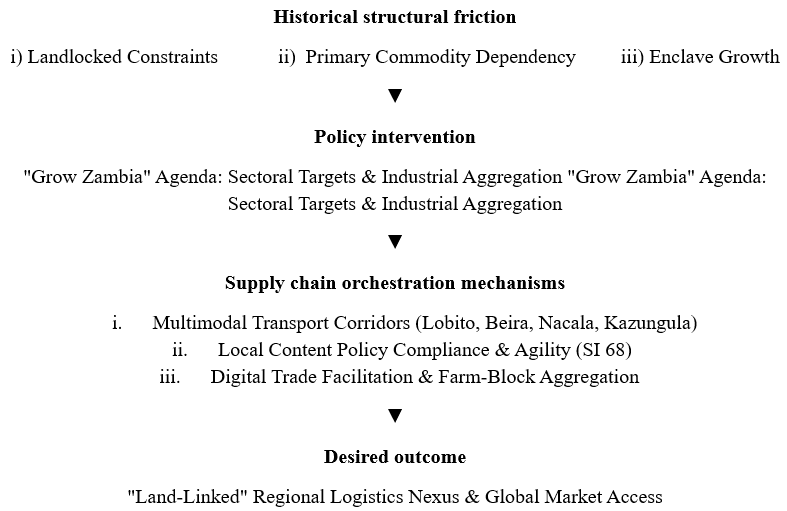
Landlocked developing countries experience major trade cost drawbacks, prolonged transit periods and export weaknesses resulting from their physical geographic position and dependency on natural resource exportation. In Southern Africa, realizing the national goals as set out in the domestic real sector strategy such as the "Grow Zambia" Agenda demands resolving critical logistical barriers, high overland transport costs and exposure to climatic risks. The current study explores the potential of using supply chain management strategy in transforming Zambia from being a landlocked nation into being a land-linked country. Using Global Value Chain Governance Theory, Dynamic Capabilities perspective and the New Economic Geography Gravity model, the research examines the mediating effect of multimodal corridors (e.g. Lobito Atlantic Railway and Kazungula Bridge), farm blocks consolidation within rural areas and the level of compliance with local content requirement as per Statutory Instrument No. 68 of 2025. Through an explanatory research design involving structured surveys and key informants' interviews, the results reveal that optimal use of rail transport and dynamic capability in supply chain management helps in avoiding port congestion, minimizing food losses after harvesting, fulfilling export agreements and protecting domestic food security. Most importantly, matching domestic productive capacities with regional integration initiatives through AfCFTA offers a clear operational template for export competitiveness and sustainable economic upgrading in developing countries.
Downloads
References
Afreximbank. (2026). African trade and economic outlook 2026: Moving up the ladder – Capturing more value from Africa's commodities. African Export-Import Bank. https://research.knowledge.afreximbank.com/do/10.5555/867689c9-0601-41c2-93fa-17920201d280/full/media/african_trade_and_economic_outlook_2026.pdf
Amrani, M., Alaoui, F. Z. S., & Labid, M. (2026). From gravity models to supply chain resilience: A bibliometric analysis of free trade agreement research. Journal of International Logistics and Trade, 28(2), 115–138. https://doi.org/10.1108/JILT-05-2026-0071
Arvis, J.-F., Ojala, L., Wiederer, C., Shepherd, B., Raj, A., Dairabayeva, K., & Kiiski, T. (2018). Connecting to compete 2018: Trade logistics in the global economy. World Bank Group. https://doi.org/10.1596/29971
Balai, H. K., Kumar, S., & Meena, S. (2026). The economics of agri-food supply chain resilience: Pandemics, climate shocks and global disruptions. Archives of Current Research International, 26(11), 223–242. https://doi.org/10.9734/acri/2026/v26i112274
Chabala, M., & Phiri, M. (2021). Durability of Zambia's agricultural exports. Agriculture, 11(2), Article 73. https://doi.org/10.3390/agriculture11020073
Chitonge, H. (2016). Contemporary land relations and the agrarian question in Zambia. Journal of Contemporary African Studies, 34(2), 209–228. https://doi.org/10.1080/02589001.2016.1202506
Joussen, R., Brusset, X., & Teller, C. (2025). Supply chain resilience and critical dynamic capabilities. International Journal of Logistics Research and Applications, 28(4), 412–435. https://doi.org/10.1080/21693277.2025.2523957
Krugman, P. R. (1991). Increasing returns and economic geography. Journal of Political Economy, 99(3), 483–499. https://doi.org/10.1086/261763
Ministry of Commerce, Trade and Industry. (2025). National trade and industrialization policy framework: Operationalizing the "Grow Zambia" strategy. Government of the Republic of Zambia.
Mwiinga, U. (2026). Determinants of agricultural trade competitiveness in Zambia: A time-series cointegration analysis of technology, energy, investment, growth, global value chains, and institutional quality (1990–2024). International Journal of Research and Innovation in Social Science, 10(1), 112–128.
Nsomba, G., & Roberts, S. (2023). Building competitive agricultural markets for Zambia (Working Paper No. S-23102-ZMB-1). International Growth Centre. https://www.theigc.org/publications/building-competitive-agricultural-markets-zambia
OECD. (2024). The Lobito Corridor: Infrastructure connectivity, critical mineral value chains, and regional trade integration in Southern Africa. OECD Publishing. https://doi.org/10.1787/5f9d2a41-en
Teece, D. J., Pisano, G., & Shuen, A. (1997). Dynamic capabilities and strategic management. Strategic Management Journal, 18(7), 509–533. https://doi.org/10.1002/(SICI)1097-0266(199708)18:7<509::AID-SMJ882>3.0.CO;2-Z
Tinbergen, J. (1962). Shaping the world economy: Suggestions for an international economic policy. The Twentieth Century Fund.
Touray, A. (2026). The gravity model of trade applied to Africa. Journal of International Business and Economics, 24(1), 125–136.
UNCTAD. (2026). Trade and development report 2026: The geoeconomics of global trade. United Nations Conference on Trade and Development. https://unctad.org/publication/trade-and-development-report-2026
Willima, D. (2024, March 13). Blue economies could take Zambia from landlocked to 'land-linked'. Institute for Security Studies (ISS Africa). https://issafrica.org/iss-today/blue-economies-could-take-zambia-from-landlocked-to-land-linked
World Bank. (2024). Zambia economic update: Enhancing logistics performance and corridor efficiency for trade expansion. World Bank Group.
Zambia Revenue Authority. (2026). 2027 Budget highlights: Overview of tax changes and Grow Zambia policy measures. Government of the Republic of Zambia. https://www.zra.org.zm
Published
How to Cite
Issue
Section
License
Copyright (c) 2026 Geoffrey Kapasa Mweshi, Namaipo Nambele, Chaponga Nguluwe

This work is licensed under a Creative Commons Attribution 4.0 International License.
Research Articles in 'International Journal of Engineering and Management Research' are Open Access articles published under the Creative Commons CC BY License Creative Commons Attribution 4.0 International License http://creativecommons.org/licenses/by/4.0/. This license allows you to share – copy and redistribute the material in any medium or format. Adapt – remix, transform, and build upon the material for any purpose, even commercially.


