Multiple Rice Leaf Disease Prediction for MO4 Rice Leaf Variety in Dakshina Kannada Using Deep Learning Technique
DOI:
https://doi.org/10.31033/ijemr.14.6.68-70Keywords:
Convolutional Neural Networks (CNNs), Deep Learning, MO4 Rice Variety, Rice Disease DetectionAbstract
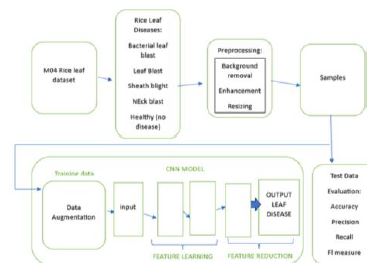
Rice serves as a staple food for millions worldwide, yet its productivity and quality are often compromised by diseases. This challenge is particularly evident in Dakshina Kannada, Karnataka, a region renowned for cultivating the MO4 rice variety. MO4 rice is especially susceptible to diseases like bacterial leaf blight, sheath blight, and neck blast, which can lead to significant crop losses if not addressed promptly. Early and accurate disease detection is critical for effective management strategies and ensuring agricultural sustainability.[3] To tackle this issue, we propose a deep learning-based system that leverages convolutional neural networks (CNNs) for the detection and classification of rice leaf diseases. Our study involved compiling an extensive and meticulously annotated dataset of MO4 rice leaf images, representing both healthy and diseased samples.
The CNN model was fine-tuned to achieve high accuracy, precision, recall, and F1 scores, demonstrating its effectiveness in disease detection. Rigorous testing under diverse conditions ensures the model's robustness and suitability for real-world applications. This system offers a practical tool for farmers and agricultural officers, enabling early diagnosis and timely intervention. By facilitating proactive disease management, it helps reduce crop losses, improve productivity, and support sustainable agriculture. Our experimental results underscore the potential of this deep learning-based approach to revolutionize rice disease management, particularly in Dakshina Kannada. The proposed system contributes to the broader vision of intelligent agriculture, enhancing food security and empowering farmers with advanced technological tools.[1]
Downloads
Downloads
Published
How to Cite
Issue
Section
License
Copyright (c) 2024 Sonal Wilson Dsouza, Arpita Suresh Naik, Megha S Gowda, Naveen Ankolekar, Sharon Dsouza

This work is licensed under a Creative Commons Attribution 4.0 International License.
Research Articles in 'International Journal of Engineering and Management Research' are Open Access articles published under the Creative Commons CC BY License Creative Commons Attribution 4.0 International License http://creativecommons.org/licenses/by/4.0/. This license allows you to share – copy and redistribute the material in any medium or format. Adapt – remix, transform, and build upon the material for any purpose, even commercially.