Hybrid Deep Learning Approach for Classifying Anxiety and Stress in Adolescents through Speech and Text Data
DOI:
https://doi.org/10.5281/zenodo.15355682Keywords:
Hybrid Deep Learning, Mel-Frequency Cepstral Coefficients (MFCCs), Convolutional Neural Networks (CNN), Bidirectional Long Short Term Memory (BiLSTM), Adolescents, Anxiety, StressAbstract
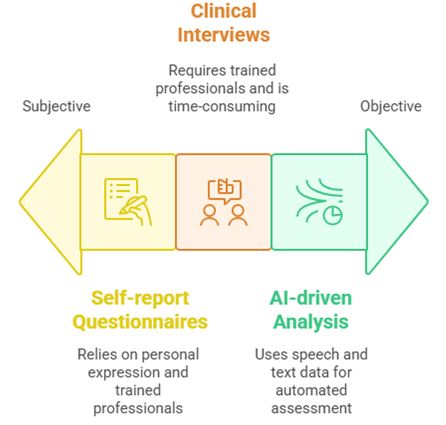
Today, adolescents are exposed to a multitude of challenges, caused both in part by academic competition, dismissal from peer pressure, social media divulgence, and the shifting picture of the family and the social surroundings that young people are familiar with. The stressors of these can turn them particularly vulnerable to psychological conditions such as anxiety and stress, and if not readily identified and treated in the long run could be severe mental long term health consequences. However, these traditional assessment methods are typically limited by subjectivity interpretation, social desirability bias, and scalability in real-life situations. To address these limitations, this study puts forward a novel hybrid deep learning framework which employs both Convolutional Neural Networks (CNN) and Bidirectional Long Short Term Memory (BiLSTM) networks for the purpose of detecting anxiety and stress levels in adolescents. Both emotional tone and linguistic patterns are captured by the system, processing multimodal inputs, from acoustic features extracted from speech and from semantic information, from transcribed text. To exploit spatial hierarchies saved in Mel-frequency cepstral coefficients (MFCCs) of speech signals, CNNs are employed. The dependencies in the textual data are modeled using BiLSTM layers. The model successfully combines these complementary representations to gain an overall view of the user’s mental state. Experimental evaluations on a labeled dataset of adolescent speech text pairs show better performance than baselines on using each modality separately. Results demonstrated that combined speech and text can be employed for reliable, automated mental health evaluation. Not only does this improve diagnostic accuracy but it also creates a real-time, scalable screening tool for early intervention and continuous mental well being monitoring in youth populations.
Downloads
References
Agarwal, P., Jindal, A., & Singh, S. (2023). Detecting anxiety from short clips of free-form speech. arXiv (Cornell University) [Preprint]. doi:10.48550/arXiv.2312.15272.
Argyle, L.P. et al. (2023). Out of one, many: Using language models to simulate human samples. Political Analysis, 31(3), 337. DOI: 10.1017/pan.2023.2.
Blakemore, S. (2019). Adolescence and mental health. The Lancet, 393(10185), 2030. DOI: 10.1016/s0140-6736(19)31013-x.
Chen, T. et al. (2024). Promoting mental health in children and adolescents through digital technology: a systematic review and meta-analysis. Frontiers in Psychology. Frontiers Media. DOI: 10.3389/fpsyg.2024.1356554.
Diep, B., Stanojević, M., & Novikova, J. (2022). Multi-modal deep learning system for depression and anxiety detection. arXiv (Cornell University) [Preprint]. DOI: 10.48550/arXiv.2212.14490.
Eisendrath, S.J. et al. (2016). A randomized controlled trial of mindfulness-based cognitive therapy for treatment-resistant depression. Psychotherapy and Psychosomatics, 85(2), 99. DOI: 10.1159/000442260.
Ford, J.D. (2013). Trauma exposure and posttraumatic stress disorder in the lives of adolescents. Journal of the American Academy of Child & Adolescent Psychiatry, 52(8), 780. DOI: 10.1016/j.jaac.2013.05.012.
Graham, S. et al. (2019). Artificial intelligence for mental health and mental illnesses: An overview. Current Psychiatry Reports. Springer Science+Business Media. DOI: 10.1007/s11920-019-1094-0.
Keles, B., McCrae, N., & Grealish, A. (2019). A systematic review: the influence of social media on depression, anxiety and psychological distress in adolescents. International Journal of Adolescence and Youth, 25(1), 79. DOI: 10.1080/02673843.2019.1590851.
Khalil, E.A.H., Houby, E.M.F.E., & Mohamed, H.K. (2021). Deep learning for emotion analysis in Arabic tweets. Journal of Big Data, 8(1). DOI: 10.1186/s40537-021-00523-w.
Lattie, E.G., Lipson, S.K., & Eisenberg, D. (2019). Technology and college student mental health: Challenges and opportunities. Frontiers in Psychiatry, 10. DOI: 10.3389/fpsyt.2019.00246.
Levine, L. et al. (2020). Anxiety detection leveraging mobile passive sensing. in Springer eBooks. Springer Nature, pp. 212. DOI: 10.1007/978-3-030-64991-3_15.
Li, N., Wang, Z., & Cheikh, F.A. (2024). Discriminating spectral–spatial feature extraction for hyperspectral image classification: A review. Sensors. pp. 2987. DOI: 10.3390/s24102987.
Li, X. et al. (2015). Assessing street-level urban greenery using Google Street View and a modified green view index. Urban Forestry & Urban Greening, 14(3), 675. DOI: 10.1016/j.ufug.2015.06.006.
Lin, D. et al. (2022). Feasibility of a machine learning-based smartphone application in detecting depression and anxiety in a generally senior population. Frontiers in Psychology, 13. DOI: 10.3389/fpsyg.2022.811517.
Mohammad, S.M., & Kiritchenko, S. (2013). Using nuances of emotion to identify personality. arXiv (Cornell University) [Preprint]. DOI: 10.48550/arxiv.1309.6352.
Morency, L., & Baltrušaitis, T. (2017). Multimodal machine learning: Integrating language. Vision and Speech, pp. 3. DOI: 10.18653/v1/p17-5002.
Rosenfeld, A. et al. (2019). Big data analytics and AI in mental healthcare. arXiv (Cornell University) [Preprint]. DOI: 10.48550/arXiv.1903.12071.
Thabrew, H. et al. (2020). Repeated psychosocial screening of high school students using YouthCHAT: Cohort study. JMIR Pediatrics and Parenting, 3(2). DOI: 10.2196/20976.
Τσίτσικα, Ά. et al. (2014). Online social networking in adolescence: Patterns of use in six european countries and links with psychosocial functioning. Journal of Adolescent Health, 55(1), 141. DOI: 10.1016/j.jadohealth.2013.11.010.
Published
How to Cite
Issue
Section
License
Copyright (c) 2025 Sonam Goyal, Vairachilai

This work is licensed under a Creative Commons Attribution 4.0 International License.
Research Articles in 'International Journal of Engineering and Management Research' are Open Access articles published under the Creative Commons CC BY License Creative Commons Attribution 4.0 International License http://creativecommons.org/licenses/by/4.0/. This license allows you to share – copy and redistribute the material in any medium or format. Adapt – remix, transform, and build upon the material for any purpose, even commercially.