A Study on the Determinants of Organic Food Purchase Intention by Adult Consumers in Kolkata
DOI:
https://doi.org/10.5281/zenodo.17033919Keywords:
Organic Food, Environmental Concern, Health Consciousness, Purchases IntentionAbstract
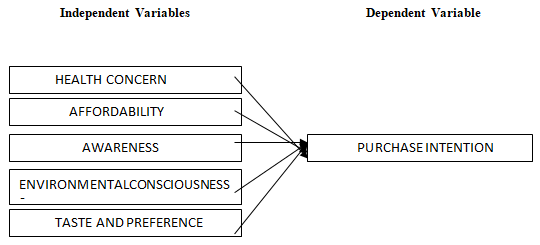
Purpose: The objective of the study is to evaluate how health, environment, awareness, affordability, taste and preferences influence Indian consumers’ intention to buy organic food.
Methodology / Design: A descriptive research design was employed. Data were collected through structured questionnaires distributed among urban consumers in India. The responses were analysed using descriptive statistics and regression analysis to examine the influence of key factors on purchase intentions.
Findings: Results indicate that health and taste considerations exert the strongest influence on buying decisions, while environmental and ethical concerns play a supporting role. Price and insufficient awareness remain major barriers to wider adoption.
Limitations: The study is limited to urban respondents and a moderate sample size, which may reduce its general applicability across rural populations.
Practical Implications: The findings provide guidance for marketers and policymakers to highlight health and taste benefits in promotional strategies, while simultaneously working to address cost and knowledge-related barriers.
Value / Originality: This research enriches the limited body of work on organic consumer behaviour in India by offering empirical evidence from an emerging market, thereby contributing to a better understanding of how demographic and attitudinal factors shape organic food adoption.
Downloads
References
Asif, M., Xuhui, W., Nasiri, A., & Ayyub, S. (2018). Determinant factors influencing organic food purchase intention and the moderating role of awareness: A comparative analysis. Food Quality and Preference, 63, 144–150. https://doi.org/10.1016/j.foodqual.2017.08.006
Bazhan, A. (2024). Factors affecting purchase intention of organic food products: Evidence from a developing nation context. Food Science & Nutrition, 1–12. https://doi.org/10.1002/fsn3.4015
Garg, S., Narwal, K. P., & Kumar, S. (2024). Exploring the determinants of purchase intention of organic consumers for organic food items: An exploratory study in India. British Food Journal, 126(3), 1238–1258. https://doi.org/10.1108/BFJ-09-2023-0788
Nguyen, T. N., Lobo, A., & Greenland, S. (2019). Pro-environmental purchase behaviour: The role of consumers’ biospheric values, attitudes and advertising scepticism.Journal of Retailing and Consumer Services, 50, 145–152. https://doi.org/10.1016/j.jretconser.2019.05.014
Sogari, G., Pucci, T., Aquilani, B., & Zanni, L. (2021). Organic food consumption: The relevance of attitude, subjective norms, and trust. Sustainability, 13(6), 3243. https://doi.org/10.3390/su13063243
Yadav, R., & Pathak, G. S. (2016). Young consumers’ intention towards buying green products in a developing nation: Extending the theory of planned behavior. Journal of Cleaner Production, 135, 732–739. https://doi.org/10.1016/j.jclepro.2016.06.120
Jackson, T. (2009). Prosperity without growth: Economics for a finite planet. Routledge.
Steffen, W., Richardson, K., Rockström, J., et al. (2015). Planetary boundaries: Guiding human development on a changing planet. Science, 347(6223), 1259855. https://doi.org/10.1126/science.1259855
Princen, T. (2002). Consumption and environment: Impacts, causes, and policy approaches. Annual Review of Environment and Resources, 27, 13–45. https://doi.org/10.1146/annurev.energy.27.122001.083429
Rockström, J., Steffen, W., Noone, K., et al. (2009). A safe operating space for humanity. Nature, 461(7263), 472–475. https://doi.org/10.1038/461472a
Smith-Spangler, C., Brandeau, M. L., & Hunter, G. E., et al. (2012). Are organic foods safer or healthier than conventional alternatives? A systematic review. Annals of Internal Medicine, 157(5), 348–366. https://doi.org/10.7326/0003-4819-157-5-201209040-00007
Willer, H., & Lernoud, J. (Eds.). (2019). The world of organic agriculture: Statistics and emerging trends 2019. Research Institute of Organic Agriculture (FiBL) and IFOAM.
Mie, A., Andersen, H. R., & Gunnarsson, S., et al. (2017). Human health implications of organic food and organic agriculture: A comprehensive review. Environmental Health, 16(1), 111. https://doi.org/10.1186/s12940-017-0315-4
Kahl, J., Baars, T., & Bügel, S., et al. (2012). Organic food quality: A framework for concept, definition, and evaluation from the European perspective. Journal of the Science of Food and Agriculture, 92(14), 2760–2765. https://doi.org/10.1002/jsfa.5640
Johnston, J. L., Fanzo, J. C., & Cogill, B. (2014). Understanding sustainable diets: A descriptive analysis of the determinants and processes that influence diets and their impact on health, food security, and environmental sustainability. Advances in Nutrition, 5(4), 418–429. https://doi.org/10.3945/an.113.005553
Vermeir, I., & Verbeke, W. (2006). Sustainable food consumption: Exploring the consumer “attitude–behavioral intention” gap. Journal of Agricultural and Environmental Ethics, 19(2), 169–194. https://doi.org/10.1007/s10806-005-5485-3
Aertsens, J., Verbeke, W., Mondelaers, K., & Van Huylenbroeck, G. (2011). Personal determinants of organic food consumption: A review. British Food Journal, 113(10), 1143–1167. https://doi.org/10.1108/00070701111179961
Garg, S., Narwal, K. P., & Kumar, S. (2024). Exploring the determinants of purchase intention of organic consumers for organic food items: An exploratory study in India. British Food Journal, 126(3), 1238–1258. https://doi.org/10.1108/BFJ-09-2023-0788
Pino, G., Peluso, A. M., & Guido, G. (2012). Determinants of regular and occasional consumers’ intentions to buy organic food. Journal of Consumer Affairs, 46(1), 157–169. https://doi.org/10.1111/j.1745-6606.2012.01223.x
Prentice, C., Chen, J., & Wang, X. (2019). The influence of health consciousness on organic food purchase intention: A moderated mediation model. Journal of Consumer Marketing, 36(4), 536–546. https://doi.org/10.1108/JCM-10-2017-2416
Sharma, A., & Foropon, C. (2022). Green product consumption in the post-COVID-19 era: Examining the role of health concerns, environmental attitude, and eco-labels. Sustainability, 14(3), 1167. https://doi.org/10.3390/su14031167
Zagata, L. (2012). Consumers’ beliefs and behavioural intentions towards organic food: Evidence from the Czech Republic. Appetite, 59(1), 81–89. https://doi.org/10.1016/j.appet.2012.03.023
Aschemann-Witzel, J., & Zielke, S. (2017). Can’t buy me green? A review of consumer perceptions of and behaviour toward the price of organic food. Journal of Consumer Affairs, 51(1), 211–251. https://doi.org/10.1111/joca.12092
Hughner, R. S., McDonagh, P., Prothero, A., Shultz, C. J., & Stanton, J. (2007). Who are organic food consumers? A compilation and review of why people purchase organic food. Journal of Consumer Behaviour, 6(2–3), 94–110. https://doi.org/10.1002/cb.210
Moser, R. (2016). Consumers’ purchasing decisions regarding sustainable food products: The case of organic food. Journal of Food Products Marketing, 22(5), 563–586. https://doi.org/10.1080/10454446.2015.1121434
Nuttavuthisit, K., & Thøgersen, J. (2017). The importance of consumer trust for the emergence of a market for green products: The case of organic food. Journal of Business Ethics, 140(2), 323–337. https://doi.org/10.1007/s10551-015-2690-5
Paul, J., & Rana, J. (2012). Consumer behaviour and purchase intention for organic food. Journal of Consumer Marketing, 29(6), 412–422. https://doi.org/10.1108/07363761211259223
Sirieix, L., Kledal, P. R., & Sulitang, T. (2011). Organic food consumers’ trade-offs between local or imported, conventional or organic products: A qualitative study in Shanghai. International Journal of Consumer Studies, 35(6), 670–678. https://doi.org/10.1111/j.1470-6431.2010.00960.x
Bazhan, A. (2024). Factors affecting purchase intention of organic food products: Evidence from a developing nation context. Food Science & Nutrition, 1–12. https://doi.org/10.1002/fsn3.4015
Biswas, A., & Roy, M. (2015). Green products: An exploratory study on the consumer behaviour in emerging economies of the East. Journal of Cleaner Production, 87(1), 463–468. https://doi.org/10.1016/j.jclepro.2014.09.075
Grunert, S. C., Hieke, S., & Wills, J. (2014). Sustainability labels on food products: consumer motivation, understanding and use. Food Policy, 44, 177–189. https://doi.org/10.1016/j.foodpol.2013.12.001
Joshi, Y., & Rahman, Z. (2019). Consumers’ sustainable purchase behaviour: Modeling the impact of psychological factors. Ecological Economics, 159, 235–243. https://doi.org/10.1016/j.ecolecon.2019.01.025
Nguyen, T. N., Lobo, A., & Greenland, S. (2019). Pro-environmental purchase behaviour: The role of consumers’ biospheric values, attitudes and advertising scepticism. Journal of Retailing and Consumer Services, 50, 145–152. https://doi.org/10.1016/j.jretconser.2019.05.014
Schäufele, I., & Hamm, U. (2018). Organic wine purchase behaviour in Germany: Exploring the attitude–behaviour gap with data from a household panel. Food Quality and Preference, 63, 1–11. https://doi.org/10.1016/j.foodqual.2017.07.010
Asif, M., Xuhui, W., Nasiri, A., & Ayyub, S. (2018). Determinant factors influencing organic food purchase intention and the moderating role of awareness: A comparative analysis. Food Quality and Preference, 63, 144–150. https://doi.org/10.1016/j.foodqual.2017.08.006
Hughner, R. S., McDonagh, P., Prothero, A., Shultz, C. J., & Stanton, J. (2007). Who are organic food consumers? A compilation and review of why people purchase organic food. Journal of Consumer Behaviour, 6(2–3), 94–110. https://doi.org/10.1002/cb.210
Magnusson, M. K., Arvola, A., Hursti, U. K. K., Åberg, L., & Sjödén, P. O. (2001). Attitudes towards organic foods among Swedish consumers. British Food Journal, 103(3), 209–227. https://doi.org/10.1108/00070700110386755
Misra, R., & Singh, D. (2016). An analysis of factors affecting the growth of organic food: Perception of consumers in Delhi-NCR (India). British Food Journal, 118(9), 2308–2325. https://doi.org/10.1108/BFJ-07-2016-0295
Sogari, G., Pucci, T., Aquilani, B., & Zanni, L. (2021). Organic food consumption: The relevance of attitude, subjective norms, and trust. Sustainability, 13(6), 3243. https://doi.org/10.3390/su13063243
Yadav, R., & Pathak, G. S. (2016). Young consumers’ intention towards buying green products in a developing nation: Extending the theory of planned behavior. Journal of Cleaner Production, 135, 732–739. https://doi.org/10.1016/j.jclepro.2016.06.120
Bryła, P. (2016). Organic food consumption in Poland: motives and barriers. Appetite, 105, 737–746. https://doi.org/10.1016/j.appet.2016.07.012
Grunert, K. G. (2005). Food quality and safety: consumer perception and demand. European Review of Agricultural Economics, 32(3), 369–391. https://doi.org/10.1093/eurrag/jbi011
Hughner, R. S., McDonagh, P., Prothero, A., Shultz, C. J., & Stanton, J. (2007). Who are organic food consumers? A compilation and review of why people purchase organic food. Journal of Consumer Behaviour, 6(2–3), 94–110. https://doi.org/10.1002/cb.210
Naspetti, S., & Zanoli, R. (2009). Organic food quality and safety perception throughout Europe. Journal of Food Products Marketing, 15(3), 249–266. https://doi.org/10.1080/10454440902908019
Schleenbecker, R., & Hamm, U. (2013). Consumers’ perception of organic product characteristics: A review. Appetite, 71, 420–429. https://doi.org/10.1016/j.appet.2013.08.020
Zanoli, R., & Naspetti, S. (2002). Consumer motivations in the purchase of organic food: A means-end approach. British Food Journal, 104(8), 643–653. https://doi.org/10.1108/00070700210425930
Published
How to Cite
Issue
Section
License
Copyright (c) 2025 Ankita Ghosh, Isita Lahiri

This work is licensed under a Creative Commons Attribution 4.0 International License.
Research Articles in 'International Journal of Engineering and Management Research' are Open Access articles published under the Creative Commons CC BY License Creative Commons Attribution 4.0 International License http://creativecommons.org/licenses/by/4.0/. This license allows you to share – copy and redistribute the material in any medium or format. Adapt – remix, transform, and build upon the material for any purpose, even commercially.