Geospatial Clustering of Psychotropic Substances Crime Locations
DOI:
https://doi.org/10.5281/zenodo.16964389Keywords:
Clustering, DBSCAN, Drug Crimes, Geospatial Analysis, Psychotropic SubstancesAbstract
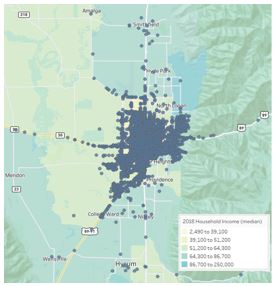
The worldwide prevalence of drug overdose and the misconception on psychotropic substances lead to the increased incidents of drug use disorders, drug offences and environmental harms along with financial burden on local and federal government for drug control and prevention. As a small step to reduce drug-related offences, we analyze the data sets consisting of drug- or alcohol-related crime incidents to discover temporal and seasonal patterns of such crimes. More importantly, we employ a density-based clustering algorithm to find a natural grouping of the geographic locations of crime incidents based on their longitude and latitude information. By visualizing such clusters with major crime types for each cluster, we allow residents and public safety officers to easily identify hot spots of drug-related crimes and hence develop new prevention plans to cope with drug-related crimes.
Downloads
References
United Nations Office on Drugs and Crime. (2024). https://www.unodc.org/unodc/en/data-and-analysis/world-drug-report-2024.html.
National Center for Drug Abuse Statistics. (2020). https://drugabusestatistics.org/.
Hartigan, J.A. (1975). Clustering algorithms. New York: Wiley.
Kim, Y., Street, W.N., & Menczer, F. (2002). Evolutionary model selection in unsupervised learning. Intelligent Data Analysis, 6(6), 531-556.
Krishna, K., & Murty, M.N. (1999). Genetic K-means algorithm. IEEE Transactions on Systems, Man and Cybernetics – Part B: Cybernetics, 29(3), 433–439.
Babu, G.P., & Murty, M.N. (1993). A near-optimal initial seed value selection in K-means algorithm using a genetic algorithm, Pattern Recognition Letters, 14(10), 763–769.
Dempster, A.P., Laird, N.M., & Rubin, D.B. (1977). Maximum likelihood from incomplete data via the EM algorithm. Journal of the Royal Statistical Society, Series B, 39(1), 1–38.
Meila, M.. & Heckerman, D. (1998). An experimental comparison of several clustering and initialization methods. In: Proceedings of the Fourteenth Conference on Uncertainty in Artificial Intelligence, pp. 386-395.
Schaffer, C.M., & Green, P.E. (1998). Cluster-based market segmentation: Some further comparisons of alternative approaches, Journal of the Market Research Society, 40(2), 155–163.
Griffiths, A., Robinson, L.A., & Willett, P. (1984). Hierarchic agglomerative clustering methods for automatic document classification. Journal of Documentation, 40(3), 175–205.
Murtagh, F., & Contreras, P. (2012). Algorithms for hierarchical clustering: An overview. WIREs Data Mining and Knowledge Discovery, 2(1), 86-97.
Ester, M., Kriegel, H.-P., Sander, J., & Xu, X. (1996). Simoudis, E., Han, J., & Fayyad, U.M. (eds.). A density-based algorithm for discovering clusters in large spatial databases with noise. Proceedings of the Second International Conference on Knowledge Discovery and Data Mining (KDD-96), pp. 226–231.
Published
How to Cite
Issue
Section
License
Copyright (c) 2025 Yong Seog Kim, Erin Crump

This work is licensed under a Creative Commons Attribution 4.0 International License.
Research Articles in 'International Journal of Engineering and Management Research' are Open Access articles published under the Creative Commons CC BY License Creative Commons Attribution 4.0 International License http://creativecommons.org/licenses/by/4.0/. This license allows you to share – copy and redistribute the material in any medium or format. Adapt – remix, transform, and build upon the material for any purpose, even commercially.