Ergonomic Postural Risk Monitoring of Worker Working on Lathe Machine
DOI:
https://doi.org/10.31033/IJEMR/16.1.2026.1836Keywords:
Ergonomics, Postural Risk, Musculoskeletal Disorders (MSDs), RULA (Rapid Upper Limb Assessment), REBA (Rapid Entire Body Assessment), Fatigue ReductionAbstract
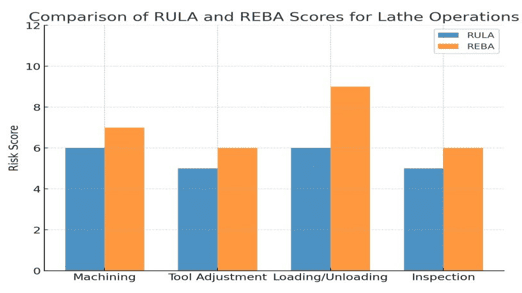
The operation of lathe machines in manufacturing industries often exposes workers to awkward postures, repetitive motions, and prolonged static positions that may contribute to musculoskeletal disorders (MSDs) and reduced productivity. Ergonomic assessment and monitoring of postural risks are therefore essential to ensure worker safety, efficiency, and overall well-being. This study focuses on the ergonomic postural risk monitoring of workers operating lathe machines using observational methods and posture evaluation tools such as RULA (Rapid Upper Limb Assessment) and REBA (Rapid Entire Body Assessment). The analysis highlights high-risk postures associated with bending, twisting, and extended arm reach during machining, loading, and unloading tasks. Data collected were further examined to identify critical risk zones and propose corrective ergonomic interventions such as workstation redesign, tool placement optimization, and work-rest scheduling. The findings indicate that ergonomic interventions not only minimize postural risks but also enhance operator comfort, reduce fatigue, and improve productivity. This study emphasizes the importance of integrating ergonomic monitoring systems into machine shop environments for sustainable industrial practices.
Downloads
References
McAtamney, L., & Corlett, E. N. (1993). RULA: A survey method for the investigation of work-related upper limb disorders. Applied Ergonomics, 24(2), 91–99.
Hignett, S., & McAtamney, L. (2000). Rapid entire body assessment (REBA). Applied Ergonomics, 31(2), 201–205.
Karhu, O., Kansi, P., & Kuorinka, I. (1977). Correcting working postures in industry: A practical method for analysis. Applied Ergonomics, 8(4), 199–201
Bridger, R. S. (2018). Introduction to human factors and ergonomics. CRC Press.
Asim Zaheer et al. (2012). Ergonomics: A work place realities in Pakistan. International Posture Journal of Science & Technology, 2(1).
Krishnamoorthy Muthukumar et al. (2012). Discomfort analysis in computerized numeric control machine operations. Saf Health Work, 3, 146-53.
Isa Halim et al. (2011). Posture, muscle activity and oxygen consumption Evaluations among metal stamping operators: A pilot studyin Malaysian small and medium industries. Journal - The Institution of Engineers, Malaysia, 72(4).
Aman Sachdeva et al. (2011). Minimizing musculoskeletal disorders in lathe machine workers. International Journal of Ergonomics, 1(2).
M.C.I. Javier Antonio, & Lom Holguín et al. (2008). Ergonomics and its relationship to the design of production processes. Ponencia Conergo.
Mohammad Iqbal et al. (2011). Ergonomics and design. International Conference on Industrial Engineering and Operations Management Kuala Lumpur, Malaysia.
L. P. Singh. (2010). Work posture assessment in forging industry: An exploratory study in INDIA. International Journal of Advanced Engineering Technology, 1(III).
Published
How to Cite
Issue
Section
License
Copyright (c) 2026 A.M. Kakde, S.M. Kherde

This work is licensed under a Creative Commons Attribution 4.0 International License.
Research Articles in 'International Journal of Engineering and Management Research' are Open Access articles published under the Creative Commons CC BY License Creative Commons Attribution 4.0 International License http://creativecommons.org/licenses/by/4.0/. This license allows you to share – copy and redistribute the material in any medium or format. Adapt – remix, transform, and build upon the material for any purpose, even commercially.