Brake Tire Sense-AI: An Artificial Intelligence-Based Smart Diagnostic Framework for Early Detection of Brake and Tire Failures in Commercial Trucks to Reduce Severe Highway Accidents
DOI:
https://doi.org/10.31033/IJEMR/16.4.2026.1937Keywords:
Artificial Intelligence (AI), Commercial Trucks, Brake Failure, Predictive Maintenance, Deep Learning, Sensor FusionAbstract
Background: Brake and tire defects remain major safety concerns in vehicles. Conventional inspection and fixed-threshold monitoring can identify established defects but may miss early, multivariable patterns of deterioration. Artificial intelligence (AI), multimodal sensing and edge analytics may permit earlier identification of safety-critical mechanical degradation.
Objective: To prospectively develop and validate Brake Tire Sense-AI, a multimodal AI framework for early detection of major brake and tire defects in heavy commercial trucks and for generation of interpretable component-level risk alerts.
Methods: A prospective multicenter engineering diagnostic-accuracy cohort is proposed involving 530 heavy commercial trucks operated in Pakistan and the USA over 12 months. Brake pressure, brake temperature, wheel-speed, vibration, tire pressure, tire temperature, vehicle-load, environmental and computer-vision data will be acquired through an edge gateway. AI pipeline will combine supervised classification, temporal modeling, anomaly detection and multimodal sensor fusion. Mechanical inspection and documented maintenance findings will serve as the reference standard.
Sample size: Using the Buderer diagnostic-test framework, assuming an anticipated sensitivity of 90%, 95% confidence level, precision of ±7%, and an estimated 15% prevalence of defect-positive trucks, approximately 471 evaluable trucks are required; allowing 10% incomplete or unusable follow-up gives 523, rounded to a proposed enrollment target of 530 trucks.
Statistical Analysis: Descriptive statistics will characterize trucks, routes, duty cycles and defect events. Diagnostic accuracy will be reported with 95% confidence intervals. AUROC and precision-recall curves will assess discrimination; calibration plots and Brier score will assess calibration. Vehicle-level bootstrapping and cluster-robust methods will account for repeated episodes. Comparisons with conventional threshold-based monitoring will use paired methods where appropriate. Time-to-defect after an alert will be assessed using survival models, and false-alert burden will be reported per distance traveled.
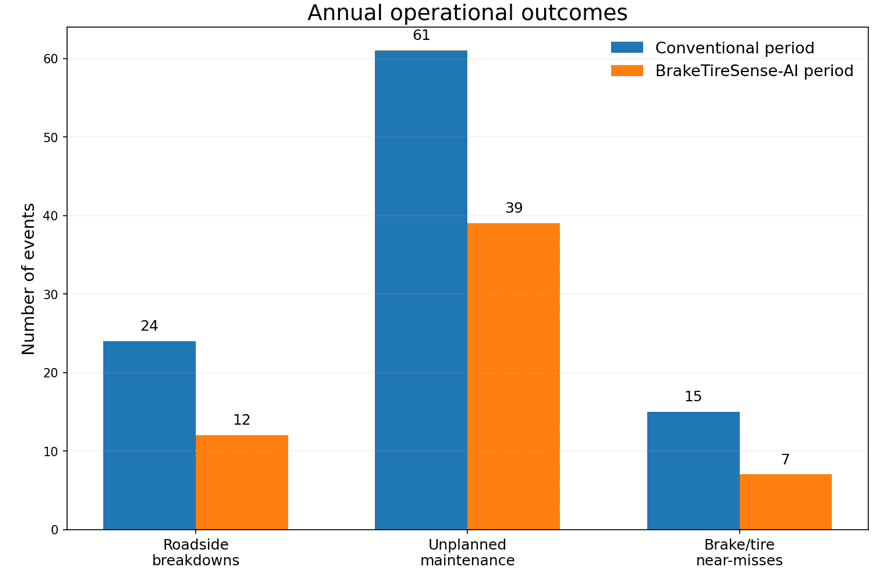
Results: Illustrative results: In the simulated 530-truck cohort, 82 trucks (15.5%) experienced at least one adjudicated major brake or tire event. In the locked test set, Brake Tire Sense-AI identified 12 of 13 events, corresponding to 92.3% sensitivity, 92.4% specificity, 98.4% negative predictive value and AUROC 0.95. The simulated operational comparison also showed fewer roadside brake/tire breakdowns and lower maintenance downtime during AI-assisted monitoring. These values are illustrative and require prospective empirical validation.
Downloads
References
Federal Motor Carrier Safety Administration. Large Truck and Bus Crash Facts 2022 [Internet]. Washington (DC): U.S. Department of Transportation; 2025 [cited 2026 Aug 8].
Commercial Vehicle Safety Alliance. CVSA releases 2025 International Roadcheck results [Internet]. Washington (DC): CVSA; 2025 Oct 7 [cited 2026 Aug 8].
Commercial Vehicle Safety Alliance. CVSA releases 2025 Brake Safety Week results [Internet]. Washington (DC): CVSA; 2025 Oct 27 [cited 2026 Aug 8].
Commercial Vehicle Safety Alliance. Nearly 600 commercial motor vehicles removed from North American roadways in one day due to brake violations [Internet]. Washington (DC): CVSA; 2026 May 19 [cited 2026 Aug 8].
National Highway Traffic Safety Administration. Tire safety ratings and awareness: TireWise [Internet]. Washington (DC): U.S. Department of Transportation [cited 2026 Aug 8].
Sepriyanto, Sumarsono DA, & Adhitya M, Sholahudin. (2026). Brake failure and fault detection in heavy vehicles: trends, challenges, and research gap from a systematic literature review. Teknosains J Sains Teknol Inform.,13(2), 400-411. doi:10.37373/tekno.v13i2.2164.
Jain M, Vasdev D, Pal K, & Sharma V. (2022). Systematic literature review on predictive maintenance of vehicles and diagnosis of vehicle health using machine learning techniques. Comput Intell., 38(6), 1990-2008. doi:10.1111/coin.12553.
Mahale Y, Kolhar S, & More AS. (2025). A comprehensive review on artificial intelligence driven predictive maintenance in vehicles: technologies, challenges and future research directions. Discov Appl Sci., 7, 243. doi:10.1007/s42452-025-06681-3.
Lin SL. (2023). Research on tire crack detection using image deep learning method. Sci Rep., 13, 8027. doi:10.1038/s41598-023-35227-z.
Saleh RAA, Konyar MZ, Kaplan K, & Ertunç HM. (2024). End-to-end tire defect detection model based on transfer learning techniques. Neural Comput Appl., 36, 12483-12503. doi:10.1007/s00521-024-09664-4.
Saleh RAA, & Ertunç HM. (2025). Attention-based deep learning for tire defect detection: fusing local and global features in an industrial case study. Expert Syst Appl., 269, 126473. doi:10.1016/j.eswa.2025.126473.
Xie M, Bian H, Jiang C, Zheng Z, & Wang W. (2024). An improved YOLOv5 algorithm for tyre defect detection. Electronics, 13(11), 2207. doi:10.3390/electronics13112207.
Chen J, Li A, Wang T, & Wang X. (2024). Research on tire internal defect identification method based on deep learning. Mech Eng Adv., 2(2), 1495. doi:10.59400/mea.v2i2.1495.
Karkaria V, Chen J, Luey C, Siuta C, Lim D, & Radulescu R, et al. (2025). A digital twin framework utilizing machine learning for robust predictive maintenance: enhancing tire health monitoring. J Comput Inf Sci Eng., 25(7), 071003. doi:10.1115/1.4067270.
Breiman L. (2001). Random forests. Mach Learn., 45(1), 5-32.
Cortes C, & Vapnik V. (1995). Support-vector networks. Mach Learn., 20, 273-297. doi:10.1007/BF00994018.
Hochreiter S, & Schmidhuber J. (1997). Long short-term memory. Neural Comput., 9(8), 1735-1780. doi:10.1162/neco.1997.9.8.1735.
He K, Zhang X, Ren S, & Sun J. (2016). Deep residual learning for image recognition. In: Proceedings of the IEEE Conference on Computer Vision and Pattern Recognition, p. 770-778. doi:10.1109/CVPR.2016.90.
Redmon J, Divvala S, Girshick R, & Farhadi A. (2016). You only look once: unified, real-time object detection. In: Proceedings of the IEEE Conference on Computer Vision and Pattern Recognition, p. 779-788.
Lundberg SM, & Lee SI. (2017). A unified approach to interpreting model predictions. In: Guyon I, von Luxburg U, Bengio S, Wallach H, Fergus R, Vishwanathan S, et al., editors. Advances in Neural Information Processing Systems 30. Red Hook (NY): Curran Associates.
Ribeiro MT, Singh S, & Guestrin C. (2016). Why should I trust you? Explaining the predictions of any classifier. In: Proceedings of the 22nd ACM SIGKDD International Conference on Knowledge Discovery and Data Mining. New York: ACM; p. 1135-1144.
Fayyad J, Jaradat MA, Gruyer D, & Najjaran H. (2020). Deep learning sensor fusion for autonomous vehicle perception and localization: a review. Sensors (Basel), 20(15), 4220. doi:10.3390/s20154220.
Buderer NMF. (1996). Statistical methodology: I. Incorporating the prevalence of disease into the sample size calculation for sensitivity and specificity. Acad Emerg Med., 3(9), 895-900. doi:10.1111/j.1553-2712.1996.tb03538.x.
Imteyaz S, & Iqbal S. (2026). Sensorless tire health monitoring system based on machine learning for passenger vehicles. SAE Technical Paper 2026-26-0670. Warrendale (PA): SAE International. doi:10.4271/2026-26-0670.
Eddy CW, Castanier MP, & Wagner JR. (2025). Predictive maintenance of a ground vehicle using digital twin technology. SAE Int J Adv Curr Pract Mobil., 7(2), 865-876. doi:10.4271/2024-01-2867.
von Wahl L, Heidenreich N, Mitra P, Nolting M, & Tempelmeier N. (2024). Data disparity and temporal unavailability aware asynchronous federated learning for predictive maintenance on transportation fleets. Proc AAAI Conf Artif Intell., 38(14), 15420-15428. doi:10.1609/aaai.v38i14.29467.
Sharma J, Mittal ML, Soni G, & Keprate A. (2024). Explainable artificial intelligence approaches in predictive maintenance: A review. Recent Pat Eng., 18(5), e170423215860. doi:10.2174/1872212118666230417084231.
International Organization for Standardization. ISO 26262-1:2018. Road vehicles - Functional safety - Part 1: Vocabulary. 2nd ed. Geneva: ISO; 2018.
International Organization for Standardization; SAE International. ISO/SAE 21434:2021. Road vehicles - Cybersecurity engineering. Geneva: ISO; 2021.
SAE International. SAE J1939_202603: Serial control and communications heavy-duty vehicle network - Top-level document. Warrendale (PA): SAE International; 2026. doi:10.4271/J1939_202603.
Khan A, et al. Which factors contribute to road crashes in non-commercial and commercial vehicles? An examination of administrative data from motorways in Pakistan. Traffic Inj Prev. 2021;22(7):541-546. doi:10.1080/17457300.2021.1972319.
World Health Organization. Road safety Pakistan 2023 country profile [Internet]. Geneva: WHO; 2024 [cited 2026 Aug 11].
Federal Motor Carrier Safety Administration. Crash statistics: large truck and bus crash facts [Internet]. Washington (DC): U.S. Department of Transportation; 2026 [cited 2026 Aug 11].
Published
How to Cite
Issue
Section
License
Copyright (c) 2026 Umair Naseer, Binu Benedict

This work is licensed under a Creative Commons Attribution 4.0 International License.
Research Articles in 'International Journal of Engineering and Management Research' are Open Access articles published under the Creative Commons CC BY License Creative Commons Attribution 4.0 International License http://creativecommons.org/licenses/by/4.0/. This license allows you to share – copy and redistribute the material in any medium or format. Adapt – remix, transform, and build upon the material for any purpose, even commercially.


