Modelling Customer Lifetime Value under Endogenous Marketing Interventions: A Structural Bayesian Approach
DOI:
https://doi.org/10.31033/IJEMR/16.4.2026.1938Keywords:
Customer Lifetime Value (CLV), Endogeneity in Marketing, Structural Bayesian Modeling, Causal Inference, Targeted Marketing OptimizationAbstract
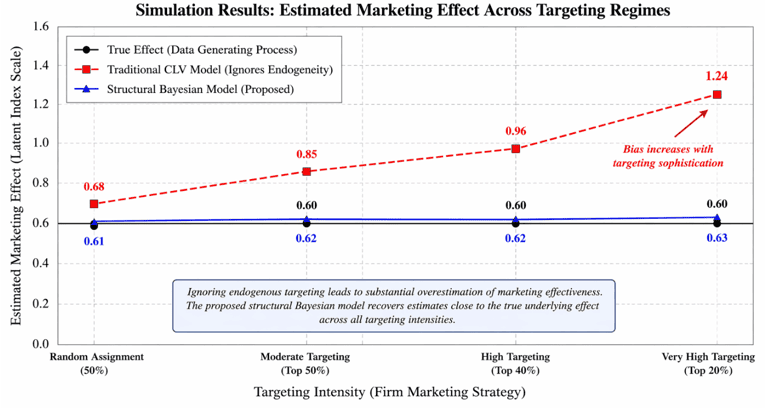
Customer lifetime value (CLV) is the present value of future profits from customer relationships and serves as a fundamental metric for resource allocation in modern marketing. Extant probabilistic approaches—notably the Pareto/NBD and BG/NBD models—estimate CLV from observed purchase histories but often overstate marketing effectiveness by treating marketing interventions as exogenous. In practice, however, firms allocate marketing strategically, targeting customers based on observable and unobservable characteristics that also predict purchase behavior, thereby inducing endogeneity. We develop a structural Bayesian framework that jointly models (i) the customer purchase process as a function of latent autonomous propensity and marketing responsiveness, and (ii) the firm’s marketing assignment process as a function of observable customer attributes and estimated response signals. By integrating causal inference principles with hierarchical Bayesian modeling, the proposed framework mitigates bias arising from endogenous marketing assignment and enables more reliable estimation of marketing effects on CLV. Monte Carlo simulations calibrated to retail e-commerce settings show that conventional CLV models can overestimate marketing elasticity by 20–40%, with bias increasing in targeting sophistication. The proposed approach recovers more accurate heterogeneous treatment effects, supporting improved customer segmentation and more effective budget allocation. Methodologically, this research extends causal inference to the lifetime value setting; substantively, it quantifies and corrects a key source of bias in contemporary CLV practice
Downloads
References
Ali, N., & Shabn, O. S. (2024). Customer lifetime value (CLV) insights for strategic marketing success and its impact on organizational financial performance. Cogent Business & Management, 11(1), 2361321. https://doi.org/10.1080/23311975.2024.2361321
Ascarza, E. (2018). Retention futility: Targeting high-risk customers might be ineffective. Journal of marketing Research, 55(1), 80-98. https://doi.org/10.1509/jmr.16.0163
Berry, S. T. (1994). Estimating discrete-choice models of product differentiation. RAND Journal of Economics, 25(2), 242-262. https://doi.org/10.2307/2555829
Chintagunta, P. K., Erdem, T., Rossi, P. E., & Wedel, M. (2006). Structural modeling in marketing: Review and research opportunities. Journal of Marketing Research, 43(3), 347-356. https://doi.org/10.1287/mksc.1050.0161
Dubé, J. P., Hitsch, G. J., & Manchanda, P. (2005). An empirical model of advertising dynamics. Quantitative Marketing and Economics, 3(2), 107-144. https://doi.org/10.1007/s11129-005-0334-2
Elwert, F., & Winship, C. (2014). Endogenous selection bias: The problem of conditioning on a collider variable. Annual Review of Sociology, 40, 31-53. https://doi.org/10.1146/annurev-soc-071913-043455
Erdem, T., & Keane, M. P. (1996). Decision-making under uncertainty: Capturing dynamic brand choice processes in turbulent consumer goods markets. Marketing Science, 15(1), 1-20. https://doi.org/10.1287/mksc.15.1.1
Fader, P. S., & Hardie, B. G. (2007). Incorporating time-invariant covariates into the Pareto/NBD and BG/NBD models. Working Paper, University of Pennsylvania and London Business School.
Fader, P. S., Hardie, B. G., & Lee, K. L. (2005). Counting your customers the easy way: An alternative to the Pareto/NBD model. Marketing Science, 24(2), 275-284. https://doi.org/10.1287/mksc.1040.0098
Grace, J. B. (2021). Instrumental variable methods in structural equation models. Methods in Ecology and Evolution, 12(7), 1148-1157. https://doi.org/10.1111/2041-210X.13600
Gupta, S., Hanssens, D., Hardie, B., Kahn, W., Kumar, V., Lin, N., Ravishanker, N., & Sriram, S. (2006). Modeling customer lifetime value. Journal of Service Research, 9(2), 139-155. https://doi.org/10.1177/1094670506293810
Hitsch, G. J., Misra, S., & Zhang, W. W. (2024). Heterogeneous treatment effects and optimal targeting policy evaluation. Quantitative Marketing and Economics, 22, 115-168. https://doi.org/10.1007/s11129-023-09278-5
Imbens, G. W., & Lemieux, T. (2008). Regression discontinuity design: A practical guide. Journal of Econometrics, 142(2), 615-635. https://doi.org/10.1016/j.jeconom.2007.05.001
Malodia, S., Dhir, A., Hasni, M. J. S., & Srivastava, S. (2023). Field experiments in marketing research: a systematic methodological review. European Journal of Marketing, 57(7), 1939-1965. https://doi.org/10.1108/EJM-03-2022-0240
Rosenbaum, P. R., & Rubin, D. B. (1983). The central role of the propensity score in observational studies for causal effects. Biometrika, 70(1), 41-55. https://doi.org/10.1093/biomet/70.1.41
Schmittlein, D. C., Morrison, D. G., & Colombo, R. C. (1987). Counting your customers: Who are they and what will they do next?. Management Science, 33(1), 1-24. https://doi.org/10.1287/mnsc.33.1.1
Shahabikargar, M., Beheshti, A., Zhang, X., Foo, J., & Jolfaei, A. (2026). A comprehensive survey on customer churn analysis studies. Journal of Information and Telecommunication, 10(1), 24-70. https://doi.org/10.1080/24751839.2025.2528440
Shaw, R., & Stone, M. (1988). Database marketing: Strategy and implementation. Gower Publishing Company.
van Oostenbruggen, V., & Cavicchia, C. (2022). A review of dynamic customer segmentation methods in e-commerce business contexts.
Wooldridge, J. M. (2010). Econometric analysis of cross section and panel data. (2nd ed.). MIT Press.
Published
How to Cite
Issue
Section
License
Copyright (c) 2026 Sudipkumar Ghanvat, Shreya Joshi, Aditi Shintre

This work is licensed under a Creative Commons Attribution 4.0 International License.
Research Articles in 'International Journal of Engineering and Management Research' are Open Access articles published under the Creative Commons CC BY License Creative Commons Attribution 4.0 International License http://creativecommons.org/licenses/by/4.0/. This license allows you to share – copy and redistribute the material in any medium or format. Adapt – remix, transform, and build upon the material for any purpose, even commercially.


