Evaluating the Effectiveness of 360-Degree Feedback (EKSUTRA INDEX)
DOI:
https://doi.org/10.5281/zenodo.15811856Keywords:
360-Degree Feedback, Performance Appraisal, Ekasutra Index, PLS-SEM, Gaussian Copula, Likert Scale, Workforce Evaluation, HR Analytics, Statistical ValidationAbstract
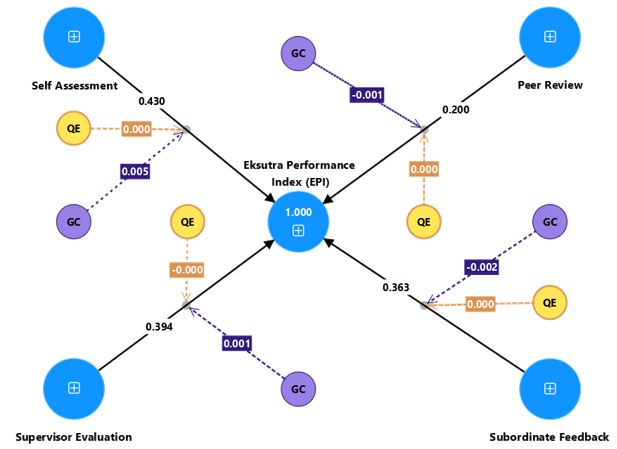
Performance appraisal is a critical function in workforce management, influencing employee motivation, career development, and organizational efficiency. Traditional performance evaluation systems often suffer from subjectivity, inconsistencies, and biases, limiting their reliability and effectiveness. This study introduces the Ekasutra Index, a structured, data-driven, and statistically validated model for performance appraisal that leverages 360-degree feedback mechanisms. Unlike conventional methods that rely primarily on managerial assessments, the Ekasutra Index integrates feedback from supervisors, peers, subordinates, and self-assessments to derive a comprehensive performance score. The study employs a five-point Likert scale and a Weighted Average Mean approach to consolidate multi-source feedback into a single, quantifiable score. Furthermore, Partial Least Squares Structural Equation Modeling (PLS-SEM) is utilized to assess the impact of different evaluation components on the final performance index. The reliability of the model is validated through Cronbach’s Alpha (0.91), ensuring high internal consistency. Additionally, Gaussian Copula (GC) adjustments are applied to account for potential endogeneity issues, confirming the robustness of the assessment framework. Key findings indicate that self-assessment (β = 0.430) and supervisor evaluation (β = 0.394) exert the strongest influence on the Ekasutra Performance Index (EPI), while peer review (β = 0.200) and subordinate feedback (β = 0.363) have relatively lower but still significant effects. The automated and statistically validated nature of the model enhances transparency, eliminates subjectivity, and improves decision-making efficiency for HR professionals. The Ekasutra Index presents a scalable and adaptable framework that can be implemented across corporate organizations, educational institutions, and public sector agencies. By integrating data science principles with structured employee feedback, the model fosters fairness, transparency, and efficiency in performance evaluations. This study contributes to the growing field of data-driven human resource management, providing a robust methodology for organizations seeking to optimize their appraisal systems in the era of digital transformation.
Downloads
References
AIHR. (2023). 360-degree feedback: A comprehensive guide. AIHR. Retrieved from: https://www.aihr.com/blog/360-degree-feedback.
U.S. Office of Personnel Management. (n.d.). 360-degree assessment. Retrieved from: https://www.opm.gov/policy-data-oversight/performance-management/performance-management-cycle/rating/360assessment.pdf.
Qualtrics. (2021). 360-degree feedback: Your ultimate guide. Retrieved from: https://www.qualtrics.com/experience-management/employee/360-degree-feedback.
Statistical tools and approaches to validate analytical methods. (2017). International Journal of Metrology and Quality Engineering. Retrieved from: https://www.metrologyjournal.org/articles/ijmqe/full_html/2017/01/ijmqe160046/ijmqe160046.html.
Wikipedia. (2008). Statistical model validation. Retrieved from: https://en.wikipedia.org/wiki/Statistical_model_validation.
Published
How to Cite
Issue
Section
License
Copyright (c) 2025 Yogita Patil, Anas Lakhani, Tausif Shaikh, Pravar Sharma

This work is licensed under a Creative Commons Attribution 4.0 International License.
Research Articles in 'International Journal of Engineering and Management Research' are Open Access articles published under the Creative Commons CC BY License Creative Commons Attribution 4.0 International License http://creativecommons.org/licenses/by/4.0/. This license allows you to share – copy and redistribute the material in any medium or format. Adapt – remix, transform, and build upon the material for any purpose, even commercially.