Comparing the Effectiveness of Traditional vs AI-Based Recruitment Methods
DOI:
https://doi.org/10.5281/zenodo.17331896Keywords:
Recruitment Methods, Artificial Intelligence, InterviewAbstract
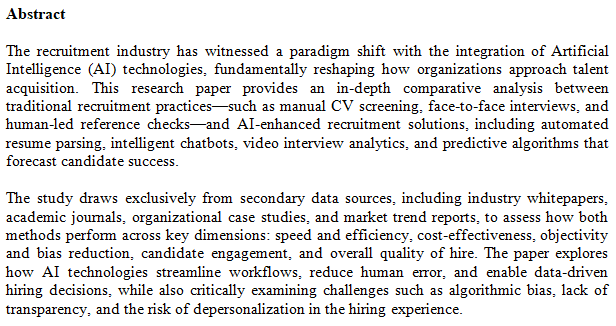
The recruitment industry has witnessed a paradigm shift with the integration of Artificial Intelligence (AI) technologies, fundamentally reshaping how organizations approach talent acquisition. This research paper provides an in-depth comparative analysis between traditional recruitment practices—such as manual CV screening, face-to-face interviews, and human-led reference checks—and AI-enhanced recruitment solutions, including automated resume parsing, intelligent chatbots, video interview analytics, and predictive algorithms that forecast candidate success.
The study draws exclusively from secondary data sources, including industry whitepapers, academic journals, organizational case studies, and market trend reports, to assess how both methods perform across key dimensions: speed and efficiency, cost-effectiveness, objectivity and bias reduction, candidate engagement, and overall quality of hire. The paper explores how AI technologies streamline workflows, reduce human error, and enable data-driven hiring decisions, while also critically examining challenges such as algorithmic bias, lack of transparency, and the risk of depersonalization in the hiring experience.
By synthesizing current literature and real-world applications, the paper aims to compare traditional recruitment methods with AI-based recruitment techniques using secondary data sources such as industry reports, academic literature, and case studies. The comparison is structured around five critical dimensions: efficiency, cost-effectiveness, bias reduction, candidate experience, and quality of hire. Through this analysis, the study seeks to highlight the advantages and limitations of both approaches and offer strategic recommendations for organizations navigating the evolving recruitment landscape.
Downloads
References
Brynjolfsson, E., & McAfee, A. (2014). The second machine age: Work, progress, and prosperity in a time of brilliant technologies.
Bersin, J. (2018). AI in Recruiting: The future of work and talent acquisition.
Caldwell, M. (2021). Leveraging AI for unbiased hiring. Harvard Business Review.
Kaufman, J. (2020). How AI is transforming recruitment. McKinsey & Company.
O'Neil, C. (2016). Weapons of math destruction: How big data increases inequality and threatens democracy.
Patel, S. (2019). Predictive analytics in recruitment: A new era. Journal of Human Resources Management.
Tambe, P. (2020). Candidate experience in the age of automation. LinkedIn Talent Blog.
LinkedIn. (2020). Global Recruiting Trends.
Published
How to Cite
Issue
Section
License
Copyright (c) 2025 Arpita Sagar Nayak, Reet Mayuresh Thule, Shivani Mayur Mankame

This work is licensed under a Creative Commons Attribution 4.0 International License.
Research Articles in 'International Journal of Engineering and Management Research' are Open Access articles published under the Creative Commons CC BY License Creative Commons Attribution 4.0 International License http://creativecommons.org/licenses/by/4.0/. This license allows you to share – copy and redistribute the material in any medium or format. Adapt – remix, transform, and build upon the material for any purpose, even commercially.